




U.S. Business Travel Spending Hits $424B in 2016
A new report by the Global Business Travel Association (GBTA) Foundation found that U.S. businesses spent $424 billion to send travelers out on the road for 514.4 million domestic business trips in 2016.
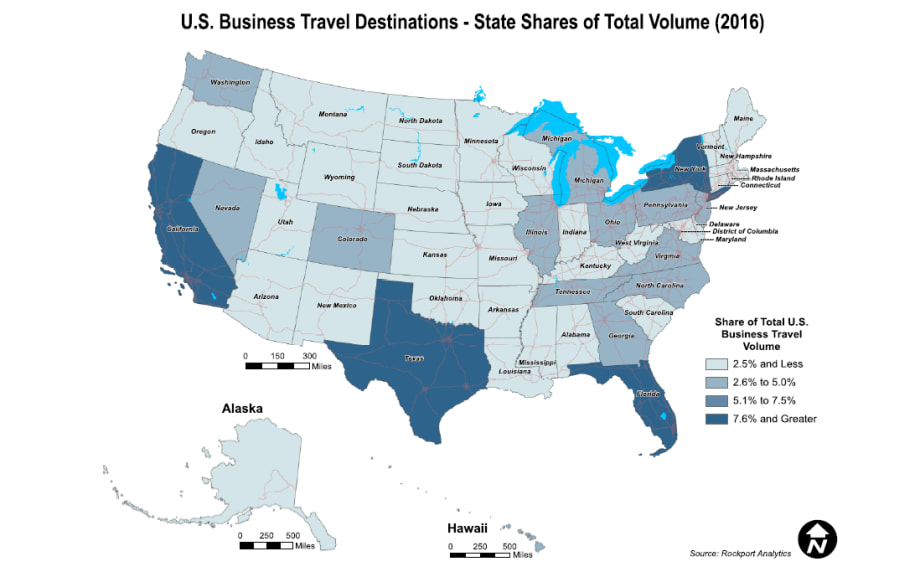
Map courtesy of the Global Business Travel Association
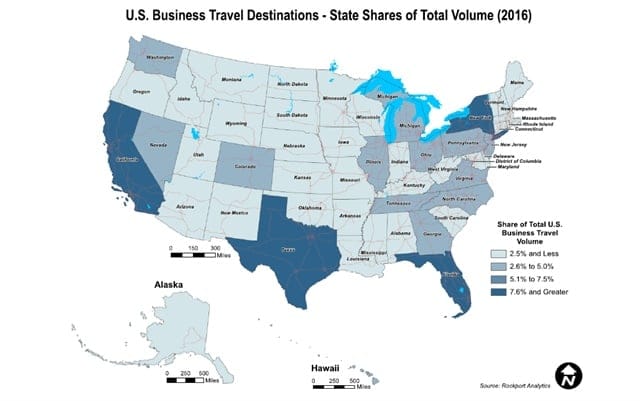
Map courtesy of the Global Business Travel Association
A new report by the Global Business Travel Association (GBTA) Foundation, in partnership with American Express Global Business Travel (GBT), highlights the positive economic impact business travel has on the nation’s economy.
“The U.S. Business Travel Economic Impact Report” revealed that business travel was responsible for about 3% ($547 billion) of U.S. GDP in 2016. Additionally, the research found that for every 1% change in business travel spending, the U.S. economy gains or loses 74,000 jobs, $5.5 billion in GDP, $3.3 billion in wages, and $1.3 billion in taxes, according to the report.
The report found that U.S. businesses spent $424 billion to send travelers out on the road for 514.4 million domestic business trips in 2016. The business travel industry supports 7.4 million jobs and generated $135 billion in federal, state, and local taxes, according to GBTA.
Much of business travel’s contribution to the economy accrues directly to industries that serve business travelers, but their supply chain beneficiaries received an additional indirect contribution of $132 billion.
“Business travel matters — it is a critical driver of the economy,” said Michael W. McCormick, GBTA’s executive director and chief operating officer. “In a time where many policies have created uncertainty and disruption around travel, this study shows the importance of enacting pro-travel polices to our nation’s bottom line.”
“The way that people and companies conduct business has undergone transformative, digitally-led changes in the past 20 years,” said David Reimer, senior vice president and general manager, North America, American Express Global Business Travel. “Yet, the U.S. Business Travel Economic Impact Report shows that face-to-face interaction enabled by business travel remains a critical business tool. Today’s modern business travelers want access to all content, to the best personalized rates and fares, and via consumerized channels. To sustain business travel’s economic impact, our industry must continue to evolve to meet the needs of these travelers.”
In 2016, the average amount spent per business fell 2.2% to $520, including $163 on lodging, $180 on transportation, $94 on food and beverages in restaurants, $33 on entertainment, and $50 on shopping and merchandise, according to the report. These averages include both domestic and international inbound trips, as well as both day and overnight trips.
Roughly half (48%) of U.S. business trips were taken for transient purposes (sales trips, client services, government and military travel, and travel for construction or repair), while 28% were taken for group travel purposes.
A personal car or truck (35%) was the most popular mode of transportation among U.S. business travelers in 2016, followed by airplane (28%) and rental cars (13%), according to the report.
More Operations

Moventum Fleet Management Names Mark Iorillo Head of Sales
Iorillo brings nearly 20 years of fleet management and sales experience to the role, including previous positions at Element Fleet Management, CEI, Donlen and Ryder.
Read More →
Fleet Has a Talent Pipeline Problem. What Comes Next? | AF News Recap
Where will fleet’s next generation of leaders come from? This week, we’re looking at the industry’s talent pipeline, what certification can add to a fleet career, how to build an award-worthy track record, and the return of Automotive Fleet’s Personal Use Survey.
Read More →
Smith System Launches Driver Risk Management Program
Fleets have more driver data than ever, but identifying risky behavior doesn't necessarily correct it. Smith System's new Driver Risk Management program combines monitoring, training, and follow-up coaching to help fleets connect risk signals with driver intervention.
Read More →
Automotive Fleet Opens 2026 Personal Use Survey for Commercial Fleet Managers
Less than two weeks left! Commercial and corporate fleet managers are invited to share how their organizations handle company vehicle personal-use policies, charges, and driver eligibility.
Read More →
From AI Prompts to AI-Generated Safety Songs | AF News Recap
Can better prompts make AI more useful for fleet managers? This week, we’re breaking down smarter fleet analysis, an AI-assisted experiment that turned safety training into music, and what happened to fuel prices in August.
Read More →
How to Write Better AI Prompts for Fleet Analysis
Include these six elements in your fleet prompts to generate more relevant analysis and accurate answers.
Read More →
Fleet Meets: Eric Kilgore
This edition of the Fleet Meets series features one of the industry's best leaders driving multi-market and national operations.
Read More →
Why Reactive Fleet Management Is Becoming Too Expensive to Sustain
Research highlights a growing need for proactive management strategies to address rising costs in fleet operations effectively.
Read More →
What Your Fleet KPIs Aren’t Telling You
Tracking fleet metrics is only useful when the data leads to better decisions. This guide helps fleet leaders assess cost, utilization, and downtime more accurately, identify performance gaps, and prioritize the actions that can improve operational results.
Read More →
Hidden in Plain Sight: Fleet Compliance Risks
Fleet compliance isn't just about having policies — it's about consistently enforcing them. This practical guide reveals six hidden compliance risks common in public sector and shared fleet operations and outlines proven strategies to improve visibility, accountability, and audit readiness
Read More →