




UPS Head: Don’t Let Fear of Unknown Hold Back Future Excellence
Sitting still and worrying about all the new technology coming at us is not an option, said Carlton Rose, UPS president, global fleet maintenance and engineering, at the kickoff breakfast for the ATA’s Technology & Maintenance Council Annual Meeting in Atlanta.
March 6, 2018


Fear of the unknown discourages investment in new trucking technologies, such as electric trucks, said UPS' Carlton Rose. Photo: Deborah Lockridge
4 min to read
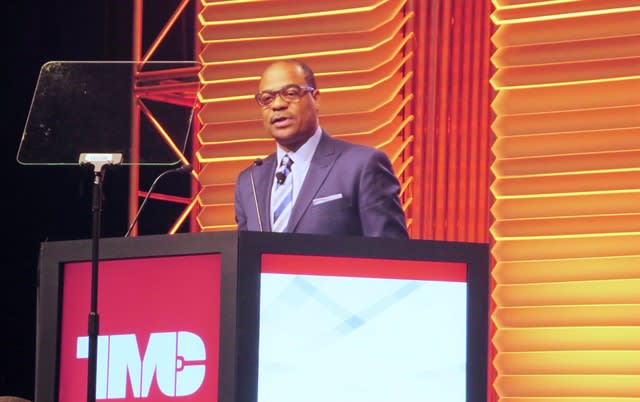
Fear of the unknown discourages investment in new trucking technologies, such as electric trucks, said UPS' Carlton Rose.Photo: Deborah Lockridge
Electric vehicles, driverless trucks, platooning, and drones. Sitting still and worrying about all the new technology coming at us is not an option, said Carlton Rose, UPS president, global fleet maintenance and engineering, at the kickoff breakfast for the ATA’s Technology & Maintenance Council Annual Meeting in Atlanta.
“You cannot be a linear thinker in an exponential world,” said Rose, who worked his way up through the UPS ranks after serving as a driver and technician.
“Today’s excellence is tomorrow’s mediocrity,” he said, building on this year’s TMC meeting theme, “Driving Excellence Through Expertise.”
Excellence, he noted, evolves, pointing to some of the earliest mobile phones as an example. But it’s evolving ever faster.
The first step in understanding what the excellence of tomorrow looks like, he said, is understanding what mediocrity looks like today.
“Mediocrity is polluted air,” he said. “Mediocrity is over 97,000 crashes across our industry, more than half of which involve injury or death. Today mediocrity is standing still, watching and worrying, as technology moves ahead faster than ever before.”
With that in mind, Rose outlined three areas where he believes the industry and UPS need to pursue excellence: Cleaner cities, safer vehicles, and knowledgeable people.
He pointed to UPS’ extensive fleet of alternative powered vehicles, including natural gas (especially renewable natural gas), hybrid and electric. UPS first bought electric vehicles in the 1930s. “You’d think by now we would have a fleet of battery powered trucks… but decades of cheap oil got in the way.” Now we’re catching up.
When it comes to safer vehicles, he noted, while we’re hearing a lot about autonomous trucks, the stepping-stone technologies, ADAS (advanced driver assistance system) could prevent up to 63,000 truck-related crashes each year. Technologies such as lane departure warning. automatic emergency braking, video based on board safety monitoring and air disc brakes are “all cost effective technologies that make the road safer for all of us right now.”
Who wouldn’t want to be better in these areas, he asked. “Yet we seem to be dragging our feet as an industry, he said, and listed three big “barriers to better”: Cost, infrastructure, and fear.
Cost: “It’s no small feat or expense to move from diesel to electric and natural gas,” he said, referring to “UPS’ recent Tesla shopping trip,” placing the largest order yet, 125, for the company’s electric Semi unveiled last year – not cheap, at $180,000 to $200,000 per truck. “But we fully expect a lower total cost of ownership,” he noted, explaining that they are expected to be cheaper to maintain.
Infrastructure: “When it comes to electric vehicles the challenges is range. On a good day for a Class 8 semi the best option might be 500 miles on a single charge, but that could vary with weather, traffic conditions, load, driver behavior and other factors. “Range anxiety is real. Even if they find a way to charge a truck in half an hour it will take a huge amount of power – that will take upgrading substations and constructing new natural gas generating power plants – billions of dollars,” Rose said. “Right now there is no federal infrastructure plan or money to pay for it. UPS hub system makes alternative vehicles possible. Sure it costs us to upgrade the infrastructure, but if any company takes on this challenge, it should be UPS. Our leadership is not only important, it’s required. When a company that logs as many miles as UPS does with its “rolling laboratory,” it shows it is serious about creating a market.”
Fear of the unknown. “It’s understandable to be afraid of all this change,” Rose said. “In fact it’s smart. But fear of the unknown discourages investment.” When you know it’s the right thing to do he, said, but you’re waiting around for the technology to be better proven, “Don’t sacrifice the good for perfect. “ Sometimes, he said, we can take a cue from Nike’s slogan “Just Do It.”
So how do we break though to better? “It’s as simple as ABC: Adaptability, bravery, and commitment.”
“We must be willing to change as technology changes,” he said. “Continuous learning is critical. Far too often we’re mentally enslaved to the familiar. Freeing ourselves may allow us to take the first step.”
More Operations

From AI Prompts to AI-Generated Safety Songs | AF News Recap
Can better prompts make AI more useful for fleet managers? This week, we’re breaking down smarter fleet analysis, an AI-assisted experiment that turned safety training into music, and what happened to fuel prices in August.
Read More →
How to Write Better AI Prompts for Fleet Analysis
Include these six elements in your fleet prompts to generate more relevant analysis and accurate answers.
Read More →
Fleet Meets: Eric Kilgore
This edition of the Fleet Meets series features one of the industry's best leaders driving multi-market and national operations.
Read More →


Sponsored•August 13, 2026
Why Reactive Fleet Management Is Becoming Too Expensive to Sustain
Research highlights a growing need for proactive management strategies to address rising costs in fleet operations effectively.
Read More →
Sponsored•August 12, 2026
What Your Fleet KPIs Aren’t Telling You
Tracking fleet metrics is only useful when the data leads to better decisions. This guide helps fleet leaders assess cost, utilization, and downtime more accurately, identify performance gaps, and prioritize the actions that can improve operational results.
Read More →
Sponsored•August 7, 2026
Hidden in Plain Sight: Fleet Compliance Risks
Fleet compliance isn't just about having policies — it's about consistently enforcing them. This practical guide reveals six hidden compliance risks common in public sector and shared fleet operations and outlines proven strategies to improve visibility, accountability, and audit readiness
Read More →
Turning Fleet Payment Data into Executive Insights
Does data alone drive results in operations?
Read More →
Automotive Fleet Opens 2026 Personal Use Survey for Commercial Fleet Managers
Commercial and corporate fleet managers are invited to share how their organizations handle company vehicle personal-use policies, charges, and driver eligibility.
Read More →
Gary Van Orden Retires After Nearly Four Decades in Commercial Fleet
From answering customer calls at Ford Motor Company to leading fleet sales across multiple OEMs and a fleet management company, Gary Van Orden's career reflects nearly four decades of leadership in commercial fleet.
Read More →
How Stellantis Plans to Get Ahead of Fleet Downtime
Vehicle acquisition may grab the headlines, but fleet uptime increasingly determines operating success. Darren Bradshaw of Mopar North America gives the details.
Read More →