




UPS announced on September 27 the U.S. deployment of its first three large package delivery vehicles using hydrogen fuel cells for power. Chris Mahoney, UPS senior vice president of global transportation services, made his remarks at a press conference in Los Angeles where the first fuel cell Dodge Sprinter is being deployed. He was joined by representatives from DaimlerChrysler, the U.S. Environmental Protection Agency (EPA), the Department of Energy and the state of California. The remaining two Sprinters will be deployed in Sacramento, CA and Ann Arbor, MI "Shifting away from a fossil fuel based economy to a hydrogen economy would be a great environmental and technological achievement," said Mahoney, adding "UPS now is jumping from a small fuel cell car to a medium-duty truck. We will continue the rapid application of this technology in hopes that in the near future, we can deploy zero-emission engines across our fleet of 88,000 vehicles." In May 2003, UPS, EPA and DaimlerChrysler announced a collaborative project to advance the state of hydrogen fuel cells by harnessing the technology to power the first commercial delivery fleet in North America; and starting in March 2004, DaimlerChrysler provided an "F-Cell," a fuel cell-powered Mercedes-Benz A-Class car. DaimlerChrysler and UPS concurrently began testing a medium-duty vehicle in Germany. Compared to the first Sprinter, the new fuel cell Sprinters feature a 20 percent increase in powertrain efficiency; a 40 percent increase in range to 155 miles, and a 45 percent increase in peak engine power, with acceleration similar to a gas- or diesel-powered UPS vehicle. The vehicles in their new configuration also offer a 10 percent increase in cargo capacity compared to the diesel-powered Sprinters now in use by UPS. Customers will be able to recognize the trucks not only because of their signature brown color and UPS logo, but also by special graphics on the sides that feature concentric circles rippling outwards, representing water.
UPS Expands In-Service Fleet Testing of Three Fuel Cell Vehicles
UPS announced on September 27 the U.S. deployment of its first three large package delivery vehicles using hydrogen fuel cells for power.
More Operations

BBL Fleet Acquires Velcor Leasing Corporation
BBL Fleet expanded its footprint in the fleet management industry with the acquisition of Velcor Leasing Corporation of Madison through a stock purchase agreement finalized Feb. 27, 2026.
Read More →
Lytx Introduces New AI Fleet Technologies at Protect 2026
The company introduced new AI-driven fleet safety and operations technologies during its annual user conference.
Read More →
Fleet Costs Are Rising: Here’s How Leaders Are Responding
Fleet leaders are under pressure to reduce costs, adapt to economic uncertainty, and make smarter decisions. See how peers across North America are responding with real data, proven strategies, and forward-looking insights. Download the 2026 Market Pulse Report to benchmark your strategy and uncover where you can gain an edge.
Read More →
From Waffle House to AI: Fleet Trends You Need to Know
In this AF news recap, host Faith Howell covers how Waffle House stepped up during disaster response and new AI tech on the market.
Read More →
Fleet Operations in the Age of AI: Navigating Ethical and Legal Challenges
AI is no longer a future concept for fleets—it’s already embedded in the tools, data, and decisions that operators rely on every day. In this episode of the Fleet Forward Podcast, recorded live at Fleet Forward, industry leaders take the conversation beyond hype to examine what responsible AI adoption really looks like in fleet operations.
Read More →
Factory Installed vs. Aftermarket: Choosing the Right Telematics Path & Managing the Data
As fleets rethink how they capture, manage, and act on vehicle data, telematics is at a major inflection point. In this episode of the Fleet Forward Podcast, we dive deep into one of the most pressing questions facing fleet leaders today: Should you rely on OEM factory-installed connectivity, aftermarket devices, or a hybrid of both?
Read More →
What Real-Time Data Reveals About EV Cost, Performance, and Scalability
Experts from telematics analytics, fleet-as-a-service operations, and national EV benchmarking share how real-time data is reshaping fleet strategy—dispelling assumptions, validating best practices, and exposing costly missteps.
Read More →
Planning Through Policy Shifts: What Fleets Must Track in 2026
A powerhouse panel featuring experts from the American Automotive Leasing Association, CalSTART, and municipal fleet leadership dives into the realities of navigating shifting emissions rules, regulatory waivers, federal agency actions, the future of the EPA’s endangerment finding, and the push for unified standards. They also examine the impacts of tariffs, autonomous vehicle policy, battery innovation, and the accelerating global EV market.
Read More →
Managing Market Turbulence with Strategic Fleet Insights
This episode kicks off with a deep dive into the technologies and market forces reshaping today’s fleet landscape. Host Chris Brown is joined by Laolu Adeola (Leke Services), Tyson Jomini (J.D. Power), and Richard Hall (ZappiRide) to break down real-world data, shifting incentives, and practical strategies fleet leaders can use right now.
Read More →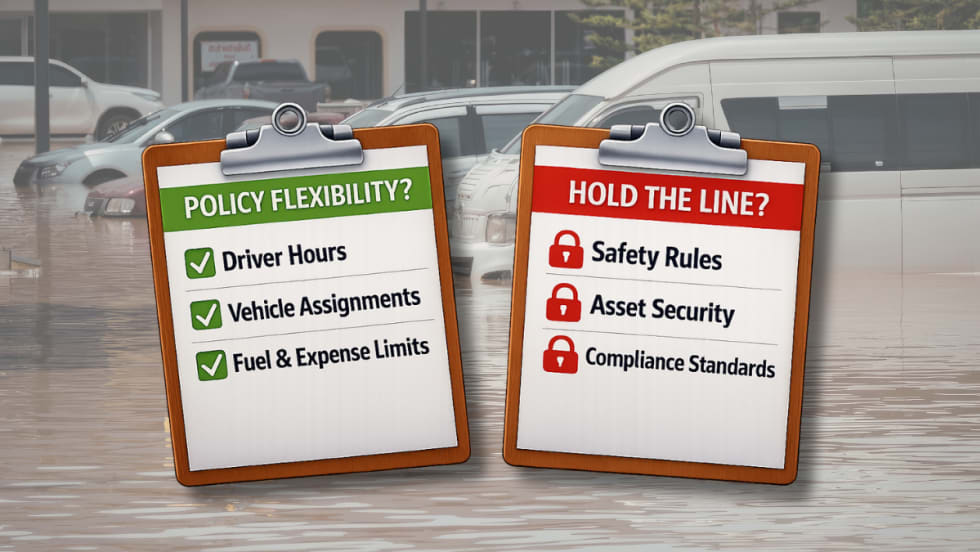
Adapting Fleet Policy When Disasters Strike
In the middle of natural disasters fleet managers must shift priorities to protect people and assets. What policy items should be loosened, and when should the line be held?
Read More →