





Learn More: Verizon Connect Helps Customer Recover $500K in Stolen Trucks
Two Pick-Up Trucks Top Most Stolen Vehicles List
Discover which trucks were most enticing to thieves in 2020.
October 12, 2021
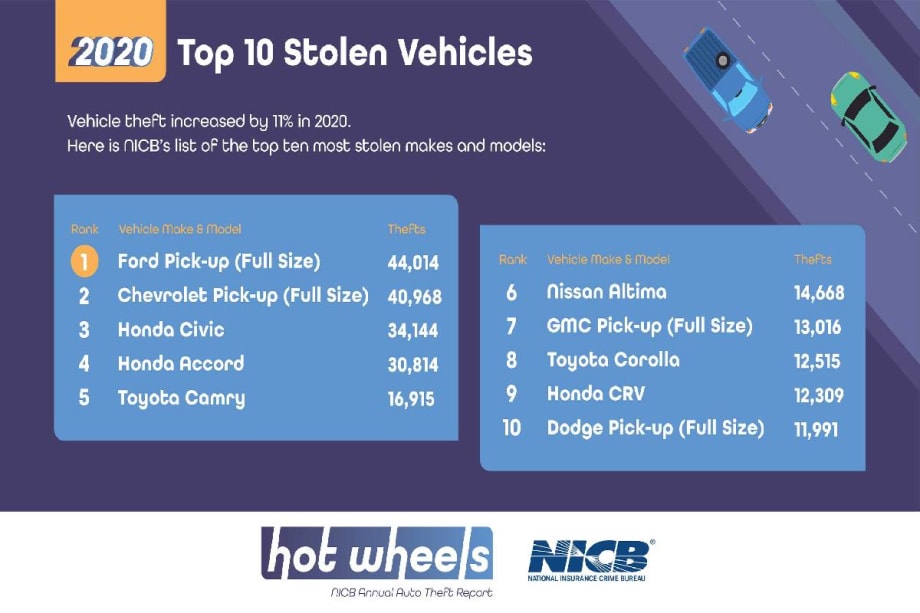
Discover which trucks were most enticing to thieves in 2020.
Photo: National Insurance Crime Bureau
3 min to read
The National Insurance Crime Bureau (NICB) has released its annual Hot Wheels report identifying the top 10 most stolen vehicles in the United States in 2020. For the second year in a row, the Ford full size pick-up was the model most targeted by thieves, followed by the Chevrolet full size pick-up, which supplanted the formerly second-place Honda Civic.
"Auto thefts saw a dramatic increase in 2020 versus 2019 in part due to the pandemic, an economic downturn, law enforcement realignment, depleted social and schooling programs, and, in still too many cases, owner complacency," said David Glawe, president and CEO of the NICB.
Thefts for all models in the top 10 were up in 2020 compared to 2019, but only Ford, Chevrolet, and GMC full size pick-ups and the Honda CR-V saw double digit theft increase percentages. In this year's list, six of the top 10 most stolen vehicles were Japanese models.
# | Vehicle Make/Model | Thefts | Increase from 2019 | Most Common Model Year Stolen |
1 | Ford Full Size Pick-up | 44,014 | 13.0% | 2006 |
2 | Chevrolet Full Size Pick-up | 40,968 | 25.7% | 2004 |
3 | Honda Civic | 34,144 | 2.8% | 2000 |
4 | Honda Accord | 30,814 | 0.2% | 1997 |
5 | Toyota Camry | 16,915 | 8.0% | 2019 |
6 | Nissan Altima | 14,668 | 9.8% | 2020 |
7 | GMC Full Size Pick-up | 13,016 | 16.6% | 2005 |
8 | Toyota Corolla | 12,515 | 3.1% | 2020 |
9 | Honda CR-V | 12,309 | 21.9% | 2000 |
10 | Dodge Full Size Pick-up | 11,991 | 6.2% | 2001 |
The annual Hot Wheels report examines vehicle theft data submitted by law enforcement to the National Crime Information Center (NCIC) and determines the vehicle make, model, and model year most reported stolen in 2020.
To guard against thefts of vehicles, NICB recommends drivers follow these four layers of protection to guard against vehicle theft:
1. Common Sense — the common-sense approach to protection is the easiest and most cost-effective way to thwart would-be thieves. You should always:
Remove your keys from the ignition
Lock your doors/close your windows
Park in a well-lit area
2. Warning Device — the second layer of protection is a visible or audible device which alerts thieves that your vehicle is protected. Popular devices include:
Audible alarms
Steering column collars
Steering wheel/brake pedal lock
Brake locks
Wheel locks
Theft deterrent decals
Identification markers in or on vehicle
VIN etching
Micro dot marking
3. Immobilizing Device — the third layer of protection is a device which prevents thieves from bypassing your ignition and hot-wiring the vehicle. Some electronic devices have computer chips in ignition keys. Other devices inhibit the flow of electricity or fuel to the engine until a hidden switch or button is activated. Some examples are:
Smart keys
Fuse cut-offs
Kill switches
Starter, ignition, and fuel pump disablers
Wireless ignition authentication
4. Tracking Device — the final layer of protection is a tracking device which emits a signal to police or a monitoring station when the vehicle is stolen. Tracking devices are very effective in helping authorities recover stolen vehicles. Some systems employ telematics which combine GPS and wireless technologies to allow remote monitoring of a vehicle. If the vehicle is moved, the system will alert the owner and the vehicle can be tracked via computer.
Originally posted on Work Truck Online
More Vehicle Research
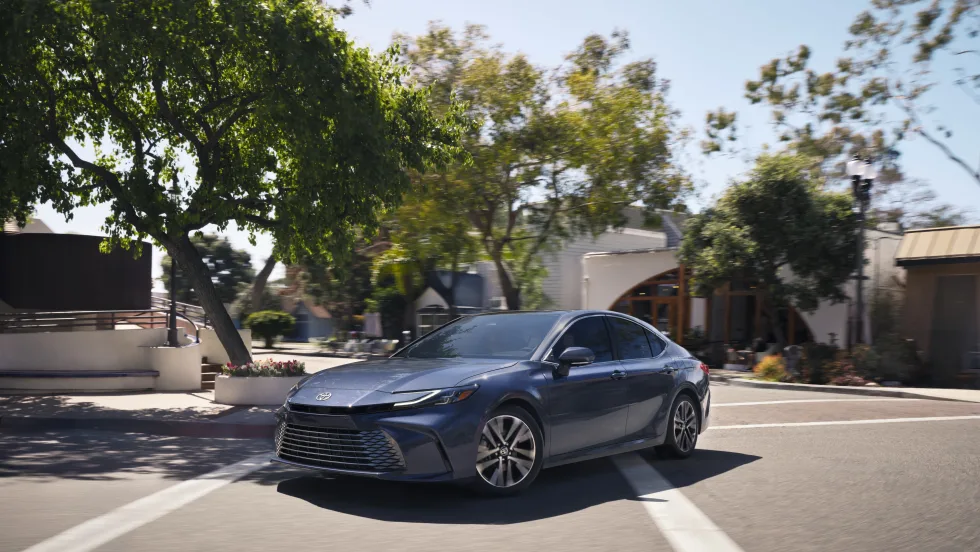
2027 Toyota Camry Offers Hybrid Powertrain Across Five Grades
The 2027 Toyota Camry is a carryover with new pricing.
Read More →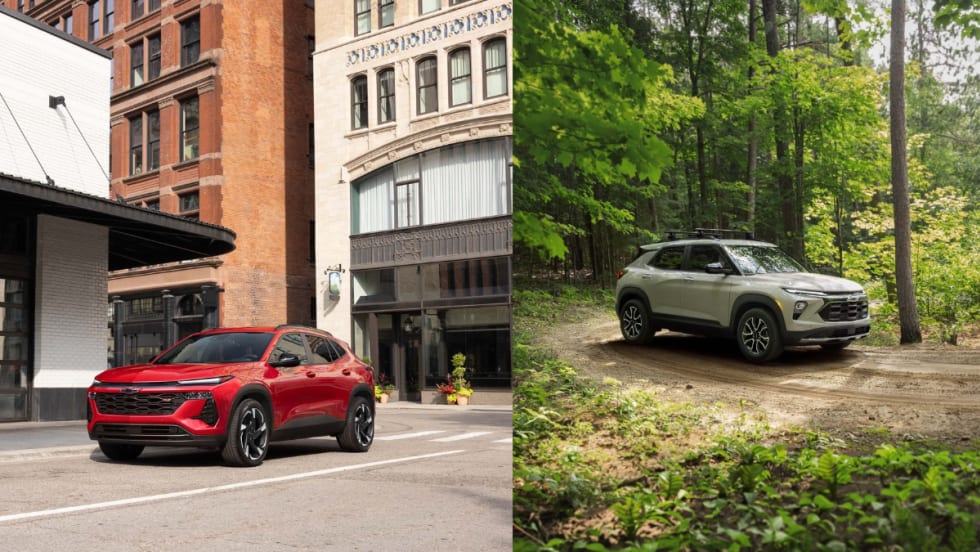
Chevrolet Updates 2027 Trax and Trailblazer with More Standard Safety Features
Chevrolet is updating two of its smallest SUVs with added driver-assistance technology, redesigned interiors, and revised trim options. The changes could add more safety equipment as standard for commercial fleets, while a new Trailblazer configuration adds another all-wheel-drive option.
Read More →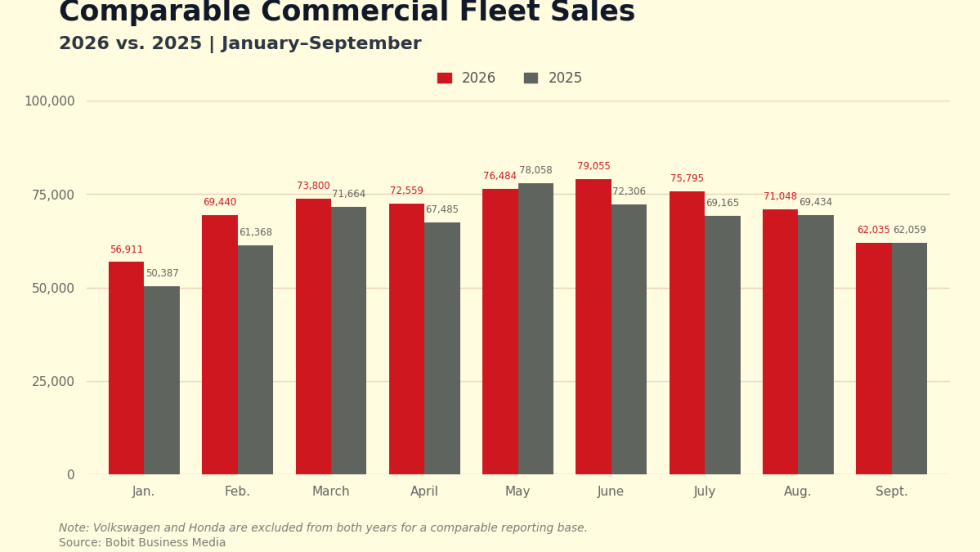
Commercial Fleet Sales Rise 5.8% Through September 2026
September commercial fleet sales were essentially unchanged from a year earlier, slowing year-to-date growth while keeping volume ahead of 2025.
Read More →
Hall of Fame Inductee: John Dmochowsky
The longtime Mondelēz International fleet executive joins the Automotive Fleet Hall of Fame.
Read More →
Hall of Fame Inductee: Lee Miller
After more than four decades at Boehringer Ingelheim, Lee Miller leaves a legacy built on fleet expertise.
Read More →
Hall of Fame Inductee: Mark F. Petersen
From managing fleets of thousands of vehicles to advancing safety and mentoring fellow professionals, Mark F. Petersen made his mark across both the corporate and supplier sides of fleet.
Read More →
When Charger Downtime Becomes a Fleet Availability Problem
As EV deployments move beyond pilot programs, charger reliability can directly affect vehicle readiness, driver productivity and route scheduling.
Read More →
2027 Nissan Rogue Hybrid Adds e-POWER, Standard AWD
The new Rogue Hybrid uses Nissan’s e-POWER system with dual electric motors, offers an estimated 40 mpg and starts at $35,490.
Read More →
2027 Subaru Forester Adds First Wilderness Hybrid
The 2027 Forester lineup starts at $29,995 and adds a Wilderness Hybrid with 194 combined horsepower and 9.3 inches of ground clearance.
Read More →
EV Realty Names Henrik Holland President as Charging Platform Expands
The former Prologis Mobility and Shell executive will help expand EV Realty’s truck charging business and move its power-first infrastructure model into autonomous vehicle depots and other fleet sectors.
Read More →