





Related: Leaked Infrastructure Plan – No Fuel Tax Hike, but Tolling Interstates OK
Trump's Call for More Infrastructure Spending Scant on Funding Details
President Trump has upped the ante by requesting Congress to craft a bipartisan bill that “generates” at least $1.5 trillion to invest in infrastructure.
January 31, 2018
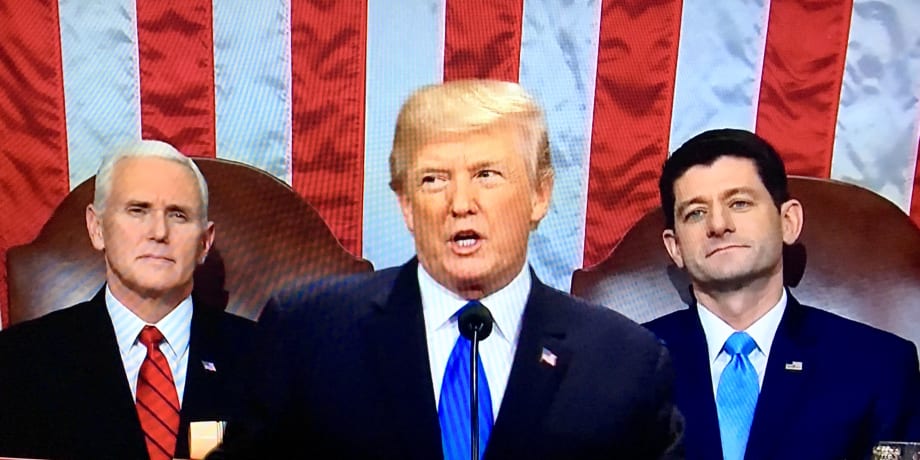
In his first State of the Union address, Presdient Trump said nothing about how to pay for his now $1.5 trillion infrastructure plan. Photo: TV screenshot
3 min to read
In his first State of the Union address, Presdient Trump said nothing about how to pay for his now $1.5 trillion infrastructure plan.Photo: TV screenshot
In his first State of the Union speech, President Trump upped the ante for infrastructure spending by requesting that Congress craft a bipartisan bill that “generates” at least $1.5 trillion to invest in the “safe, fast, reliable, and modern infrastructure our economy needs and our people deserve.”
However, Trump did not indicate at all how he would pay for that largesse. What’s more, the $1.5 trillion figure is $500 billion more than the president has previously called for to fund infrastructure.
It was the only new detail mentioned about his long-anticipated infrastructure plan during his 80-minute SOFU address to a joint session of Congress on Jan. 30.
“I am asking both parties to come together to give us the safe, fast, reliable, and modern infrastructure our economy needs and our people deserve,” said Trump.
How to Pay for Infrastructure Improvements
Based on what the Trump Administration has previously stated – as well as a recently leaked draft document – the president’s approach to financing infrastructure improvements apparently remains fixed on priming the pump with $200 billion in cash and tax credits, which presumably will stoke spending by state and even local governments as well as private investors, to actually fund most of the price tag that Trump has hung on improving highway, railroad, airport, marine, and other infrastructure.
“Every federal dollar should be leveraged by partnering with state and local governments and, where appropriate, tapping into private sector investment — to permanently fix the infrastructure deficit,” Trump added, suggesting yet again that he does not expect Congress to come up with all the $1.5 trillion he is seeking now.
Indicative of the pushback Trump can expect from Democrats in Congress was the reaction of House Transportation Committee Ranking Member Peter DeFazio (D-OR). “President Trump cannot pretend to solve our infrastructure woes by slashing real investments to states and local governments, pushing the responsibility off federal balance sheets, cutting existing transportation programs to pay for Wall Street and foreign investors to toll our roads, and gutting bedrock environmental protections," DeFazio said, according to a Politico.com report.
The president also again called for slashing the red tape that can slow infrastructure projects by years. “Is it not a disgrace that it can now take 10 years just to get a permit approved for a simple road?” Trump asked rhetorically, before demanding that any infrastructure bill must “streamline the permitting and approval process — getting it down to no more than two years, and perhaps even one.”
Beyond infrastructure
In his far-ranging address, the president also declared that the U.S. has “finally turned the page on decades of unfair trade deals.” While offering no details, he stated that his administration will “work to fix bad trade deals and negotiate new ones.”
Trump also made a pitch for investing more in workforce development and job training. “Let us open great vocational schools so our future workers can learn a craft and realize their full potential,” he said. In addition, he declared his support for providing workers with paid family leave.
More Operations

Moventum Fleet Management Names Mark Iorillo Head of Sales
Iorillo brings nearly 20 years of fleet management and sales experience to the role, including previous positions at Element Fleet Management, CEI, Donlen and Ryder.
Read More →
Fleet Has a Talent Pipeline Problem. What Comes Next? | AF News Recap
Where will fleet’s next generation of leaders come from? This week, we’re looking at the industry’s talent pipeline, what certification can add to a fleet career, how to build an award-worthy track record, and the return of Automotive Fleet’s Personal Use Survey.
Read More →
Smith System Launches Driver Risk Management Program
Fleets have more driver data than ever, but identifying risky behavior doesn't necessarily correct it. Smith System's new Driver Risk Management program combines monitoring, training, and follow-up coaching to help fleets connect risk signals with driver intervention.
Read More →
Automotive Fleet Opens 2026 Personal Use Survey for Commercial Fleet Managers
Less than two weeks left! Commercial and corporate fleet managers are invited to share how their organizations handle company vehicle personal-use policies, charges, and driver eligibility.
Read More →
From AI Prompts to AI-Generated Safety Songs | AF News Recap
Can better prompts make AI more useful for fleet managers? This week, we’re breaking down smarter fleet analysis, an AI-assisted experiment that turned safety training into music, and what happened to fuel prices in August.
Read More →
How to Write Better AI Prompts for Fleet Analysis
Include these six elements in your fleet prompts to generate more relevant analysis and accurate answers.
Read More →
Fleet Meets: Eric Kilgore
This edition of the Fleet Meets series features one of the industry's best leaders driving multi-market and national operations.
Read More →
Why Reactive Fleet Management Is Becoming Too Expensive to Sustain
Research highlights a growing need for proactive management strategies to address rising costs in fleet operations effectively.
Read More →
Sponsored•August 12, 2026
What Your Fleet KPIs Aren’t Telling You
Tracking fleet metrics is only useful when the data leads to better decisions. This guide helps fleet leaders assess cost, utilization, and downtime more accurately, identify performance gaps, and prioritize the actions that can improve operational results.
Read More →
Sponsored•August 7, 2026
Hidden in Plain Sight: Fleet Compliance Risks
Fleet compliance isn't just about having policies — it's about consistently enforcing them. This practical guide reveals six hidden compliance risks common in public sector and shared fleet operations and outlines proven strategies to improve visibility, accountability, and audit readiness
Read More →