


Related: Toyota Developing Battery EV
 MENU
MENU SEARCH
Toyota has developed a more efficient four-cylinder engine, two transmissions, and a next-generation hybrid powertrain, the automaker has announced.
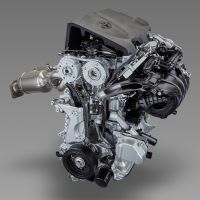
Photo of 2.5L engine courtesy of Toyota.
Photo of 2.5L engine courtesy of Toyota.
Toyota has developed a more efficient four-cylinder engine, two transmissions, and a next-generation hybrid powertrain, the automaker has announced.
Toyota has developed a 2.5L direct-injection inline-4 gasoline engine based on the Toyota New Global Architecture (TNGA) that "achieve greater thermal efficiency, resulting in high output, due to a reduction in energy losses associated with, among others, exhaust and cooling systems and the movement of mechanical parts," according to the company.
Toyota has also developed two automatic transmissions, including the 8-speed Direct Shift-8AT and the 10-speed Direct shift-10AT that were designed "to minimize energy loss and heighten transmission efficiency."
Toyota has also enhanced the gasoline-electrid hybrid powertrain for the Prius. The Toyota Hybrid System II (THS-II) for 2.5L engines "excels in both power and fuel-economy performance due to the synergistic effect of size-reducing, weight-reducing and loss-reducing technologies coupled with the high thermal efficiency and output of a new TNGA-based engine," according to Toyota.

Where will fleet’s next generation of leaders come from? This week, we’re looking at the industry’s talent pipeline, what certification can add to a fleet career, how to build an award-worthy track record, and the return of Automotive Fleet’s Personal Use Survey.
Read More →
Fleets have more driver data than ever, but identifying risky behavior doesn't necessarily correct it. Smith System's new Driver Risk Management program combines monitoring, training, and follow-up coaching to help fleets connect risk signals with driver intervention.
Read More →
Less than two weeks left! Commercial and corporate fleet managers are invited to share how their organizations handle company vehicle personal-use policies, charges, and driver eligibility.
Read More →
Can better prompts make AI more useful for fleet managers? This week, we’re breaking down smarter fleet analysis, an AI-assisted experiment that turned safety training into music, and what happened to fuel prices in August.
Read More →
Include these six elements in your fleet prompts to generate more relevant analysis and accurate answers.
Read More →
This edition of the Fleet Meets series features one of the industry's best leaders driving multi-market and national operations.
Read More →
Research highlights a growing need for proactive management strategies to address rising costs in fleet operations effectively.
Read More →
Tracking fleet metrics is only useful when the data leads to better decisions. This guide helps fleet leaders assess cost, utilization, and downtime more accurately, identify performance gaps, and prioritize the actions that can improve operational results.
Read More →
Fleet compliance isn't just about having policies — it's about consistently enforcing them. This practical guide reveals six hidden compliance risks common in public sector and shared fleet operations and outlines proven strategies to improve visibility, accountability, and audit readiness
Read More →
Does data alone drive results in operations?
Read More →