




Theft Devices Target Push-Button Start Vehicles
Car and truck thieves are using new technology that makes break-ins alarmingly simple, and the National Insurance Crime Bureau has finally learned how these devices work.

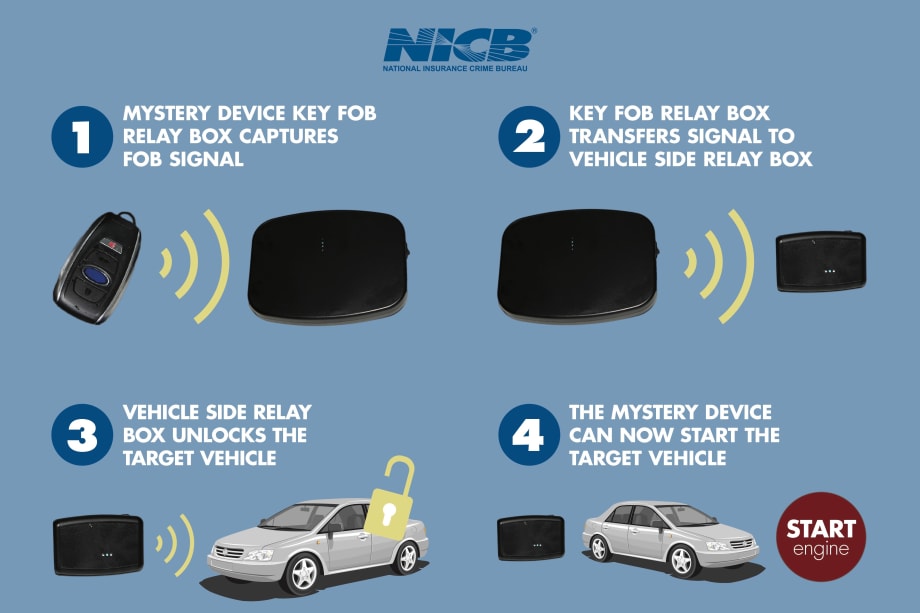
Infographic courtesy of the National Insurance Crime Bureau.
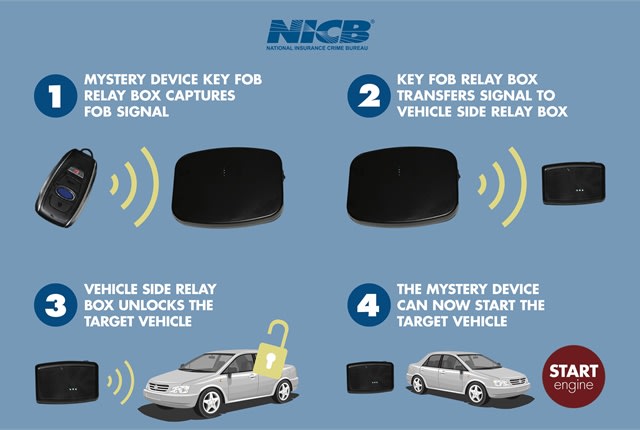
Infographic courtesy of the National Insurance Crime Bureau.
A growing number of criminals are using new technology to not only unlock and open vehicles, but also to start and steal them, according to the National Insurance Crime Bureau.
NICB recently obtained one of the so-called “mystery devices” that the public was first warned about more than two years ago. At the time, thieves were being seen on security cameras across the country, using unknown devices to unlock vehicles and steal valuables inside. In recent months, NICB has received reports of thieves not only opening the vehicles, but also starting them and driving away.
NICB obtained the device after it was purchased through a third-party security expert from an overseas company. The device was developed by engineers in an effort to provide manufacturers and other anti-theft organizations the ability to test the vulnerability of various vehicles’ systems.
Called a “relay attack” unit, this particular model only works on cars and trucks that use a keyless remote and a push-button ignition.
In a series of unscientific tests at different locations over a two-week period, 35 different makes and models of cars, SUVs, minivans, and a pickup truck were tested. NICB partnered with member company CarMax because it has nearly every make and model in its inventory. Tests were also performed at a new car dealership, at an independent used car dealer, at an auto auction, and on NICB employee vehicles and ones owned by private individuals. The vehicles were tested to see if the device could open the door, start the vehicle, permit the vehicle to be driven away, and turn off and restart the engine without the original fob present.
NICB said it was able to open 19 (54%) of the vehicles and start and drive away 18 (51%) of them. After driving the 18 vehicles away and turning off the ignition, the device was used to restart 12 (34%) of them.
NICB noted that evidence suggests there are a number of different devices available for sale to thieves. Some use different technology and may work on different makes and models and ignition systems. More expensive device models may have a greater range and better capabilities for opening and starting a vehicle.
“We’ve now seen for ourselves that these devices work,” said NICB President and CEO Joe Wehrle. “Maybe they don’t work on all makes and models, but certainly on enough that car thieves can target and steal them with relative ease. And the scary part is that there’s no warning or explanation for the owner. Unless someone catches the crime on a security camera, there’s no way for the owner or the police to really know what happened. Many times, they think the vehicle has been towed.”
Wehrle said it’s important for law enforcement officers to be aware of this threat and to be on the lookout for thieves who may be using the technology.
Vehicle manufacturers must continue their efforts to counter the attacks on anti-theft technology, added NICB Chief Operating Officer Jim Schweitzer, who oversees all NICB investigations.
“Vehicles are a valuable commodity and thieves will continue to wage a tug-of-war with the manufacturers to find a way to steal them,” Schweitzer said. “Anti-theft technology has been a major factor in reducing the number of thefts over the past 25 years. The manufacturers have made tremendous strides with their technology, but now they have to adapt and develop countermeasures as threats like this surface.”
While there may not be an effective way of preventing this kind of theft at this time, NICB advised drivers to always lock their vehicle and take the remote fob or keys with them. Drivers should also be on the lookout for suspicious persons or activity and alert law enforcement rather than confronting a possible thief.
It’s also a good idea to never invite a break-in by leaving valuables in plain sight. Also, keep in mind that once thieves get inside, they can easily steal a garage door opener and valuable papers such as a vehicle registration that could lead them to the driver’s home. So NCIB recommends that drivers take any garage door opener with them and take a picture of their registration on their cell phone rather than keeping it in the glove compartment.
Anyone with information concerning insurance fraud or vehicle theft can report it anonymously by calling toll-free 800-TEL-NICB (800-835-6422), texting keyword “fraud” to TIP411 (847411), or submitting a form on the NICB website. Or you can download the NICB Fraud Tips app on your iPhone or Android device.
More Safety

Nexar-Nauto Merger Aims to Give Fleets Better Safety Intelligence Through Larger Driving Dataset
Stefan Heck tells Automotive Fleet that combining more than 10 billion miles of driving history with Nexar's AI models will give fleets deeper insights into driver risk and roadway conditions than either company could provide independently.
Read More →
Don't Wait for a Crisis: 5 Ways to Build Mental Health Into Your Fleet Safety Program
For Suicide Prevention Month, fleet and safety leaders have an opportunity to put mental health where it belongs: at the center of workplace safety.
Read More →
How Camera Data Can Strengthen a Fleet’s Insurance Renewal
Insights from a commercial insurance carrier and a broker show how fleets can turn video telematic data, driver coaching, and improved claims results into a stronger case at insurance renewal.
Read More →
The Safest Fleets Aren’t the Ones with the Most Technology
You’ve made the telematics investment. Here’s how to capture the other half of its value and build the safest fleet on the road.
Read More →
Hidden in Plain Sight: Fleet Compliance Risks
Fleet compliance isn't just about having policies — it's about consistently enforcing them. This practical guide reveals six hidden compliance risks common in public sector and shared fleet operations and outlines proven strategies to improve visibility, accountability, and audit readiness
Read More →
NETS Sets 2026 Fleet Safety Benchmark Conference for Indianapolis
The Sept. 15–17 program will feature fleet benchmarking data, case studies, emerging technologies, and implementation strategies while running alongside the NSC Safety Congress & Expo.
Read More →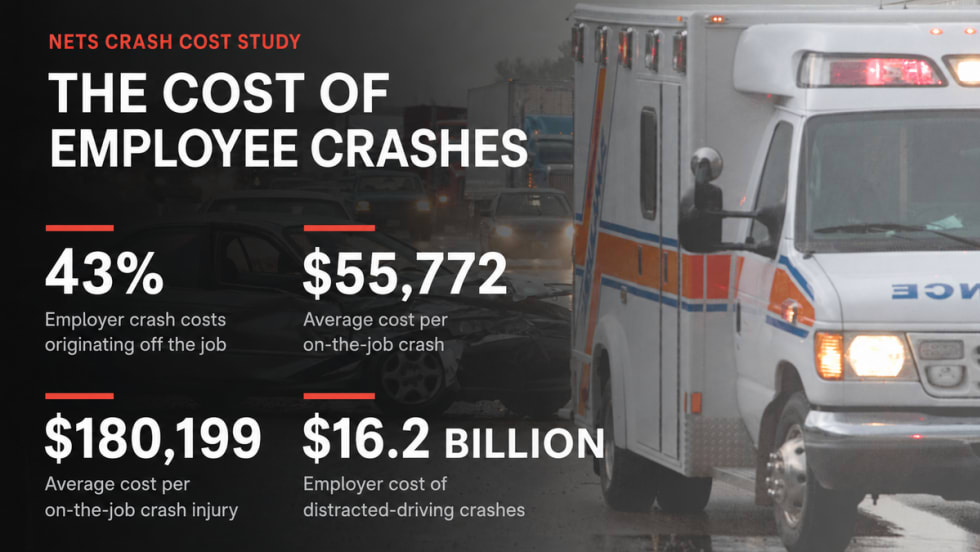
Off-the-Job Crashes Account for 43% of Employers’ $61.7 Billion Crash Burden
NETS quantifies costs dispersed across fleet, risk, HR, and other departments while providing new per-crash benchmarks for employers.
Read More →
Ram Recalls More Than 1.27 Million 1500 Pickups for Seat Belt Anchor Issue
The recall affects certain 2019-2026 Ram 1500 pickups that may have improperly attached second-row seat belt buckle anchors.
Read More →
How Better Visibility Cut Speeding Violations by 48%
Fleet leaders don't need more data, they need clearer visibility into what the data is saying. This case study explores how one utility replaced speeding-event counts with a single metric — miles driven in violation — to strengthen safety and significantly reduce speeding violations.
Read More →
Operation Safe Driver Week: Why the Industry's Oldest Safety Campaign Still Matters to Fleets
A look at how a 2007 enforcement initiative became one of the most consequential weeks on the fleet safety calendar, and what it means for your drivers in 2026.
Read More →