




Thanksgiving Traffic Forecast: Longer Delays on Wednesday Afternoon
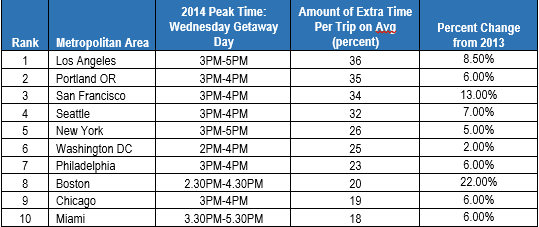
Anyone out driving the day before Thanksgiving needs to be prepared for possible big traffic delays with traffic congestion predicted to be 25% worse than a typical Wednesday afternoon, according to the traffic analytics company Inrix.
Graphic: Inrix
Anyone out driving the day before Thanksgiving needs to be prepared for possible big traffic delays with traffic congestion predicted to be 25% worse than a typical Wednesday afternoon, according to the traffic analytics company Inrix.
According to the company’s annual Thanksgiving Traffic Forecast, the Wednesday pre-Thanksgiving rush hour is expected to begin two hours earlier than a typical Wednesday. Drivers trying to avoid the worst delays should avoid travelling between 2:00-5:00 p.m, according to Inrix
"Encouraged by low gas prices and a steady economy, travelers will experience more traffic on our roads than in recent years when more people stayed closer to home for the holiday," said Jim Bak, Inrix analyst. "While good news for businesses, drivers will battle more traffic heading out of town this year, particularly on routes near major airports."
Top 10 Busiest Cities for Thanksgiving Traffic
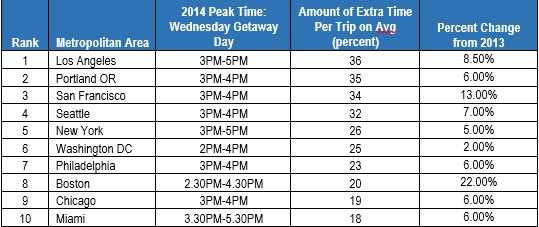
Los Angeles, New York, Portland, and San Francisco top this year's list of worst traffic cities with trips out of town expected to take from 25% to 36% percent longer than a typical Wednesday afternoon. The chart below predicts the peak congestion period and extent of delays for the 10 worst cities.
Graphic: Inrix
"Our advice to drivers wanting to avoid the worst traffic is to leave by 2 p.m. or after 6 p.m. on Wednesday,” said Bak. “If it's possible to wait to leave until Thanksgiving morning, roads will be free and clear as long as you're not heading to the Macy's parade or a major shopping center to get a leg up on Black Friday."
The above chart shows, for example, the average trip in Los Angeles on the day before Thanksgiving is predicted to take drivers more than a third longer than usual. "Los Angeles is simply the worst place to be on the Wednesday before Thanksgiving," said Bak. "The combination of people arriving for the holiday with those leaving town and normal commuter traffic will result in steady traffic all day long."
Busiest Airport Routes
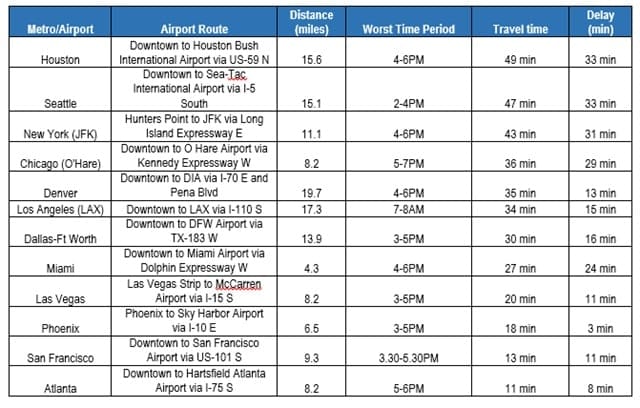
Traffic congestion this year is expected to be worst on key routes to and from major airports nationwide as travelers headed toward flights combine with car travelers to create bottlenecks at these locations, meaning delays for anyone delivering or picking up air freight.
Graphic: Inrix
Black Friday Forecast
Inrix also analyzed traffic levels around America's busiest shopping centers over the last three years to predict what drivers can expect travelling around these areas on Black Friday. It forecasts traffic congestion will peak between 1 p.m. and 5 p.m., advising shoppers to head out early to avoid the worst traffic delays and hassles finding parking at the mall.
The following table tracks the Top 10 busiest U.S. shopping centers, the peak congestion hour and the percentage change over 2013.
More Operations

Fleet Has a Talent Pipeline Problem. What Comes Next? | AF News Recap
Where will fleet’s next generation of leaders come from? This week, we’re looking at the industry’s talent pipeline, what certification can add to a fleet career, how to build an award-worthy track record, and the return of Automotive Fleet’s Personal Use Survey.
Read More →
Smith System Launches Driver Risk Management Program
Fleets have more driver data than ever, but identifying risky behavior doesn't necessarily correct it. Smith System's new Driver Risk Management program combines monitoring, training, and follow-up coaching to help fleets connect risk signals with driver intervention.
Read More →
Automotive Fleet Opens 2026 Personal Use Survey for Commercial Fleet Managers
Less than two weeks left! Commercial and corporate fleet managers are invited to share how their organizations handle company vehicle personal-use policies, charges, and driver eligibility.
Read More →
From AI Prompts to AI-Generated Safety Songs | AF News Recap
Can better prompts make AI more useful for fleet managers? This week, we’re breaking down smarter fleet analysis, an AI-assisted experiment that turned safety training into music, and what happened to fuel prices in August.
Read More →
How to Write Better AI Prompts for Fleet Analysis
Include these six elements in your fleet prompts to generate more relevant analysis and accurate answers.
Read More →
Fleet Meets: Eric Kilgore
This edition of the Fleet Meets series features one of the industry's best leaders driving multi-market and national operations.
Read More →
Why Reactive Fleet Management Is Becoming Too Expensive to Sustain
Research highlights a growing need for proactive management strategies to address rising costs in fleet operations effectively.
Read More →
What Your Fleet KPIs Aren’t Telling You
Tracking fleet metrics is only useful when the data leads to better decisions. This guide helps fleet leaders assess cost, utilization, and downtime more accurately, identify performance gaps, and prioritize the actions that can improve operational results.
Read More →
Hidden in Plain Sight: Fleet Compliance Risks
Fleet compliance isn't just about having policies — it's about consistently enforcing them. This practical guide reveals six hidden compliance risks common in public sector and shared fleet operations and outlines proven strategies to improve visibility, accountability, and audit readiness
Read More →
Turning Fleet Payment Data into Executive Insights
Does data alone drive results in operations?
Read More →