




Related Video: What an Exploding Takata Air Bag Looks Like
Takata Civil Penalty Could Reach $200M
The safety system supplier has reached a settlement with the National Highway Traffic Safety Administration, and more air bag inflator recalls may be in the offing.
by Staff
November 3, 2015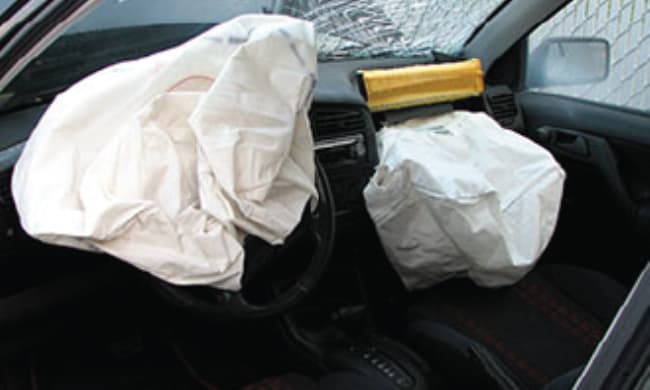
Photo courtesy of NHTSA.
3 min to read
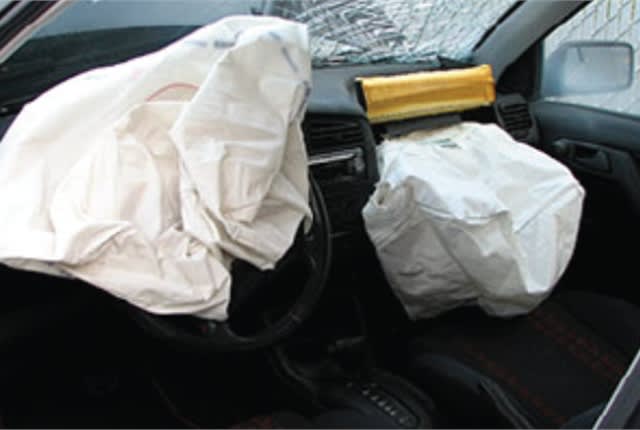
Photo courtesy of NHTSA.
The National Highway Traffic Safety Administration has imposed a potentially record-setting civil penalty of $200 million on auto safety system supplier Takata for violations of the Motor Vehicle Safety Act.
Of the $200 million, $70 million is payable in cash. An additional $130 million will become due if Takata fails to meet its commitments spelled out in a consent order or if NHTSA discovers additional Safety Act violations, the agency announced.
In accordance with the consent order, Takata has filed with NHTSA four defect information reports that raise the possibility of expanded recalls covering several types of driver-side and passenger-side air bag inflators.
Current recalls involve about 19 million vehicles from 12 different manufacturers.
The consent order also requires the company to phase out the manufacture and sale of air bag inflators that use phase-stabilized ammonium nitrate propellant. The chemical compound is believed to be a factor in air bag inflator ruptures responsible for seven deaths and nearly 100 injuries in the U.S.
As part of the settlement, Takata has admitted that it was aware of a safety defect but failed to issue a timely recall – a violation of the Motor Vehicle Safety Act. As a result, Takata will be subject to unprecedented oversight for the next five years, NHTSA said.
NHTSA also contends that Takata repeatedly provided inaccurate information to federal regulators and automakers, dating back to at least 2009.
“NHTSA does not have confidence in the long-term performance of Takata-made inflators using phase-stabilized ammonium nitrate propellant, particularly those without desiccant (a chemical additive that combats the effects of moisture),” NHTSA said in a released summary of the consent order.
The order prohibits Takata from entering into any new contracts with automakers for the sale of inflators using phase-stabilized ammonium nitrate. The company must complete its phase-out of supplying ammonium nitrate inflators by the end of 2018.
But NHTSA also might alter the phase-out schedule, if necessary, to “protect the public from an unreasonable risk to safety,” the agency said.
“We are pleased to have reached this agreement with NHTSA, which presents a clear path forward to advancing safety and restoring the trust of automakers and the driving public,” said Shigehisa Takada, CEO of Takata Corp. “We have worked extensively with NHTSA and our automaker customers over the past year to collect and analyze a multitude of testing data in an effort to support actions that work for all parties and, most importantly, advance driver safety.”
Headquartered in Tokyo, Takata operates an American subsidiary in Auburn Hills, Mich., called TK Holdings.
An independent monitor, selected by NHTSA, will oversee Takata’s compliance with the phase-out schedule and other requirements. The monitor will also help NHTSA supervise the recall remedy program.
NHTSA said it will use its authority to both speed and prioritize the Takata recalls.
“We are accelerating Takata recalls to get safe air bags into American vehicles more quickly, ensuring that consumers at the greatest risk are protected and addressing the long-term risk of Takata’s use of a suspect propellant,” said NHTSA Administrator Mark Rosekind.
Separately, NHTSA ordered Takata and the 12 automakers involved in existing Takata recalls to prioritize their own remedy programs based on risk.
Automakers must ensure they have enough replacement parts on hand to meet demand for the highest-risk inflators by June 2016. They also must provide final remedies for all vehicles, including those that will receive interim remedies because of supply and design issues, by the end of 2019, NHTSA said.
Takata has agreed to continue internal testing to determine the safety and service life of non-desiccated phase-stabilized ammonium nitrate-based inflators. The company will also begin testing inflators with desiccant. NHTSA can order additional safety recalls based on future field ruptures, test data results or other evidence that raises safety concerns.
Takata pledged to “work with its automotive customers to develop plans for reaching out to vehicle owners in order to maximize recall completion rates.”
More Safety

Does Your Fleet's Culture Encourage Distracted Driving?
What happens when the people responsible for enforcing safety rules are the ones setting the wrong example? The answer may reveal why some of the biggest risks to fleet drivers have little to do with what's written in the employee handbook.
Read More →
Sponsored•October 1, 2026
Fleet Manager’s Ultimate Playbook: Navigating the New Standard in OEM Connectivity
Rising operating costs, driver safety concerns, and unplanned downtime are putting unprecedented pressure on modern fleets. Discover how fleet managers use embedded OEM connectivity and real-time vehicle data to cut TCO, prevent downtime, and protect drivers without aftermarket telematics hardware.
Read More →
From Driver Well-Being to EV Charging | AF News Recap
Mental health belongs in the fleet safety conversation. This week, we’re looking at five ways fleets can support employee well-being before a crisis, plus Holman’s expansion in Mexico, new one-day Fleet Forward passes, and why EV charging demand is outpacing infrastructure growth.
Read More →
Nexar-Nauto Merger Aims to Give Fleets Better Safety Intelligence Through Larger Driving Dataset
Stefan Heck tells Automotive Fleet that combining more than 10 billion miles of driving history with Nexar's AI models will give fleets deeper insights into driver risk and roadway conditions than either company could provide independently.
Read More →
Don't Wait for a Crisis: 5 Ways to Build Mental Health Into Your Fleet Safety Program
For Suicide Prevention Month, fleet and safety leaders have an opportunity to put mental health where it belongs: at the center of workplace safety.
Read More →
How Camera Data Can Strengthen a Fleet’s Insurance Renewal
Insights from a commercial insurance carrier and a broker show how fleets can turn video telematic data, driver coaching, and improved claims results into a stronger case at insurance renewal.
Read More →
The Safest Fleets Aren’t the Ones with the Most Technology
You’ve made the telematics investment. Here’s how to capture the other half of its value and build the safest fleet on the road.
Read More →
Sponsored•August 7, 2026
Hidden in Plain Sight: Fleet Compliance Risks
Fleet compliance isn't just about having policies — it's about consistently enforcing them. This practical guide reveals six hidden compliance risks common in public sector and shared fleet operations and outlines proven strategies to improve visibility, accountability, and audit readiness
Read More →
NETS Sets 2026 Fleet Safety Benchmark Conference for Indianapolis
The Sept. 15–17 program will feature fleet benchmarking data, case studies, emerging technologies, and implementation strategies while running alongside the NSC Safety Congress & Expo.
Read More →
Off-the-Job Crashes Account for 43% of Employers’ $61.7 Billion Crash Burden
NETS quantifies costs dispersed across fleet, risk, HR, and other departments while providing new per-crash benchmarks for employers.
Read More →