





The Truth: Costs and Hidden Considerations of Maintaining EVs
Survey Reveals Most & Least EV-Friendly Cities
iSeeCars' latest survey shows how organizations can have more confidence in electrifying their fleet in some areas as opposed to others.
March 6, 2023

The shift from gasoline-powered cars to zero-emission electric vehicles is underway, with new government incentives aiming to get to 50% EV market share by 2030.
Photo: Canva/Automotive Fleet
4 min to read
The latest iSeeCars study revealed which US cities and states are the most and least EV-friendly, both for Tesla and non-Tesla EV operators.
iSeeCars analyzed the national EV charging infrastructure to determine which cities and states offer the best and worst electric vehicle charging support for EV owners looking to plug into public chargers, according to iSeeCars' news release.
The analysis looked at both Level 2 and Level 3 chargers (also known as DC fast chargers), and also evaluates the Tesla and non-Tesla networks separately, to see where cities and states rank based on how many residents each EV charging station must potentially serve.
In the study, the numbers reflect how many plugs (or charging ports) are available.
Over the past two years, the electric vehicle market share has grown from 2.7% to 6.4%. That means more than 300,000 new EV drivers on U.S. roads today, with tens of thousands more joining them every month. And while Tesla’s Supercharger Network is considered superior to the non-Tesla EV networks setup by ChargePoint, Electrify America, EVgo, and others, all EV owners are facing an electric vehicle charging infrastructure that simply can’t keep pace with this rate of growth, according to iSeeCars.
“Many drivers are on the verge of making their first EV purchase,” said Karl Brauer, executive analyst at iSeeCars. “Consumers looking to switch from gasoline to electric power should consider their local charging equipment options to understand how many potential electric vehicle owners they may be competing with, both today and in the near future.”
Overall Electric Vehicle Charging Support
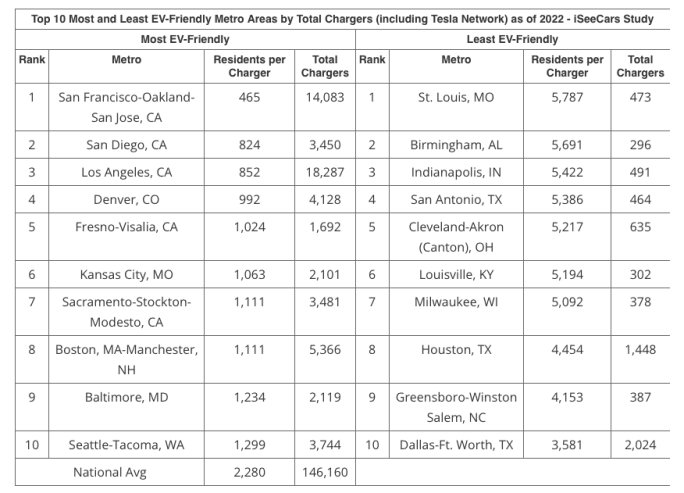
The survey advised all new EV charging stations will need to be managed and maintained, whether by their original manufacturers or by companies that specialize in EV chargers.
Photo: iSeeCars
Texas has three of the top 10 least EV-friendly cities in the nation, though St. Louis ranks the worst, Birmingham, Alabama, is the second worst, and Indianapolis lands at number three.
“Five of the top 10 EV-friendly cities are located in California, which isn’t really surprising, but who knew Denver was the most EV-friendly city outside California?” said Brauer. “It’s also interesting to see that the 10th ranked most EV-friendly market, Seattle-Tacoma, has nearly three times as many residents competing for each EV charger as the top-ranked market, San Francisco/Oakland/San Jose.”
The national average is one EV charger for every 2,280 residents, or less than half the number of residents per charger compared to the worst city, St. Louis, Missouri, at 5,787 residents per charger. These numbers include the Tesla Supercharger Network along with the ChargePoint, EVgo, and Electrify America EV charging networks. While Tesla uses its own charging plug, most of the rest use the Combined Charging System, or CCS, connector.
Most and Least EV-Friendly Cities
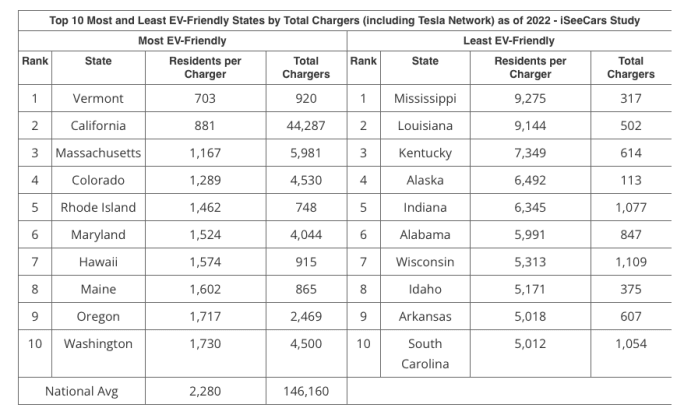
As iSeeCars listed the most and least EV-friendly cities, the survey noted that user experience for EV drivers will depend on effective social media and mobile app support.
Photo: iSeeCars
Vermont is the most EV-friendly city with only 703 residents per charger. California comes in at number two, with 881 residents per charger. Massachusetts, Colorado, and Rhode Island round out the top five states.
Mississippi is the least EV-friendly state, with 9,275 residents per charger – more than 10 times the residents per charger compared to number one Vermont.
Best and Worst Cities for Level 3 Fast Charging
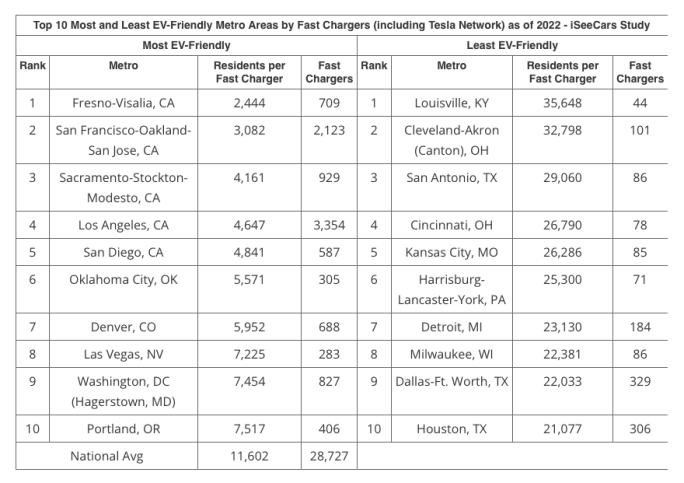
There are approximately 30,000 Level 3 fast charging stations in the U.S. right now.
Photo: iSeeCars
While any EV charger can save an electric vehicle limping along on its last few miles of range, only Level 3 fast charging locations provide a useful charging experience and the functionality needed for midday errand running or road trip charging, offering a charge rate comparable to fueling a gasoline vehicle.
Level 3 charging solutions (also known as DC fast charging) feature heavy-duty cables and require a 480-volt high power source, allowing them to restore 80% of an EV’s battery level in less than 30 minutes. Compared to the 12-20 miles of range added during an hour of charging on a 240-volt, 50-amp home wall box, charging EVs at a Level 3 charger adds 200+ miles in one hour.
The national average is one Level 3 fast charger for every 11,602 residents. In terms of useful public charging options, these cities are the best and worst locations for quickly replenishing an electric vehicle.
California once again offers the best EV infrastructure for fast charging needs, with the top five cities all located in the Golden State. Louisville, Kentucky, is the worst city for Level 3 chargers, averaging just one charger for every 35,648 residents.
“We’re living in the most disruptive era in the 140-year history of the automobile,” said Brauer. “Nobody knows exactly what the next 10 years will look like in terms of electrification, but everyone can agree on this point – it won’t be boring.”
More Green Fleet
Sponsored•October 1, 2026
New Propane Autogas Program Offers Fleet Compensation
Qualified commercial fleets can receive $7,500 per eligible propane autogas vehicle and up to $10,000 for new refueling site prep. Learn how the program works and see whether your fleet qualifies.
Read More →
EV Charging Use Is Outpacing Infrastructure Growth
ChargePoint’s 2026 Charging Forward Report points to rising charger use, higher-powered charging, commercial vehicle electrification, and energy-management technology. Here’s what fleets should know.
Read More →
Merchants Fleet Reports 290M EV Miles as Fleets Navigate Changing Electrification Market
From millions in operating savings to hundreds of millions of EV miles, Merchants Fleet’s latest report reveals what’s working and what’s changing in fleet electrification.
Read More →

The EV Breakdown Nobody's Talking About: Why Most Electric Vehicle Roadside Calls Aren't Mechanical Failures
Here's why EV breakdowns are widely misunderstood.
Read More →
ChargePoint Now Available in Energy Pass
ChargePoint and additional planned charging network integrations were added to GM's Energy Pass.
Read More →

First Look: Slate Auto's Electric Fleet Pickup
Could an affordable, modular EV pickup make electrification more practical for fleets?
Read More →
Slate Debuts Colorful, Unique EV Models
A recent media and client event, studded with electric vehicles dressed up on platforms, planted a new position for the manufacturer in the wider EV market. Fleets will find cost-saving advantages.
Read More →
Slate Electric SUV, Pickup Switchable Model Aims For Light-Duty Fleets
Everything about this EV is counterintuitive and understated, making it stand out from the crowd.
Read More →
Inspiration Mobility Acquires Key Electrada Assets
Inspiration Mobility Group has acquired select assets of Electrada, adding the fleet electrification provider's team, technology, and charging infrastructure development capabilities to its energy management business.
Read More →