




Study Underscores Benefits of Ignition Interlock Devices for First-Time Offenders
ARLINGTON, VA — A new study by the Insurance Institute for Highway Safety (IIHS) concludes that motorists convicted for the first time of alcohol-impaired driving are less likely to reoffend if they have to install ignition interlocks on their vehicles.
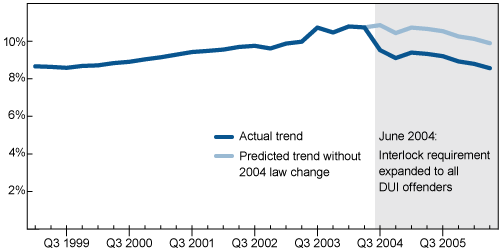
Trend in two-year recidivism rates for simple DUI
offenders arrested during January 1999-June 2006
ARLINGTON, VA — A new study by the Insurance Institute for Highway Safety (IIHS) concludes that motorists convicted for the first time of alcohol-impaired driving are less likely to reoffend if they have to install ignition interlocks on their vehicles.
The finding provides support for requiring the devices for all offenders, not just those with multiple arrests or high blood alcohol concentrations (BACs), IIHS said.
Researchers studied driver records in Washington for people with convictions related to alcohol-impaired driving. They found that after the state expanded its interlock requirement to everyone convicted of driving under the influence (DUI), the recidivism rate for people affected by the expansion fell 12 percent. Only about a third of those offenders actually went through with interlock installations. If all of them had, their recidivism rate would have fallen by nearly half, the researchers estimated.
An ignition interlock device is a breath-testing unit that a driver must blow into before starting the vehicle. If the reading exceeds a preset level, the vehicle won't start. Previous studies have also found that offenders who get interlocks are much less likely to be arrested again on DUI charges than those who don't.
Legislation pending in Congress would encourage states to require interlocks for all impaired-driving convictions by linking highway funds to the issue. Opponents of the measure argue that interlocks should be mandated only for people with multiple convictions or who register BACs of more than 0.15 percent. However, nearly a third of legally impaired drivers involved in fatal crashes have BACs below 0.15 percent.
"Drivers with previous impaired-driving convictions are overrepresented in alcohol-related fatal crashes, so deterring people from reoffending is a good first step to reduce the death toll," said Anne McCartt, IIHS senior vice president for research and the study's main author. "As this study shows, the more offenders are covered by an interlock law, the better it works."
Alcohol-impaired driving deaths fell sharply in the United States during the 1980s and early 1990s, but there has been little progress since then. The proportion of fatally injured drivers with BACs of 0.08 percent or higher has remained at about one-third. In 2010, about 7 percent of drivers with BACs of 0.08 percent or higher who were involved in fatal crashes had previous alcohol-impaired driving convictions within the past three years on their records.
"This report from the Insurance Institute for Highway Safety provides strong validation for MADD's Campaign to Eliminate Drunk Driving and our efforts to require all convicted drunk drivers to use an ignition interlock device," said Jan Withers, national president of Mothers Against Drunk Driving. "We will continue to work at the state and federal levels to ensure that all Americans are protected by comprehensive and lifesaving interlock laws."
Washington is one of 15 states that require everyone convicted of DUI to install an interlock for a certain period if they want to drive. Another 22 states apply the restriction to drivers with high BACs and/or to repeat offenders. Elsewhere, interlock restrictions aren't mandatory but may be imposed.
Judges in Washington have had the authority to order the installation of interlocks since 1987. In 1999, interlocks became mandatory in the state for repeat offenders, high-BAC offenders, and those who refused an alcohol test. In 2004, Washington extended the interlock requirement to all drivers convicted of DUI. That includes first-time offenders with BACs of less than 0.15 percent, referred to in the study as simple DUIs.
Washington driver records obtained by IIHS researchers showed that about three-quarters of convictions stemming from DUI arrests during January 1999-June 2006 were first offenses. Of those, about 30-40 percent were simple DUI convictions. Another 30-40 percent were alcohol-related negligent driving convictions, which occur when drivers arrested on DUI charges are allowed to plead guilty to the lesser charge. Such a conviction doesn't carry an interlock requirement, but it does count as a prior offense if the person is arrested again on a DUI charge.
The researchers found that the expansion of the interlock requirement reduced the 2-year recidivism rate for first-time simple DUI offenders by 1.3 percentage points. So, for example, in the second quarter of 2006, the last part of the study period, the recidivism rate was 9.3 percent. That is a 12 percent reduction from the 10.6 percent that would have been expected without the change. There also was an 11 percent reduction in recidivism (from 10.2 percent to 9.1 percent) among all first offenders, including those convicted of negligent driving, those with high BACs, and other types.
The change in the law didn't result in all offenders getting interlocks, but the number who did increased sharply. Among simple DUI offenders, about one-third had the devices installed, compared with less than 5 percent before. The researchers estimated what would have happened if everyone had gotten interlocks and concluded that recidivism would have fallen much more steeply.
For instance, recidivism for simple DUI offenders arrested in the second quarter of 2006 would have gone from 9.3 percent to 5.3 percent. If all first offenders arrested in that quarter, including those convicted of negligent driving, had gotten interlocks, the rate would have dropped from 9.1 percent to 3.2 percent, IIHS said.
Trend in two-year recidivism rates for simple DUI
offenders arrested during January 1999-June 2006
The ability to plead down to negligent driving allows impaired-driving offenders to avoid getting interlocks. Not surprisingly, the number of such convictions went up somewhat after Washington's interlock law was changed to include simple DUI convictions. So one obvious way to increase the proportion of first offenders who get interlocks is to require them for alcohol-related negligent driving.
Washington is trying to increase the number of offenders covered by the interlock law who actually install the devices. After the study period, in 2011, the law was changed again so that people with DUI convictions now can't simply wait out the interlock period with a suspension. If they ever want to regain their license, they need to first drive with an interlock.
"It's easier to drive illegally with a suspended license than it is to defeat an interlock," McCartt said. "If the latest change to Washington's law increases the number of interlocks installed, the state can expect a further reduction in the number of convicted drivers who go out and reoffend."
More Safety

Fleet Manager’s Ultimate Playbook: Navigating the New Standard in OEM Connectivity
Rising operating costs, driver safety concerns, and unplanned downtime are putting unprecedented pressure on modern fleets. Discover how fleet managers use embedded OEM connectivity and real-time vehicle data to cut TCO, prevent downtime, and protect drivers without aftermarket telematics hardware.
Read More →
From Driver Well-Being to EV Charging | AF News Recap
Mental health belongs in the fleet safety conversation. This week, we’re looking at five ways fleets can support employee well-being before a crisis, plus Holman’s expansion in Mexico, new one-day Fleet Forward passes, and why EV charging demand is outpacing infrastructure growth.
Read More →
Nexar-Nauto Merger Aims to Give Fleets Better Safety Intelligence Through Larger Driving Dataset
Stefan Heck tells Automotive Fleet that combining more than 10 billion miles of driving history with Nexar's AI models will give fleets deeper insights into driver risk and roadway conditions than either company could provide independently.
Read More →
Don't Wait for a Crisis: 5 Ways to Build Mental Health Into Your Fleet Safety Program
For Suicide Prevention Month, fleet and safety leaders have an opportunity to put mental health where it belongs: at the center of workplace safety.
Read More →
How Camera Data Can Strengthen a Fleet’s Insurance Renewal
Insights from a commercial insurance carrier and a broker show how fleets can turn video telematic data, driver coaching, and improved claims results into a stronger case at insurance renewal.
Read More →
The Safest Fleets Aren’t the Ones with the Most Technology
You’ve made the telematics investment. Here’s how to capture the other half of its value and build the safest fleet on the road.
Read More →
Hidden in Plain Sight: Fleet Compliance Risks
Fleet compliance isn't just about having policies — it's about consistently enforcing them. This practical guide reveals six hidden compliance risks common in public sector and shared fleet operations and outlines proven strategies to improve visibility, accountability, and audit readiness
Read More →
NETS Sets 2026 Fleet Safety Benchmark Conference for Indianapolis
The Sept. 15–17 program will feature fleet benchmarking data, case studies, emerging technologies, and implementation strategies while running alongside the NSC Safety Congress & Expo.
Read More →
Off-the-Job Crashes Account for 43% of Employers’ $61.7 Billion Crash Burden
NETS quantifies costs dispersed across fleet, risk, HR, and other departments while providing new per-crash benchmarks for employers.
Read More →
Ram Recalls More Than 1.27 Million 1500 Pickups for Seat Belt Anchor Issue
The recall affects certain 2019-2026 Ram 1500 pickups that may have improperly attached second-row seat belt buckle anchors.
Read More →