




Storm Blasts East Coast with Blizzard Conditions
A massive winter storm known as a Bomb Cyclone has slammed the East Coast from Florida to Maine, bringing with it snow, high winds, and frigid temperatures that are creating difficult traveling conditions across a wide swath of the Northeast.

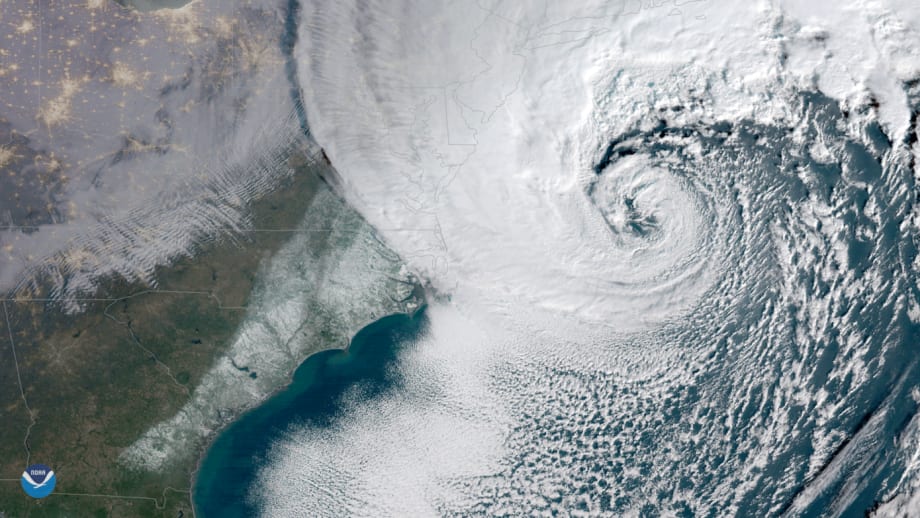
Winter Storm Grayson Photo: National Oceanic and Atmospheric Administration
Winter Storm Grayson Photo: National Oceanic and Atmospheric Administration
A massive winter storm has slammed the East Coast from Florida to Maine, bringing with it snow, high winds, and frigid temperatures that are creating difficult traveling conditions across a wide swath of the Northeast.
Commonly referred to as a Bomb Cyclone type of weather event, Winter Storm Grayson quickly grew into one of the most powerful East Coast winter weather phenomenons in recent history. It includes a dangerous mix of snow, thunderstorms, and winds of up to 80 miles per hour, and states up and down the Eastern Seaboard have braced for blizzard conditions.
New York Governor Andrew Cuomo declared a state of emergency for parts of the state in advance of the storm's main impact, with predictions of up to 11 inches of snow in some portions of the state. Up to two thirds of the flights out of the main airports in the New York region were being cancelled on Jan. 4, according to a New York Daily News report. Road traffic and public transit were also being affected, though not to the same degree.
New Jersey Governor Chris Christie also declared a state of emergency for portions of the state and closed all government offices for the day.
Southern states were also affected, with unseasonal deep freezes in places like Charleston, S.C., and Savannah, Ga. Georgia Governor Nathan Deal issued a state of emergency for coastal communities on Jan. 3. In Florida, areas that had not seen snow in nearly 30 years were given a light dusting of powder, bringing with it the specter of snow-covered palm trees.
Some seaports have also taken winter weather precautions with the Port of Virginia closing terminal gates on Jan. 4 until Friday afternoon at the earliest. The Coast Guard has also blocked incoming ships to the Chesapeake Bay area, affecting traffic to the Port of Baltimore. Terminals however, will remain open to trucks carrying goods in and out of the complex.
While the storm is fast moving and will likely be gone by Friday, it will leave extremely cold temperatures in its wake. Below zero temperatures are being forecast as far south as Jacksonville, Fla., with some East Coast cities approaching -40 degrees Fahrenheit. So far,12 deaths have been reported across the country as a result of the cold weather, according to CNN.com.
More Operations

Fleet Has a Talent Pipeline Problem. What Comes Next? | AF News Recap
Where will fleet’s next generation of leaders come from? This week, we’re looking at the industry’s talent pipeline, what certification can add to a fleet career, how to build an award-worthy track record, and the return of Automotive Fleet’s Personal Use Survey.
Read More →
Smith System Launches Driver Risk Management Program
Fleets have more driver data than ever, but identifying risky behavior doesn't necessarily correct it. Smith System's new Driver Risk Management program combines monitoring, training, and follow-up coaching to help fleets connect risk signals with driver intervention.
Read More →
Automotive Fleet Opens 2026 Personal Use Survey for Commercial Fleet Managers
Less than two weeks left! Commercial and corporate fleet managers are invited to share how their organizations handle company vehicle personal-use policies, charges, and driver eligibility.
Read More →
From AI Prompts to AI-Generated Safety Songs | AF News Recap
Can better prompts make AI more useful for fleet managers? This week, we’re breaking down smarter fleet analysis, an AI-assisted experiment that turned safety training into music, and what happened to fuel prices in August.
Read More →
How to Write Better AI Prompts for Fleet Analysis
Include these six elements in your fleet prompts to generate more relevant analysis and accurate answers.
Read More →
Fleet Meets: Eric Kilgore
This edition of the Fleet Meets series features one of the industry's best leaders driving multi-market and national operations.
Read More →
Why Reactive Fleet Management Is Becoming Too Expensive to Sustain
Research highlights a growing need for proactive management strategies to address rising costs in fleet operations effectively.
Read More →
What Your Fleet KPIs Aren’t Telling You
Tracking fleet metrics is only useful when the data leads to better decisions. This guide helps fleet leaders assess cost, utilization, and downtime more accurately, identify performance gaps, and prioritize the actions that can improve operational results.
Read More →
Hidden in Plain Sight: Fleet Compliance Risks
Fleet compliance isn't just about having policies — it's about consistently enforcing them. This practical guide reveals six hidden compliance risks common in public sector and shared fleet operations and outlines proven strategies to improve visibility, accountability, and audit readiness
Read More →
Turning Fleet Payment Data into Executive Insights
Does data alone drive results in operations?
Read More →