




States Urged to Escalate Fight Against Drugged Driving
A new report highlights the problem’s complexity and the need for states to implement best practices.
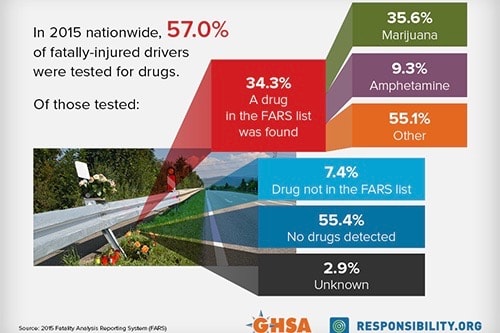
Graphic courtesy of GHSA.
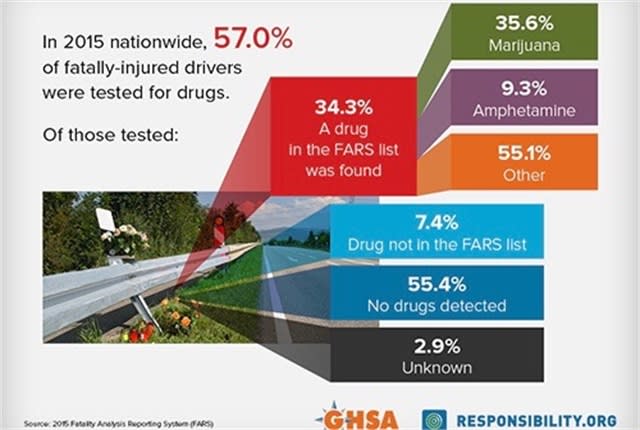
Graphic courtesy of GHSA.
To combat the festering problem of drugged driving, the Governors Highway Safety Association (GHSA) is recommending that individual states expand special law enforcement training so officers can more readily identify and arrest drug-impaired drivers.
Additionally, GHSA recommends that each state form a task force to develop a strategic plan for battling the problem and take measures to improve data collection on drug-impaired driving. These recommendations are included in a newly released report, “Drug Impaired Driving: A Guide for States.”
GHSA produced the report — an update of a 2015 document — in conjunction with the Foundation for Advancing Alcohol Responsibility (Responsibility.org).
The fight against drug-impaired driving is much more complex than the fight against drunken driving, the report stresses. Hundreds of different drugs can impair drivers, and it’s more difficult for law enforcement to detect drugged driving during roadside stops.
Moreover, when drugs are a factor in a crash, most jurisdictions fail to adequately collect and record that data. Laws regarding drug-impaired driving also vary from state to state. Also complicating drug policy efforts is the fact that individual people differ widely in how their bodies absorb and metabolize a specific drug. The effects of alcohol are simpler to assess because alcohol is quickly absorbed into the body, and impairment can be measured by blood alcohol content (BAC).
“As states across the country continue to struggle with drug-impaired driving, it’s critical that we help them understand the current landscape and provide examples of best practices so they can craft the most effective countermeasures,” said Jonathan Adkins, GHSA executive director.
The effectiveness of specialized law enforcement training has been documented. Following four successful pilot programs in 2016, this year five states will receive grants totaling $100,000.
The Illinois, Montana, Washington, West Virginia and Wisconsin highway safety offices will each use their funding to implement advanced roadside impaired driving enforcement (ARIDE) training and drug recognition expert (DRE) programs. Sixteen states and territories applied for these competitive grants. A selection committee composed of experts from around the country reviewed the applications and determined the recipients.
“As drunk driving has declined, drugged driving has increased dramatically and many of today’s impaired drivers are combining two or more substances, which has a multiplicative effect on driver impairment,” said Ralph. S. Blackman, president and CEO of Responsibility.org. “We are pleased to partner with GHSA to fill a critical gap. These training grants will prepare law enforcement to detect drug-impaired drivers and make roads safer for us all.”
The report also shares best practices. California’s efforts to form a task force could serve as a model for other states, according to the report, and New York is at the forefront of drug-impairment data collection.
In California, a committee of stakeholders is working to develop a blueprint to guide the state’s efforts to combat drug impaired driving. The plan is expected for release by the end of this year.
New York has launched a promising new data system that takes advantage of tablet computers to help law enforcement officers record investigation data on the scene. This information is transferred into a centralized system for immediate access.
“Drugged driving is a complicated issue,” said Dr. Jim Hedlund, a former senior official with the National Highway Traffic Safety Administration and the author of the report. “The more we can synthesize the latest research and share what’s going on around the country to address drug-impaired driving, the better positioned states will be to prevent it.”
More Safety
IIHS Crash Avoidance Tests Reveal Safety Gaps in Cargo Vans and Work Trucks
New crash-avoidance ratings from the Insurance Institute for Highway Safety reveal inconsistent performance among commercial vehicles, with several popular cargo vans and heavy-duty pickups struggling to avoid collisions with other vehicles and pedestrians.
Read More →
What’s Next for Fleet? Safety, AI & Industry Recognition | AF News Recap
Could your company's culture be encouraging distracted driving? This week, we're exploring how workplace expectations affect driver safety, what AI, EVs, and autonomous vehicles could mean for the future of fleet management, and how fleet professionals can strengthen their award nominations.
Read More →
Does Your Fleet's Culture Encourage Distracted Driving?
What happens when the people responsible for enforcing safety rules are the ones setting the wrong example? The answer may reveal why some of the biggest risks to fleet drivers have little to do with what's written in the employee handbook.
Read More →
Fleet Manager’s Ultimate Playbook: Navigating the New Standard in OEM Connectivity
Rising operating costs, driver safety concerns, and unplanned downtime are putting unprecedented pressure on modern fleets. Discover how fleet managers use embedded OEM connectivity and real-time vehicle data to cut TCO, prevent downtime, and protect drivers without aftermarket telematics hardware.
Read More →
From Driver Well-Being to EV Charging | AF News Recap
Mental health belongs in the fleet safety conversation. This week, we’re looking at five ways fleets can support employee well-being before a crisis, plus Holman’s expansion in Mexico, new one-day Fleet Forward passes, and why EV charging demand is outpacing infrastructure growth.
Read More →
Nexar-Nauto Merger Aims to Give Fleets Better Safety Intelligence Through Larger Driving Dataset
Stefan Heck tells Automotive Fleet that combining more than 10 billion miles of driving history with Nexar's AI models will give fleets deeper insights into driver risk and roadway conditions than either company could provide independently.
Read More →
Don't Wait for a Crisis: 5 Ways to Build Mental Health Into Your Fleet Safety Program
For Suicide Prevention Month, fleet and safety leaders have an opportunity to put mental health where it belongs: at the center of workplace safety.
Read More →
How Camera Data Can Strengthen a Fleet’s Insurance Renewal
Insights from a commercial insurance carrier and a broker show how fleets can turn video telematic data, driver coaching, and improved claims results into a stronger case at insurance renewal.
Read More →
The Safest Fleets Aren’t the Ones with the Most Technology
You’ve made the telematics investment. Here’s how to capture the other half of its value and build the safest fleet on the road.
Read More →
Hidden in Plain Sight: Fleet Compliance Risks
Fleet compliance isn't just about having policies — it's about consistently enforcing them. This practical guide reveals six hidden compliance risks common in public sector and shared fleet operations and outlines proven strategies to improve visibility, accountability, and audit readiness
Read More →