




“As of right now, what they’re asking for doesn’t exist."
Southern California Mayors Aim for Zero Emissions at Ports
The mayors of Los Angeles and Long Beach, California, are aiming for zero emissions at the ports or Los Angeles and Long Beach by 2035 as part of their commitment to adopting the Paris Climate Agreement goals in their cities.
by Staff
June 19, 2017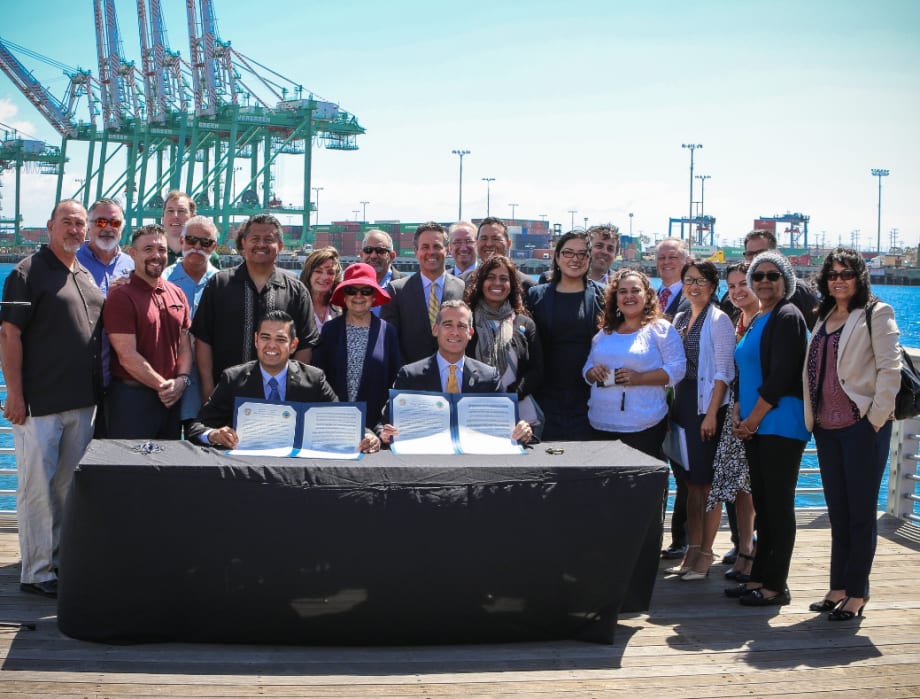
(Left) Long Beach Mayor Robert Garcia and L.A. Mayor Eric Garcetti signed a joint declaration to set goals for the transition to zero emissions at Southern California ports. Photo: Office of Mayor Eric Garcetti
3 min to read
(Left) Long Beach Mayor Robert Garcia and L.A. Mayor Eric Garcetti signed a joint declaration to set goals for the transition to zero emissions at Southern California ports.Photo: Office of Mayor Eric Garcetti
The mayors of Los Angeles and Long Beach, California, are aiming for zero emissions at the ports or Los Angeles and Long Beach by 2035 as part of their commitment to adopting the Paris Climate Agreement goals in their cities.
Mayor Eric Garcetti of Los Angeles and Mayor Robert Garcia of Long Beach signed a joint declaration to set goals for the twin ports to make the transition to zero emissions in their Clean Air Action Plan. The CAAP will include new investments in clean technology, expanding emissions reductions, and launching a zero-emissions drayage truck pilot in the next few years.
“Our ports are the engines that power our economy — they must also be the forces that drive our region toward a greener, more sustainable future,” said Garcetti. “I am proud to stand with my fellow Climate Mayor Robert Garcia today, as we renew our commitment to cleaning our air, and moving boldly toward our goal of zero emissions goods movement at the ports.”
A spokesman for the Harbor Trucking Association, an advocacy group of intermodal carriers in California, is supportive of clean air technology but told HDT the group is skeptical that the goals stated by the two mayors were actually achievable.
“We’re not against clean technology or clean air, but you need to be careful in the goals you set,” said Weston LaBar, the executive director of the HTA. “You can’t set hard goals and milestones to get to zero emissions when the technology does not really exist today.”
The two mayors also launched the Green Ports Collaborative, a program aimed at creating shared environmental standards for ports and cities in the U.S., and to demonstrate demand for zero emissions equipment. The mayors’ declaration also puts in place a CAAP implementation Stakeholder Advisory Group, which will bring together stakeholders from the government, maritime industry, utility and community leaders, to oversee the 2017 update.
The HTA states that the technology has a long way to go before the zero emissions goals and deadlines can be realized. It says the technology needs to be available and commercially viable before trucking companies should be held accountable for missing emissions goals.
“As of right now, what they’re asking for doesn’t exist,” said LaBar. "You can't penalize the trucking community in the form of bans or fines if there's no suitable technology out there. It needs to be an affordable technology that the industry can really find a return on investment, otherwise the whole system breaks down."
The two ports are the busiest container ports in the U.S., and play a vital role in achieving cleaner air and emissions goals for the state. Nearly 40% of the cargo that comes to the U.S. moves through the Southern California ports complex.
More Operations

Fleet Has a Talent Pipeline Problem. What Comes Next? | AF News Recap
Where will fleet’s next generation of leaders come from? This week, we’re looking at the industry’s talent pipeline, what certification can add to a fleet career, how to build an award-worthy track record, and the return of Automotive Fleet’s Personal Use Survey.
Read More →
Smith System Launches Driver Risk Management Program
Fleets have more driver data than ever, but identifying risky behavior doesn't necessarily correct it. Smith System's new Driver Risk Management program combines monitoring, training, and follow-up coaching to help fleets connect risk signals with driver intervention.
Read More →
Automotive Fleet Opens 2026 Personal Use Survey for Commercial Fleet Managers
Less than two weeks left! Commercial and corporate fleet managers are invited to share how their organizations handle company vehicle personal-use policies, charges, and driver eligibility.
Read More →
From AI Prompts to AI-Generated Safety Songs | AF News Recap
Can better prompts make AI more useful for fleet managers? This week, we’re breaking down smarter fleet analysis, an AI-assisted experiment that turned safety training into music, and what happened to fuel prices in August.
Read More →
How to Write Better AI Prompts for Fleet Analysis
Include these six elements in your fleet prompts to generate more relevant analysis and accurate answers.
Read More →
Fleet Meets: Eric Kilgore
This edition of the Fleet Meets series features one of the industry's best leaders driving multi-market and national operations.
Read More →
Why Reactive Fleet Management Is Becoming Too Expensive to Sustain
Research highlights a growing need for proactive management strategies to address rising costs in fleet operations effectively.
Read More →
Sponsored•August 12, 2026
What Your Fleet KPIs Aren’t Telling You
Tracking fleet metrics is only useful when the data leads to better decisions. This guide helps fleet leaders assess cost, utilization, and downtime more accurately, identify performance gaps, and prioritize the actions that can improve operational results.
Read More →
Sponsored•August 7, 2026
Hidden in Plain Sight: Fleet Compliance Risks
Fleet compliance isn't just about having policies — it's about consistently enforcing them. This practical guide reveals six hidden compliance risks common in public sector and shared fleet operations and outlines proven strategies to improve visibility, accountability, and audit readiness
Read More →
Turning Fleet Payment Data into Executive Insights
Does data alone drive results in operations?
Read More →