




Sono Motors Launches Solar Bus Trailer
In partnership with the Munich Transport Company MVG, Sono Motors’ solar bus trailer can offer a possible savings of up to 2,500 liters of diesel per year as well as reducing local carbon dioxide emissions by more than 6.5 metric tons per bus.

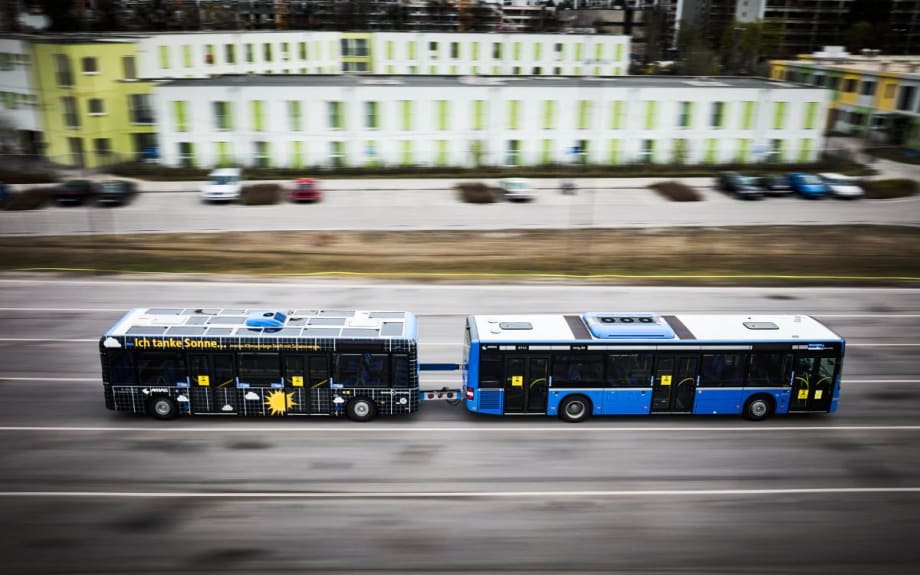
On Sono Motors’ solar bus trailer, 20 special photovoltaic (PV) modules provide over 2,000 watts of energy to power the vehicle’s battery as well as the trailer’s steering system.
Photo: Sono Motors
Sono Motors has launched its solar technology to public transport. In partnership with the Munich Transport Company MVG, the solar bus trailer will hit the roads in Munich soon, testing the energy yields as well as the potential of the technology in daily operation.
Offering possible savings of up to 2,500 liters of diesel per year and an annual local carbon dioxide saving potential of more than 6.5 metric tons per bus, Sono Solar Technology contributes to climate protection and the reduction of inner-city greenhouse gas emissions, according to the company.
Twenty semi-flexible special photovoltaic (PV) modules provide over 2,000 watts of energy to power the vehicle’s battery as well as the trailer’s steering system.
“The partnership with MVG illustrates the enormous potential of our unique solar technology, which is now being used for the first time in the company's history on public transport,” said Laurin Hahn, co-founder and CEO of Sono Motors. “This is a milestone in Sono Motors’ mission to make every vehicle solar.”
“Especially in times of rising energy prices and increasing urban area emission regulations, our solar technology offers great added value for public transport operators. City buses and coaches, whether electric or diesel-powered, offer a lot of space and are out on the road every day. The first solar bus trailer for MVG will hit the streets of Munich in the future and allow MVG passengers to experience solar mobility in daily use,” continued Hahn.
For a medium-sized fleet of around 300 buses, calculations show the possibility of savings of up to 2,000 metric tons of carbon dioxide per year, according to Sono. Further increases are possible in the future, as both the solar cells and the power electronics are expected to become more efficient.
The solar technology was developed and tested specifically for use on buses. In addition to the solar installation, which is optimized for vehicle integration, it also includes electrical integration by means of the power electronics developed by Sono’s MPPT central unit called MCU. The solar charge controller has an intelligent algorithm that optimizes the PV modules’ energy yields. The modules cover a total area of 12 square meters and supply the 24-V battery with over 2,000 watts. In this case, the generated solar energy is used to operate the HVAC system (heating, ventilation, air conditioning) and to support the trailer steering system.
"The photovoltaic system on our bus trailer now allows us to test under real conditions how well the power generation works and whether there are perhaps routes in our network that are better suited than others for this type of power generation,” said Veit Bodenschatz, managing director and head of MVG’s Bus Division. “The question of what energy savings can be achieved by using solar energy are, of course, particularly exciting against the background of current fuel and energy prices."
Sono’s solar technology has been developed to be integrated and licensed into a range of vehicles.
"When e-buses are factory-equipped with our solar technology, additional range can immediately be generated through solar energy on the roof and sides,” said Hahn. “This not only reduces the standstill times for charging processes, but also protects the battery through a constant charging process. As a result, the e-bus can be operated longer.”
After technical approval by supervisory authorities, the bus trailer will go into regular service for Munich residents, according to Sono.
More Fleet Forward


Erin Gilchrist Receives Mike Antich Spirit of Fleet Award
Last week at AFLA in Vegas, Erin Gilchrist received the inaugural, brand-new Spirit of Fleet Award.
Read More →
Dominika Leja Named the 2026 Fleet Manager of the Year
The AstraZeneca associate director of fleet was recognized for her leadership in fleet electrification, cost savings, and operational transformation.
Read More →
Jamie McKay Named the 2026 Fleet Visionary Award Winner
The Aptive Pest Control fleet manager was recognized for her approach to operations, data, lifecycle management, and driver needs.
Read More →
Fleet Forward Conference Introduces One-Day Passes for 2026
New one-day registration gives fleet professionals the flexibility to attend Tuesday, Wednesday, or Thursday, with passes available for $199 through Sept. 18.
Read More →
Vibe Coding: When Fleet Managers Become Software Builders
Five fleet professionals — none with programming skills — discuss how they’re using AI to build fleet solutions in-house and in a fraction of the time.
Read More →
Fleet Forward Conference Tackles Fleet Industry’s Growing Leadership Gap
This session will examine succession planning, knowledge transfer, and the skills the next generation of fleet leaders will need as veteran professionals leave the industry.
Read More →
2026 Fleet Manager of the Year Finalists Announced
Who are the 2026 Fleet Manager of the Year finalists?
Read More →
John Rossant to Deliver Opening Keynote at 2026 Fleet Forward Conference
The CoMotion founder will draw on developments across Europe, China, the Middle East, and other international markets to identify trends that could influence how U.S. fleets plan for the coming decade.
Read More →
How to Build Custom Fleet Tools With AI and Vibe Coding [Webinar]
A new Automotive Fleet webinar explores how fleet managers are using AI and vibe coding to automate routine work and create simple operational tools without traditional programming skills.
Read More →