




Senators’ Highway Deal: 6-Year Bill Funded for 3
Two top Senators reached agreement today to put forward a bipartisan, multi-year highway bill that would fund projects for the next three years — leaving it to the next Congress to determine how to fund its final three years.

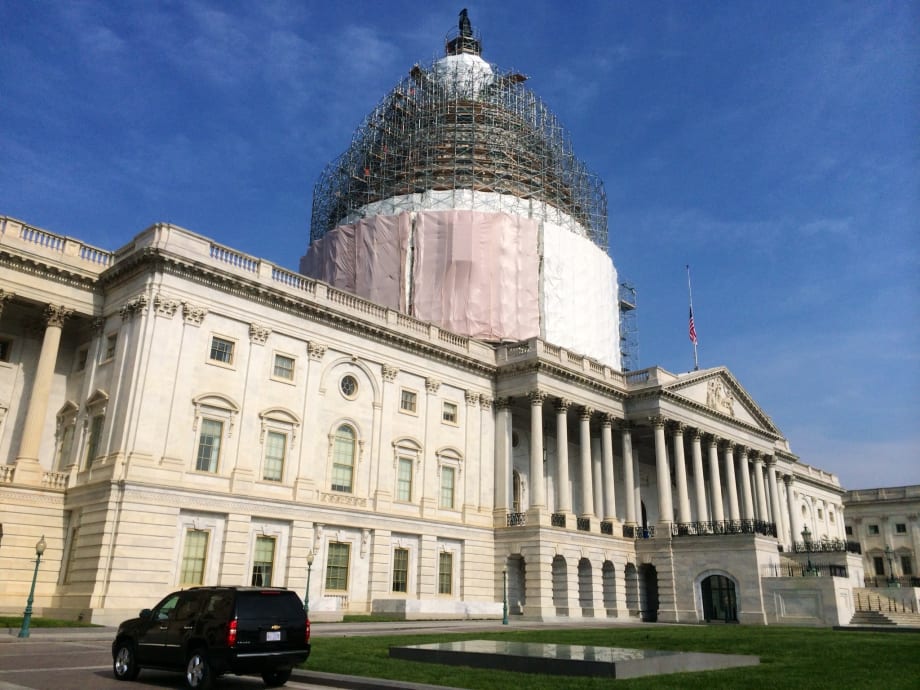
U.S. Capitol Photo: David Cullen
U.S. Capitol Photo: David Cullen
Two top Senators reached agreement Tuesday morning to put forward a bipartisan, multi-year highway bill that would fund projects for the next three years— leaving it to the next Congress to determine how to fund its final three years.
However, in the latest development, a motion introduced Tuesday afternoon at 4 pm EDT to begin debate on the bill was blocked, 41-56. Sixty votes were needed to move forward.
Addressing the Senate after that vote, Senate Majority Leader Mitch McConnell (R-KY) applauded the bipartisan effort that went into framing the measure and stated that the chamber will be in session this Saturday and Sunday if that's what it takes to send the bill to the House.
"I can't say the House will pass a long-term bill, and without raising the gas tax, but it is more appealling [to do that] than doing this again in December," said McConnell
The deal that brought the bill forward had been put together in the past few days by Sen. McConnell and Sen. Barbara Boxer (D-CA), Ranking Member of the Committee on Environment & Public Works.
Also speaking on the Senate floor after the procedural vote failed, Sen. Boxer urged her colleagues to keep "an eye on the prize... 800,000 construction workers are not back to work; seven states are not doing anything; in California, there was a bridge collapse two days ago."
Boxer pointed out that 68 organizations "from labor to business groups to governors have asked us to move forward [with a long-term highway bill]. They agree that passing another short-term extension is death by a thousand cuts. I think there wil be huge momentum [for a long-term bill in the House] if we can move this bill in a bipartisan fashion."
Neither senator has released details of their agreement. Regardless, one thing is certain: The McConnell-Boxer proposal differs sharply from the measure to fund highway and infrastructure expenditures through Dec. 18 that was passed by the full House last week.
"This is a six-year highway authorization that will allow planning for important long-term projects around the country, and the bill provides three years of guaranteed funding for the highway trust," McConnell said, when speaking about the deal on the Senate floor Tuesday morning.
"Senators from both parties know that a long-term highway bill is in the best interest of our country," he added. "So we'll continue working together to get a good one passed. Thanks to the dedication of both Republican and Democratic Senators and their staffs, I'm hopeful we will."
More Operations
Here's When You Should Make an Exception to Fleet Policy
Fleet policies are designed to create consistency, but not every driver or situation fits neatly within standard rules.
Read More →
AI-Native or AI-Acquired: What Should Fleet Managers Look for in an AI Platform?
Six questions can help fleet managers look beyond AI marketing claims to evaluate integration, data access, and real-world operational performance.
Read More →
A buyer's guide to fleet management software in 2027
Buying fleet management software in 2027 means looking beyond features and price. As fleet operations, technology and expectations evolve, this guide explores what today’s fleet professionals should consider when choosing a system that can deliver value now and adapt to what comes next.
Read More →

What Will Shape the Next Era of Fleet Management?
EVs, AI, and autonomous vehicles are reshaping fleet management. Discover what’s ahead—and how fleet leaders can prepare for the next era.
Read More →
How Fleets Can Recruit and Train Veterans for Technician Roles
Here's how the technician shortage has affected uptime for fleets, and what to do about it.
Read More →
Avis Budget Group Deploys Neology Toll Management Technology Across Major Brands
Neology’s neoFleet platform will manage toll transactions and toll-authority operations for vehicles across Avis, Budget, Payless, Budget Truck and Zipcar.
Read More →
Fleet Personal-Use Charges Edge Higher in 2026
Nearly eight in 10 surveyed fleets allow personal use of company vehicles, while just over half of respondents report charging employees for the privilege.
Read More →
The Future of Fleet + What’s Changing Right Now | AF News Recap
Could developments overseas offer a preview of what’s coming for U.S. fleets? This week, we’re looking at the future of AI, autonomy, and electrification, plus Ford Pro’s new certified pre-owned program, smarter vehicle offboarding, and a new way for fleets to manage toll expenses.
Read More →
How to Handle Vehicle Offboarding
What do fleet managers need to do when a driver leaves?
Read More →
Fleet Manager’s Ultimate Playbook: Navigating the New Standard in OEM Connectivity
Rising operating costs, driver safety concerns, and unplanned downtime are putting unprecedented pressure on modern fleets. Discover how fleet managers use embedded OEM connectivity and real-time vehicle data to cut TCO, prevent downtime, and protect drivers without aftermarket telematics hardware.
Read More →