




Senate to Consider 6-Year, $350 Billion Highway Bill
A bipartisan effort by four key Senators led the Senate Environment & Public Works Committee on June 24 to recommend that the full Senate consider a six-year bill that calls for spending $350 billion on surface-transportation infrastructure.

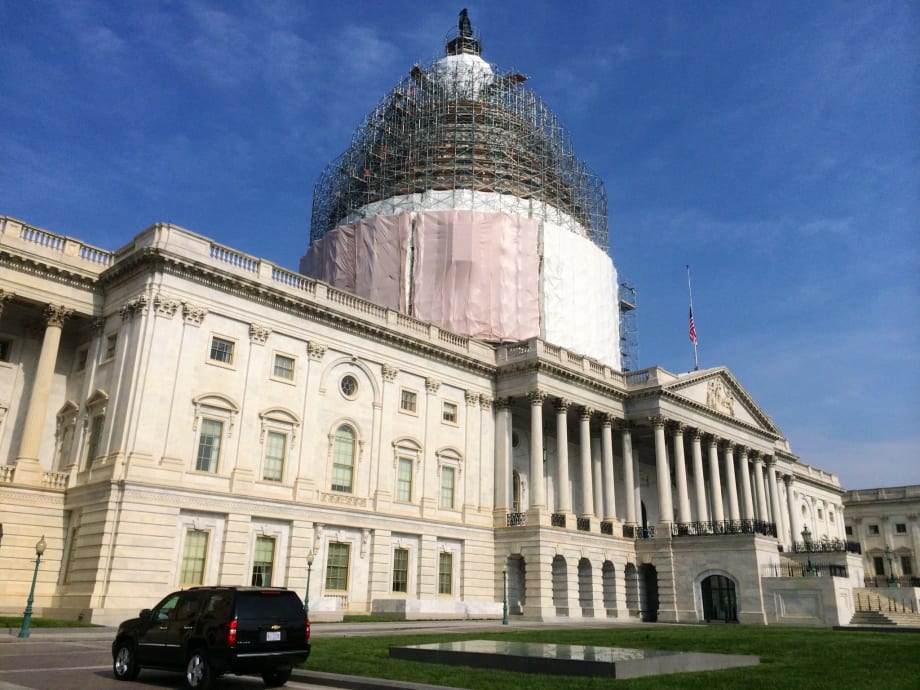
Senate bill would provide $350 billion over six years for surface transportation. Photo: David Cullen
Senate bill would provide $350 billion over six years for surface transportation.Photo: David Cullen
A bipartisan effort by four key Senators led the Senate Environment & Public Works (EPW) Committee on June 24 to recommend that the full Senate consider a six-year bill that calls for spending $350 billion (including $13.5 billion for national freight-related building projects) on surface-transportation infrastructure.
The Developing a Reliable and Innovative Vision for the Economy (DRIVE) Act (S. 1647) was introduced by Sens. Jim Inhofe (R-OK), Chairman of the EPW Committee; Barbara Boxer (D-CA), EPA Ranking Member; David Vitter (R-LA), Chairman of the EPW Subcommittee on Transportation and Infrastructure; and Tom Carper (D-DE), senior member of the EPW Committee.
However, even if the DRIVE Act is passed by the Senate and then the House, there’s no indication yet that Capitol Hill will come up with the money to fund the measure marked up by EPW— let alone before the current legislation that funds the Highway Trust Fund expires on July 31.
On the other hand, as the EPW’s bill moves in the Senate, it may serve as a tangible outline that will help give shape to a parallel long-term funding bill. As reported by The Washington Post, a senior Senate staffer who worked on the EPW measure pointed out that “There’s a cart-and-horse issue here, and sometimes it’s better to say what you’re buying before you write the check. Our view is that you spell out a framework of what you get for the money instead of talking about everything in abstract.”
Indeed, in a statement praising Chairman Inhofe and Ranking Member Boxer for making “a good start on crafting a bipartisan six-year transportation bill,” Secretary of Transportation Anthony Foxx said that EPW had “advanced the ball toward policy and funding goals that the Administration put forth in the GROW AMERICA Act, but there is still much work to be done."
Regarding that work, he contended in particular that infrastructure funding needs to be raised “to a level that will adequately address maintenance backlogs and needed expansion"
Foxx also remarked that, “Unlike last year, when progress stopped at this point, I hope that the EPW committee’s work this week is just the beginning– not the end– of actions by Congress to address America’s critical transportation issues and bring funding in line with our country’s needs."
“The DRIVE Act will provide states and local communities with the certainty they deserve to plan and construct infrastructure projects efficiently,” said Inhofe in a statement. “This bipartisan bill also contains the hallmark accomplishment of a new freight program to prioritize federal spending on the facilities that will most directly benefit our economy, in addition to prioritizing federal dollars towards bridge safety and the interstate system.”
Boxer observed that “The clock is ticking, and action in the EPW Committee is a major first step -- the other [Capitol Hill] committees also need to act” to fund the measure. “I’m certainly proud to say that we’ve come up with a workable, passable bipartisan bill that will make the necessary updates that our nation’s roads and bridges desperately need,” noted Vitter.
“In order to make the DRIVE Act a reality, we must provide full funding so that city, state and local governments have the certainty they need to make the investments we’ve outlined in this bill,” Carper stated. “I am steadfast in my dedication to working with my colleagues in Congress, Republicans and Democrats alike, to find the bipartisan funding compromise Americans expect and deserve."
More Operations

How Fleets Can Recruit and Train Veterans for Technician Roles
Here's how the technician shortage has affected uptime for fleets, and what to do about it.
Read More →
Avis Budget Group Deploys Neology Toll Management Technology Across Major Brands
Neology’s neoFleet platform will manage toll transactions and toll-authority operations for vehicles across Avis, Budget, Payless, Budget Truck and Zipcar.
Read More →
Fleet Personal-Use Charges Edge Higher in 2026
Nearly eight in 10 surveyed fleets allow personal use of company vehicles, while just over half of respondents report charging employees for the privilege.
Read More →
The Future of Fleet + What’s Changing Right Now | AF News Recap
Could developments overseas offer a preview of what’s coming for U.S. fleets? This week, we’re looking at the future of AI, autonomy, and electrification, plus Ford Pro’s new certified pre-owned program, smarter vehicle offboarding, and a new way for fleets to manage toll expenses.
Read More →
How to Handle Vehicle Offboarding
What do fleet managers need to do when a driver leaves?
Read More →
Fleet Manager’s Ultimate Playbook: Navigating the New Standard in OEM Connectivity
Rising operating costs, driver safety concerns, and unplanned downtime are putting unprecedented pressure on modern fleets. Discover how fleet managers use embedded OEM connectivity and real-time vehicle data to cut TCO, prevent downtime, and protect drivers without aftermarket telematics hardware.
Read More →
U.S. Bank Adds Verra Mobility Toll Management to Voyager Fleet Platform
The integration allows U.S. Bank Voyager fleet customers to manage toll payments and violations alongside fuel, EV charging and maintenance expenses.
Read More →
ADAS Prevents Crashes. But Repairs Cost More | AF News Recap
ADAS-equipped vehicles may crash less often, but they can cost more when they do. This week, we’re breaking down what that tradeoff means for fleets, plus Subaru’s first Forester Wilderness Hybrid, Nissan’s new e-POWER Rogue, and why Calstart has become Catalyst Mobility.
Read More →
Moventum Fleet Management Names Mark Iorillo Head of Sales
Iorillo brings nearly 20 years of fleet management and sales experience to the role, including previous positions at Element Fleet Management, CEI, Donlen and Ryder.
Read More →
Fleet Has a Talent Pipeline Problem. What Comes Next? | AF News Recap
Where will fleet’s next generation of leaders come from? This week, we’re looking at the industry’s talent pipeline, what certification can add to a fleet career, how to build an award-worthy track record, and the return of Automotive Fleet’s Personal Use Survey.
Read More →