




Self-Driving Vehicle Taps IBM’s Watson
Local Motors debuts an autonomous vehicle that uses IBM’s Watson Internet of Things to analyze and learn transportation data and to verbally interact with passengers.
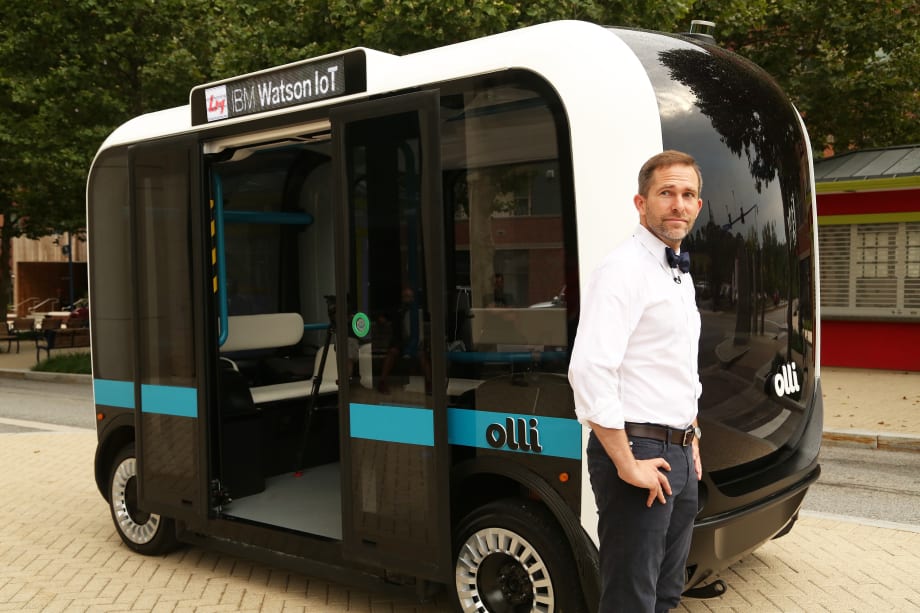
Local Motors CEO John B. Rogers Jr. introduces Olli, an autonomous vehicle, on June 16 in Fort Washington, Md. Photo courtesy of IBM.
Local Motors CEO John B. Rogers Jr. introduces Olli, an autonomous vehicle, on June 16 in Fort Washington, Md. Photo courtesy of IBM.
Local Motors, a vehicle technology integrator, recently introduced an electric-powered, self-driving vehicle that uses the cloud-based cognitive computing capabilities of IBM Watson Internet of Things.
The vehicle employs IBM Watson IoT to analyze and learn from high volumes of transportation data, produced by more than 30 sensors embedded throughout the vehicle, according to IBM. Dubbed Olli, the vehicle was unveiled during the opening of a new Local Motors facility in National Harbor, Md.
Olli, which can carry up to 12 people, has begun using public roads in the Washington D.C. area. Later this year, the vehicle will begin using roads in Miami-Dade County and Las Vegas, IBM said.
“Olli with Watson acts as our entry into the world of self-driving vehicles, something we’ve been quietly working on with our co-creative community for the past year,” said Local Motors CEO John B. Rogers Jr. “We are now ready to accelerate the adoption of this technology and apply it to nearly every vehicle in our current portfolio and those in the very near future.”
Using the Local Motors open vehicle development process, sensors will be added and adjusted continuously as passenger needs and local preferences are identified.
Furthermore, the platform takes advantage of four Watson developer application programming interfaces — Speech to Text, Natural Language Classifier, Entity Extraction and Text to Speech — to enable seamless interactions between the vehicle and passengers.
Passengers will be able to interact conversationally with Olli while traveling from point A to point B, discussing topics such as how the vehicle works, where they’re going, and Olli's specific driving decisions.
Watson empowers Olli to understand and respond to passengers’ questions as they enter the vehicle, including about destinations (“Olli, can you take me downtown?”) or specific vehicle functions (“How does this feature work?” or even “Are we there yet?”).
Passengers can also ask for recommendations on local destinations such as popular restaurants or historical sites based on analysis of personal preferences. These interactions with Olli are designed to create more comfortable, intuitive, and interactive experiences for riders as they journey in autonomous vehicles, according to IBM.
“Cognitive computing provides incredible opportunities to create unparalleled, customized experiences for customers, taking advantage of the massive amounts of streaming data from all devices connected to the Internet of Things, including an automobile’s myriad sensors and systems,” said Harriet Green, general manager of IBM Watson Internet of Things, commerce and education.
As part of Olli’s debut, Local Motors opened its new National Harbor facility in Maryland to serve as a public place where co-creation can flourish and vehicle technologies can advance. The company’s 3D-printed cars are on display, along with a large-scale 3D printer and an interactive experience designed to showcase what the future of the nation’s capital might look like.
The first Olli will remain in National Harbor this summer, and the public will be able to interact with it during select times over the next several months. Production of additional Ollies is taking place at Local Motors headquarters near Phoenix.
More Safety

What’s Next for Fleet? Safety, AI & Industry Recognition | AF News Recap
Could your company's culture be encouraging distracted driving? This week, we're exploring how workplace expectations affect driver safety, what AI, EVs, and autonomous vehicles could mean for the future of fleet management, and how fleet professionals can strengthen their award nominations.
Read More →
Does Your Fleet's Culture Encourage Distracted Driving?
What happens when the people responsible for enforcing safety rules are the ones setting the wrong example? The answer may reveal why some of the biggest risks to fleet drivers have little to do with what's written in the employee handbook.
Read More →
Fleet Manager’s Ultimate Playbook: Navigating the New Standard in OEM Connectivity
Rising operating costs, driver safety concerns, and unplanned downtime are putting unprecedented pressure on modern fleets. Discover how fleet managers use embedded OEM connectivity and real-time vehicle data to cut TCO, prevent downtime, and protect drivers without aftermarket telematics hardware.
Read More →
From Driver Well-Being to EV Charging | AF News Recap
Mental health belongs in the fleet safety conversation. This week, we’re looking at five ways fleets can support employee well-being before a crisis, plus Holman’s expansion in Mexico, new one-day Fleet Forward passes, and why EV charging demand is outpacing infrastructure growth.
Read More →
Nexar-Nauto Merger Aims to Give Fleets Better Safety Intelligence Through Larger Driving Dataset
Stefan Heck tells Automotive Fleet that combining more than 10 billion miles of driving history with Nexar's AI models will give fleets deeper insights into driver risk and roadway conditions than either company could provide independently.
Read More →
Don't Wait for a Crisis: 5 Ways to Build Mental Health Into Your Fleet Safety Program
For Suicide Prevention Month, fleet and safety leaders have an opportunity to put mental health where it belongs: at the center of workplace safety.
Read More →
How Camera Data Can Strengthen a Fleet’s Insurance Renewal
Insights from a commercial insurance carrier and a broker show how fleets can turn video telematic data, driver coaching, and improved claims results into a stronger case at insurance renewal.
Read More →
The Safest Fleets Aren’t the Ones with the Most Technology
You’ve made the telematics investment. Here’s how to capture the other half of its value and build the safest fleet on the road.
Read More →
Hidden in Plain Sight: Fleet Compliance Risks
Fleet compliance isn't just about having policies — it's about consistently enforcing them. This practical guide reveals six hidden compliance risks common in public sector and shared fleet operations and outlines proven strategies to improve visibility, accountability, and audit readiness
Read More →
NETS Sets 2026 Fleet Safety Benchmark Conference for Indianapolis
The Sept. 15–17 program will feature fleet benchmarking data, case studies, emerging technologies, and implementation strategies while running alongside the NSC Safety Congress & Expo.
Read More →