





Related: July 4 Remains Deadliest Driving Day
Safety Council Grades States on Safety Policies
In the category of road safety, the top five performers are Illinois, Louisiana, Washington D.C., Delaware and Maine.
June 28, 2017
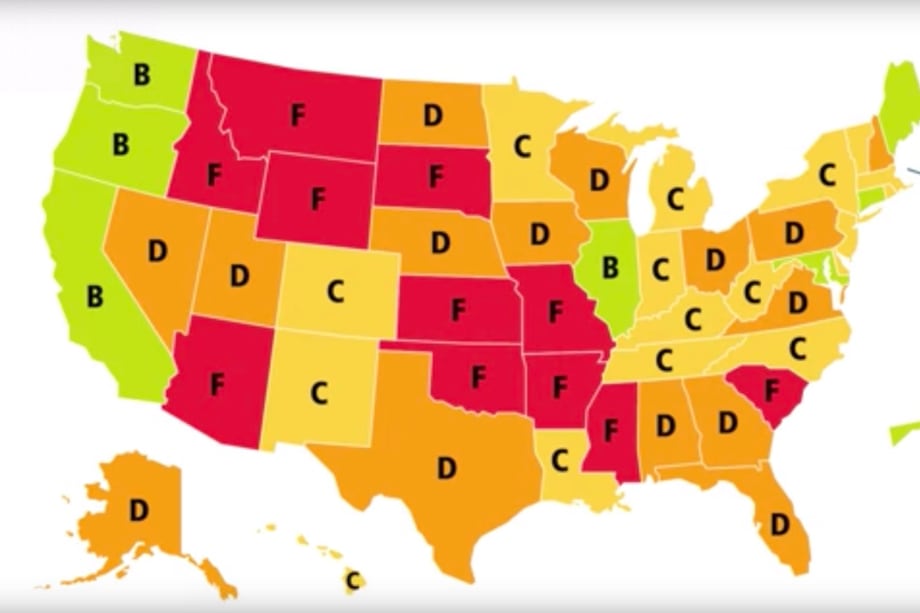
Photo: NSC
3 min to read
None of the 50 states deserves an A grade for its overall safety policies, a new report from the National Safety Council concluded. But seven states drew an overall B grade from the council for their efforts in preventing injury and death on roads, in the home and community, and at the workplace.
The states that earned an overall B grade from the National Safety Council (NSC) are California, Connecticut, Illinois, Maine, Maryland, Oregon, and Washington. Washington D.C., also warranted a B, according to the NSC’s “State of Safety” report.
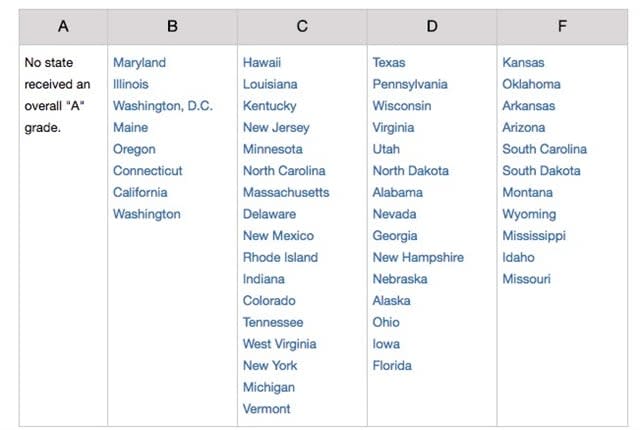
Overall safety grades for all 50 states and the District of Columbia. (These grades take into account policies that promote safety on roads, at home and in the community, and at the workplace.)
In the category of road safety, the report’s top five performers are Illinois, Louisiana, Washington D.C., Delaware a,nd Maine. The bottom five states in this category are Wyoming, Arizona, Missouri, South Dakota, and Montana.
An estimated 40,200 people died on U.S. roads in 2016, making motor vehicle crashes a leading cause of unintentional death in the U.S. — second only to drug overdoses.
To judge each state’s efforts to promote road safety, NSC looked at policy and legislation related to a wide range of risk factors. These factors included fatigue, alcohol use, seat belt use, speeding, and distraction. Also considered were laws about child passengers, teen drivers, drivers 65 and older, bicyclists, motorcyclists, and pedestrians.
The report stressed that states have a major role to play in ensuring safe roads.
“A comprehensive road safety approach that integrates laws, enforcement, and driver education can shift culture over time so safety becomes the norm, and safe behaviors become customary,” the report said.
While judging efforts to prevent alcohol-impaired driving, NSC gave the lowest grades to both Montana and Michigan. This subcategory’s criteria included the presence of a state sobriety checkpoint program, ignition interlock requirements for all first-time and repeat DUI offenders, administrative 90-plus-day license revocation for drivers who test above .08 blood alcohol content or who refuse the test, and a ban on open containers for drivers and passengers.
The report found only four states — California, Texas, Louisiana, and New Jersey — to be “on track” with their seat belt policy. All other states lagged behind. The NSC advocates for primary-enforcement seat belt laws that cover all occupants and seating positions.
The worst performers in the fight against distracted driving, according to the report, are Montana, Arizona, Missouri, and Florida. The NSC evaluated states based on whether they have a total ban on cell phone use for teens and novice drivers and a texting ban for all drivers.
In the report’s evaluation of state efforts to prevent dangerous vehicle speeds, the winners are Iowa and Illinois. Additionally, California is the leading state in the regulation of teen drivers, and Oregon is the leader in protecting motorcyclists, bicyclists, and pedestrians. Oklahoma and Tennessee are the leaders in protecting child passengers, according to the report.
More Safety

Sponsored•October 1, 2026
Fleet Manager’s Ultimate Playbook: Navigating the New Standard in OEM Connectivity
Rising operating costs, driver safety concerns, and unplanned downtime are putting unprecedented pressure on modern fleets. Discover how fleet managers use embedded OEM connectivity and real-time vehicle data to cut TCO, prevent downtime, and protect drivers without aftermarket telematics hardware.
Read More →
From Driver Well-Being to EV Charging | AF News Recap
Mental health belongs in the fleet safety conversation. This week, we’re looking at five ways fleets can support employee well-being before a crisis, plus Holman’s expansion in Mexico, new one-day Fleet Forward passes, and why EV charging demand is outpacing infrastructure growth.
Read More →
Nexar-Nauto Merger Aims to Give Fleets Better Safety Intelligence Through Larger Driving Dataset
Stefan Heck tells Automotive Fleet that combining more than 10 billion miles of driving history with Nexar's AI models will give fleets deeper insights into driver risk and roadway conditions than either company could provide independently.
Read More →
Don't Wait for a Crisis: 5 Ways to Build Mental Health Into Your Fleet Safety Program
For Suicide Prevention Month, fleet and safety leaders have an opportunity to put mental health where it belongs: at the center of workplace safety.
Read More →
How Camera Data Can Strengthen a Fleet’s Insurance Renewal
Insights from a commercial insurance carrier and a broker show how fleets can turn video telematic data, driver coaching, and improved claims results into a stronger case at insurance renewal.
Read More →
The Safest Fleets Aren’t the Ones with the Most Technology
You’ve made the telematics investment. Here’s how to capture the other half of its value and build the safest fleet on the road.
Read More →
Sponsored•August 7, 2026
Hidden in Plain Sight: Fleet Compliance Risks
Fleet compliance isn't just about having policies — it's about consistently enforcing them. This practical guide reveals six hidden compliance risks common in public sector and shared fleet operations and outlines proven strategies to improve visibility, accountability, and audit readiness
Read More →
NETS Sets 2026 Fleet Safety Benchmark Conference for Indianapolis
The Sept. 15–17 program will feature fleet benchmarking data, case studies, emerging technologies, and implementation strategies while running alongside the NSC Safety Congress & Expo.
Read More →
Off-the-Job Crashes Account for 43% of Employers’ $61.7 Billion Crash Burden
NETS quantifies costs dispersed across fleet, risk, HR, and other departments while providing new per-crash benchmarks for employers.
Read More →
Ram Recalls More Than 1.27 Million 1500 Pickups for Seat Belt Anchor Issue
The recall affects certain 2019-2026 Ram 1500 pickups that may have improperly attached second-row seat belt buckle anchors.
Read More →