





Related: Improving Driver Retention Practices During a Pandemic
Roadway Fatalities Rise 18.4% in First Half of 2021
New data from the National Highway Traffic Safety Administration paints a grim picture of our nation’s roadways.
November 1, 2021
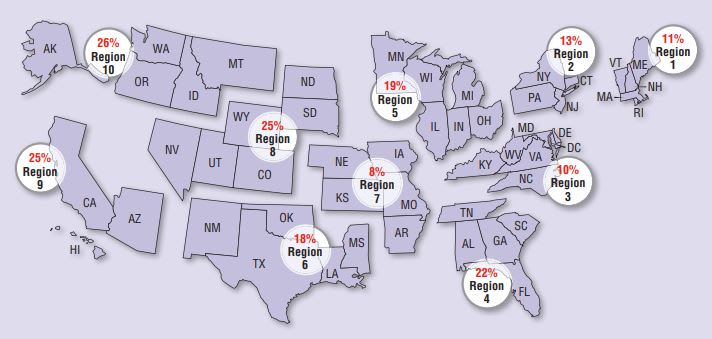
This chart shows percentage change in estimated fatalities in the first half of 2021 from estimated fatalities in the same half of 2020, by NHTSA region.
Image courtesy of NHTSA.
3 min to read
Approximately 20,160 people lost their lives in motor vehicle crashes in the first half of 2021, up 18.4% over 2020 and the largest number of projected fatalities in that time period since 2006.
The National Highway Traffic Safety Administration released the new data on Oct. 28, and the reaction was grim. The National Safety Council released a statement saying the fatality estimates “paint a dark picture of the state of safety on our nation’s roadways.” United States Transportation Secretary Pete Buttigieg called the traffic deaths “a crisis” that we cannot and should not accept as simply a part of everyday life.
Rounding out the roadway picture and adding further context, preliminary data from the Federal Highway Administration show that vehicle miles traveled in the first half of 2021 increased by about 173.1 billion miles, or about 13%. The fatality rate for the first half of 2021 increased to 1.34 fatalities per 100 million VMT, up from the projected rate of 1.28 fatalities per 100 million VMT in the first half of 2020.
In addition to the traffic fatality data, NHTSA also released a report on Oct. 28 that evaluates key factors driving the spike in fatalities.
The report explores motorists’ behaviors from March 2020 through June 2021 and finds that incidents of speeding and lack of seat belt compliance remain higher than during pre-pandemic times.
For example, the report examines ejections from vehicles because they are a surrogate measure of seat belt use since people using seat belts are less likely to be ejected.
Based on EMS data when responding to a collision, the ejection rate in most of 2020 after week 10 — when the COVID-19 emergency was declared — shows an increase as compared to 2019. Moreover, the ejection rates through week 34 of 2021 were also higher in most weeks than those observed in 2019.
The report also examines speed data on various types of roads in both urban and rural settings. For example, it shows the range in speeds for urban interstates from the slowest 1% of vehicles (1st percentile) to the fastest 1% of vehicles (99th percentile) from January 2019 through June 2021.
It is interesting to note that the range of speeds from March 2020 through February 2021 became relatively narrow compared to previous months. Also noteworthy is the shift to consistently faster 99th percentile speeds from March through June 2021. In short, speeding has become a habitual practice of many drivers.
The rapid rise of traffic fatalities and drivers’ continued risky driving behaviors has prompted the U.S. Department of Transportation to produce the Department’s first ever National Roadway Safety Strategy to identify action steps for all stakeholders working to save lives on the roads.
The goal of the Safety Strategy is to significantly reduce serious injuries and deaths on our nation’s roadways. While the Department has an important leadership role to play in addressing this crisis, the agency notes that it will take concerted and coordinated effort across all levels of government, the private sector, and communities to reverse the current trend. The strategy will be released in January.
More Safety
IIHS Crash Avoidance Tests Reveal Safety Gaps in Cargo Vans and Work Trucks
New crash-avoidance ratings from the Insurance Institute for Highway Safety reveal inconsistent performance among commercial vehicles, with several popular cargo vans and heavy-duty pickups struggling to avoid collisions with other vehicles and pedestrians.
Read More →
What’s Next for Fleet? Safety, AI & Industry Recognition | AF News Recap
Could your company's culture be encouraging distracted driving? This week, we're exploring how workplace expectations affect driver safety, what AI, EVs, and autonomous vehicles could mean for the future of fleet management, and how fleet professionals can strengthen their award nominations.
Read More →
Does Your Fleet's Culture Encourage Distracted Driving?
What happens when the people responsible for enforcing safety rules are the ones setting the wrong example? The answer may reveal why some of the biggest risks to fleet drivers have little to do with what's written in the employee handbook.
Read More →
Sponsored•October 1, 2026
Fleet Manager’s Ultimate Playbook: Navigating the New Standard in OEM Connectivity
Rising operating costs, driver safety concerns, and unplanned downtime are putting unprecedented pressure on modern fleets. Discover how fleet managers use embedded OEM connectivity and real-time vehicle data to cut TCO, prevent downtime, and protect drivers without aftermarket telematics hardware.
Read More →
From Driver Well-Being to EV Charging | AF News Recap
Mental health belongs in the fleet safety conversation. This week, we’re looking at five ways fleets can support employee well-being before a crisis, plus Holman’s expansion in Mexico, new one-day Fleet Forward passes, and why EV charging demand is outpacing infrastructure growth.
Read More →
Nexar-Nauto Merger Aims to Give Fleets Better Safety Intelligence Through Larger Driving Dataset
Stefan Heck tells Automotive Fleet that combining more than 10 billion miles of driving history with Nexar's AI models will give fleets deeper insights into driver risk and roadway conditions than either company could provide independently.
Read More →
Don't Wait for a Crisis: 5 Ways to Build Mental Health Into Your Fleet Safety Program
For Suicide Prevention Month, fleet and safety leaders have an opportunity to put mental health where it belongs: at the center of workplace safety.
Read More →
How Camera Data Can Strengthen a Fleet’s Insurance Renewal
Insights from a commercial insurance carrier and a broker show how fleets can turn video telematic data, driver coaching, and improved claims results into a stronger case at insurance renewal.
Read More →
The Safest Fleets Aren’t the Ones with the Most Technology
You’ve made the telematics investment. Here’s how to capture the other half of its value and build the safest fleet on the road.
Read More →
Sponsored•August 7, 2026
Hidden in Plain Sight: Fleet Compliance Risks
Fleet compliance isn't just about having policies — it's about consistently enforcing them. This practical guide reveals six hidden compliance risks common in public sector and shared fleet operations and outlines proven strategies to improve visibility, accountability, and audit readiness
Read More →