




Ram Truck to Adopt SAE Towing Standard
Beginning with the 2015 model-year, Ram will adopt the Society of Automotive Engineers (SAE) J2807 standardized tow rating practices across all three full-size pickup truck segments, including the ½-ton Ram 1500, ¾-ton Ram 2500 Heavy Duty, and 1-ton “King of the Hill” Ram 3500 Heavy Duty,
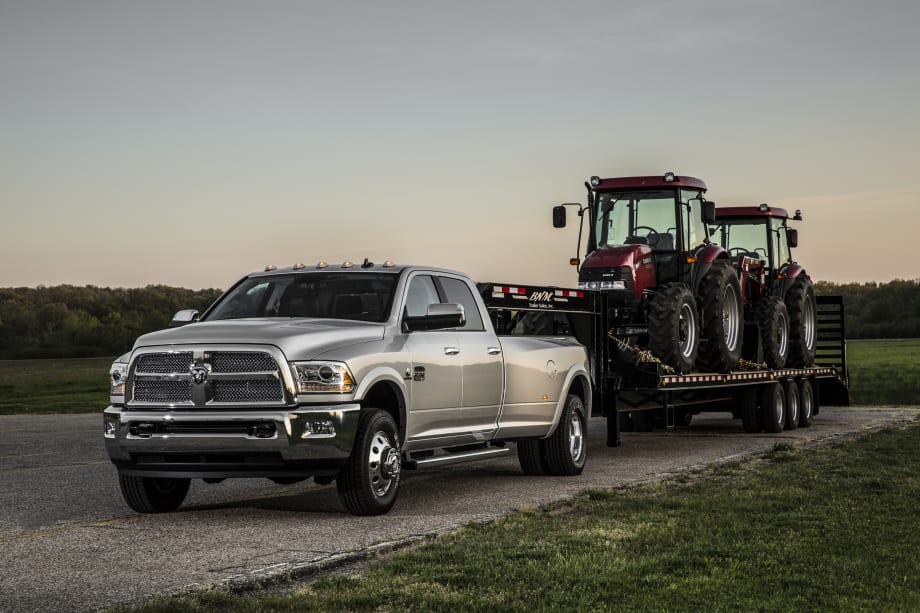
The SAE J2807 towing capacity for a 2015 Ram 3500 with 6.7L Cummins diesel is 30,000 pounds - 2013-MY vehicle pictured. (PHOTO: Chrysler)
The SAE J2807 towing capacity for a 2015 Ram 3500 with 6.7L Cummins diesel is 30,000 pounds - 2013-MY vehicle pictured. (PHOTO: Chrysler)
Beginning with the 2015 model-year, Ram will become the first automaker to adopt the Society of Automotive Engineers (SAE) J2807 standardized tow rating practices across all three full-size pickup truck segments, including the ½-ton Ram 1500, ¾-ton Ram 2500 Heavy Duty, and 1-ton “King of the Hill” Ram 3500 Heavy Duty, according to the automaker.
“Because our customers asked for it, every single 2015 model year pickup truck Ram sells will come with a trailer-tow rating achieved using SAE’s J2807 testing protocols,” said Reid Bigland, president and CEO – Ram Truck Brand. “No other automaker can make that claim.”
On the heels of finalized SAE towing specifications that now include trucks up to 14,000-pounds GVWR, Ram has validated its full pickup line with the SAE J2807 Towing Standard – the only truck maker to adopt the standard in all three pickup truck weight classes, according to Ram Truck.
“Ram Truck has been preparing for integration of the SAE towing standard over the past few years and adding heavier ¾ and 1-ton trucks to the criteria gives it more teeth,” said Mike Cairns, director- Ram Truck Engineering, Chrysler Group LLC. “For too long, an uneven playing field existed and towing capacities went unchecked. We’re happy to be the only pickup truck manufacturer to align with the SAE J2807 towing standard across our pickup truck lineup.”
The SAE J2807 towing standard outlines dynamic and performance criteria as it relates to a given vehicle. Examples within the standard include a number of tests while towing: 0-60 mph time allowance, tackling the notorious Davis Dam Grade while maintaining no less than 40 MPH for single-rear-wheel trucks and 35 mph for dual-rear-wheel trucks, a constant radius understeer test while increasing speed and a sway maneuver using aggressive steering input. The purpose is to put all trucks through the schedule of tests in which operators will likely see in the real world. SAE standards have existed in a number of other areas including engine torque and horsepower. Ram Truck is the first to adopt the official towing standard for ½-ton, ¾-ton, and 1-ton trucks.
2015 Ram SAE J2807 towing capacities:
Ram 1500 V-6 with 3.6L gasoline Pentastar – 7,600 pounds
Ram 1500 V-6 with 3.0L EcoDiesel – 9,200 pounds
Ram 1500 V-8 with 5.7L gasoline HEMI – 10,650 pounds
Ram 2500 V-8 with 6.4L gasoline HEMI – 16,300 pounds
Ram 2500 with 6.7L Cummins diesel – 17,970 pounds
Ram 3500 V-8 with 6.4L gasoline HEMI – 16,420 pounds
Ram 3500 with 6.7L Cummins diesel – 30,000 pounds
Check out a video below:
More Operations

Fleet Has a Talent Pipeline Problem. What Comes Next? | AF News Recap
Where will fleet’s next generation of leaders come from? This week, we’re looking at the industry’s talent pipeline, what certification can add to a fleet career, how to build an award-worthy track record, and the return of Automotive Fleet’s Personal Use Survey.
Read More →
Smith System Launches Driver Risk Management Program
Fleets have more driver data than ever, but identifying risky behavior doesn't necessarily correct it. Smith System's new Driver Risk Management program combines monitoring, training, and follow-up coaching to help fleets connect risk signals with driver intervention.
Read More →
Automotive Fleet Opens 2026 Personal Use Survey for Commercial Fleet Managers
Less than two weeks left! Commercial and corporate fleet managers are invited to share how their organizations handle company vehicle personal-use policies, charges, and driver eligibility.
Read More →
From AI Prompts to AI-Generated Safety Songs | AF News Recap
Can better prompts make AI more useful for fleet managers? This week, we’re breaking down smarter fleet analysis, an AI-assisted experiment that turned safety training into music, and what happened to fuel prices in August.
Read More →
How to Write Better AI Prompts for Fleet Analysis
Include these six elements in your fleet prompts to generate more relevant analysis and accurate answers.
Read More →
Fleet Meets: Eric Kilgore
This edition of the Fleet Meets series features one of the industry's best leaders driving multi-market and national operations.
Read More →
Why Reactive Fleet Management Is Becoming Too Expensive to Sustain
Research highlights a growing need for proactive management strategies to address rising costs in fleet operations effectively.
Read More →
What Your Fleet KPIs Aren’t Telling You
Tracking fleet metrics is only useful when the data leads to better decisions. This guide helps fleet leaders assess cost, utilization, and downtime more accurately, identify performance gaps, and prioritize the actions that can improve operational results.
Read More →
Hidden in Plain Sight: Fleet Compliance Risks
Fleet compliance isn't just about having policies — it's about consistently enforcing them. This practical guide reveals six hidden compliance risks common in public sector and shared fleet operations and outlines proven strategies to improve visibility, accountability, and audit readiness
Read More →
Turning Fleet Payment Data into Executive Insights
Does data alone drive results in operations?
Read More →