




Propane Option Now Offered for E-Series Vans
LIVONIA, MI - ROUSH Performance is launching into the next phase of their liquid propane injected vehicle offerings with a line of E-Series vans.
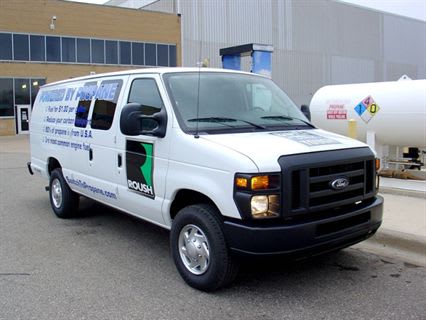
LIVONIA, MI - ROUSH Performance is launching into the next phase of their liquid propane injected vehicle offerings with a line of E-Series vans.
"The response from the fleets to our line of F-150, F-250, and F-350 propane pickups and conversion kits has been outstanding, and their feedback inspired us to develop the complete line of E-Series vans," said Jack Roush, chairman of ROUSH Enterprises. "Many of the fleet managers we have spoken with utilize a tremendous number of vans in the course of their daily business and were looking for the type of cost and environmental advantages that propane offers as a motor fuel. Their desire is what motivated ROUSH to continue to add to our line of propane vehicles."
The order banks are now open for the propane-fueled E-150, E-250, and E-350 and production is anticipated to begin in the first quarter of 2010. ROUSH will offer fuel conversion solutions for both passenger and cargo van applications. The E-Series was selected because Ford has long held a leadership role in the van segment for more than 30 years and fleet managers are familiar with the ordering process, cost of ownership, and maintenance schedules.
From an emissions reduction standpoint, the ROUSH propane-fueled E-Series vans will achieve Super Ultra Low Emission Vehicle (SULEV) II emission standards; on average a SULEV vehicle is 90 percent cleaner in emissions than the average new model year car or truck. The ROUSH conversion system works on the Ford 5.4L, V-8 engine found in 2009 and newer vans, including the gaseous prep engine offered by the Ford Motor Company.
Numerous studies have been conducted on the operational savings fleets can achieve by converting to propane as a motor fuel. A savings calculator is available online at www.SwitchToPropane.com that allows the user to input variables specific to their usage. It is not uncommon for fleet managers to see savings of more than $17,500 per van over a total vehicle life of 150,000 miles, according to the company.
As with all the ROUSH propane-fueled vehicles, the E-Series vans will be covered by a 3-year/36,000 mile warranty. Dealers are able to order the conversion on a ship-through basis to help reduce transportation costs, or conversion systems can be ordered and installed through any authorized Ford dealership for vehicles already in operation.
While propane fueling stations are already quite prevalent, such as at each of the more than 1200 U-Haul locations nationwide, many of the fleets prefer to have a refueling station on-site at their location of business. ROUSH can assist with this by working with propane distributors such as Ferrellgas, AmeriGas, or Heritage Propane to install a propane fueling station at little to no cost to the fleet.
ROUSH is currently working on developing a propane kit for the Ford 6.8L, V-10 engine used on the E-450 Cutaway vehicle, scheduled to be available in late 2010.
More Green Fleet

Merchants Fleet Reports 290M EV Miles as Fleets Navigate Changing Electrification Market
From millions in operating savings to hundreds of millions of EV miles, Merchants Fleet’s latest report reveals what’s working and what’s changing in fleet electrification.
Read More →
The EV Breakdown Nobody's Talking About: Why Most Electric Vehicle Roadside Calls Aren't Mechanical Failures
Here's why EV breakdowns are widely misunderstood.
Read More →
ChargePoint Now Available in Energy Pass
ChargePoint and additional planned charging network integrations were added to GM's Energy Pass.
Read More →
First Look: Slate Auto's Electric Fleet Pickup
Could an affordable, modular EV pickup make electrification more practical for fleets?
Read More →
Slate Debuts Colorful, Unique EV Models
A recent media and client event, studded with electric vehicles dressed up on platforms, planted a new position for the manufacturer in the wider EV market. Fleets will find cost-saving advantages.
Read More →
Slate Electric SUV, Pickup Switchable Model Aims For Light-Duty Fleets
Everything about this EV is counterintuitive and understated, making it stand out from the crowd.
Read More →
Inspiration Mobility Acquires Key Electrada Assets
Inspiration Mobility Group has acquired select assets of Electrada, adding the fleet electrification provider's team, technology, and charging infrastructure development capabilities to its energy management business.
Read More →
Turning Connected Vehicle Data Into Decisions That Matter
Fleet leaders have more data than ever, but turning that data into clear, actionable decisions remains a challenge. This white paper shows how leading organizations are using connected vehicle data to improve safety, reduce costs, and optimize fleet performance. Learn how to turn insight into action across your fleet.
Read More →
Are You Tracking Your Fleet's True Total Cost of Ownership?
Bobit Business Media surveyed 190 fleet professionals and found that while most fleets are tracking costs, fragmented systems and data gaps are keeping true TCO visibility out of reach. With rising pressure to control spend in an increasingly volatile environment, the gap between what fleets think they know and what the data actually shows is wider than you might expect. See how your peers are managing costs today and where the industry still has room to improve.
Read More →