





Read More: NHTSA Expands Tesla Autopilot Probe to 830,000 Vehicles, Engineering Analysis
Partial Automation Prompts Multitasking in Early Adopters
A recent study from IIHS assesses the habits of drivers of partially automated vehicles. One key finding: Super Cruise and Autopilot users are more likely than ProPILOT users to do things that involve taking their hands off the wheel or their eyes off the road.
October 14, 2022
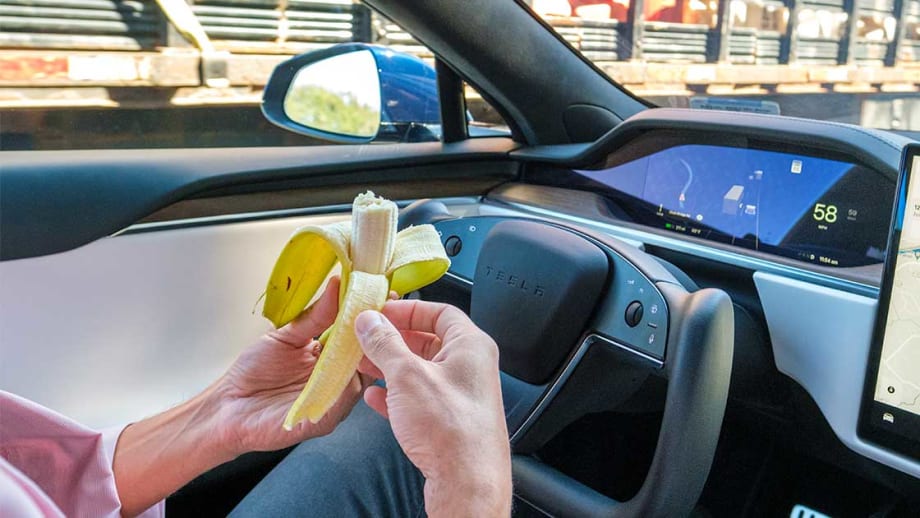
Users of Super Cruise and Autopilot are more likely than ProPILOT users to say they can do non-driving activities better and more often while using their partial automation systems.
Photo: IIHS
4 min to read
Some 53% of Super Cruise users, 42% of Autopilot users, and 12% of ProPILOT Assist users reported they are comfortable treating their vehicles as fully self-driving, according to a new study from the Insurance Institute for Highway Safety (IIHS).
But the fact is, vehicles equipped with self-driving features still require the full focus of the driver — whose hands and eyes should remain on the wheel and the road, respectively.
Disturbingly, the study reveals that drivers who use partial automation on a regular basis often treat their vehicles as fully self-driving despite widespread warnings and numerous high-profile crash reports.
Research indicates that early adopters of these systems have a poor understanding of the technology’s limits — leading many to multi-task behind the wheel, for example. However, IIHS notes that there are also clear differences between three specific owner populations — Cadillac, Nissan/Infiniti, and Tesla. So it is possible that system design and marketing are adding to these misconceptions.
Most of today’s partial automation systems consist of two main features that are designed to assist in highway driving — adaptive cruise control and lane centering. None of the current systems is designed to replace a human driver or to make it safe for a driver to perform other activities that take their focus away from the road.
To assess how frequent users view this budding technology, IIHS researchers surveyed around 600 Cadillac, Nissan/Infiniti, and Tesla owners who routinely use their vehicle’s partial automation system.
Although all three systems use sensors in the steering wheel to detect when the driver’s hands are on it, Cadillac’s Super Cruise is designed to allow drivers to take their hands off the wheel for extended periods, whereas the other two systems require drivers to keep their hands on the wheel essentially all the time. Super Cruise uses a driver-facing camera to monitor whether the driver is looking at the road, and as of 2021 Tesla’s Autopilot does as well.
The three systems use different methods to recall the attention of the driver when it strays as well as different escalation sequences and fail-safe measures. Only Autopilot and Super Cruise include a lockout feature that disables the system and prevents drivers from immediately restarting it as a final step in their escalation sequences.
ProPILOT Assist allows the driver to make manual steering adjustments without automatically suspending the lane centering feature, while Autopilot’s lane centering feature deactivates and Super Cruise’s temporarily suspends operation until the driver has stopped steering.
The survey responses point to striking differences in how the systems’ owners use them, too.
For example, Super Cruise and Autopilot users are more likely than ProPILOT users to do things that involve taking their hands off the wheel or their eyes off the road. They’re also more likely than ProPILOT users to say they can do non-driving activities better and more often while using their partial automation systems. Similarly, Super Cruise users are the most likely and ProPILOT users the least likely to say that an activity they think is unsafe to do when the system is switched off is safe to do when the system is switched on.
Experts at IIHS believe both system design and marketing contributed to those differences in how owners actually use the technology and understand its capabilities. For instance, TV commercials for Super Cruise focus on its hands-free capabilities by depicting drivers patting their laps and clapping their hands along with a song.
Also noteworthy, approximately 40% of users of Autopilot and Super Cruise, the two systems with lockout features, reported that their systems had at some point switched off while they were driving and would not reactivate. Some of those drivers confused a temporary suspension of the feature with the lockout procedure. But those high percentages nevertheless suggest that many drivers failed to respond to warnings intended to ensure they were paying attention to the road or that they repeatedly violated the operating parameters often enough to trigger the lockout.
On the other end of the spectrum, a substantial portion of ProPILOT Assist users reported that they had never even received an attention reminder.
Finally, while a portion of drivers who received attention reminders said the alerts were at least somewhat annoying, the vast majority said they thought they were helpful and made them feel safer using the technology. System lockouts were also broadly accepted. IIHS experts say the good news is that these two features can be more widely implemented to help combat distracted driving.
More Safety
IIHS Crash Avoidance Tests Reveal Safety Gaps in Cargo Vans and Work Trucks
New crash-avoidance ratings from the Insurance Institute for Highway Safety reveal inconsistent performance among commercial vehicles, with several popular cargo vans and heavy-duty pickups struggling to avoid collisions with other vehicles and pedestrians.
Read More →
What’s Next for Fleet? Safety, AI & Industry Recognition | AF News Recap
Could your company's culture be encouraging distracted driving? This week, we're exploring how workplace expectations affect driver safety, what AI, EVs, and autonomous vehicles could mean for the future of fleet management, and how fleet professionals can strengthen their award nominations.
Read More →
Does Your Fleet's Culture Encourage Distracted Driving?
What happens when the people responsible for enforcing safety rules are the ones setting the wrong example? The answer may reveal why some of the biggest risks to fleet drivers have little to do with what's written in the employee handbook.
Read More →
Sponsored•October 1, 2026
Fleet Manager’s Ultimate Playbook: Navigating the New Standard in OEM Connectivity
Rising operating costs, driver safety concerns, and unplanned downtime are putting unprecedented pressure on modern fleets. Discover how fleet managers use embedded OEM connectivity and real-time vehicle data to cut TCO, prevent downtime, and protect drivers without aftermarket telematics hardware.
Read More →
From Driver Well-Being to EV Charging | AF News Recap
Mental health belongs in the fleet safety conversation. This week, we’re looking at five ways fleets can support employee well-being before a crisis, plus Holman’s expansion in Mexico, new one-day Fleet Forward passes, and why EV charging demand is outpacing infrastructure growth.
Read More →
Nexar-Nauto Merger Aims to Give Fleets Better Safety Intelligence Through Larger Driving Dataset
Stefan Heck tells Automotive Fleet that combining more than 10 billion miles of driving history with Nexar's AI models will give fleets deeper insights into driver risk and roadway conditions than either company could provide independently.
Read More →
Don't Wait for a Crisis: 5 Ways to Build Mental Health Into Your Fleet Safety Program
For Suicide Prevention Month, fleet and safety leaders have an opportunity to put mental health where it belongs: at the center of workplace safety.
Read More →
How Camera Data Can Strengthen a Fleet’s Insurance Renewal
Insights from a commercial insurance carrier and a broker show how fleets can turn video telematic data, driver coaching, and improved claims results into a stronger case at insurance renewal.
Read More →
The Safest Fleets Aren’t the Ones with the Most Technology
You’ve made the telematics investment. Here’s how to capture the other half of its value and build the safest fleet on the road.
Read More →
Sponsored•August 7, 2026
Hidden in Plain Sight: Fleet Compliance Risks
Fleet compliance isn't just about having policies — it's about consistently enforcing them. This practical guide reveals six hidden compliance risks common in public sector and shared fleet operations and outlines proven strategies to improve visibility, accountability, and audit readiness
Read More →