




Obama Repeats Call for Tax Reform to Pay for Highway Bill
President Obama used his State of the Union address to repeat his call to reform corporate taxes and spend some of the proceeds on a long-term highway bill.

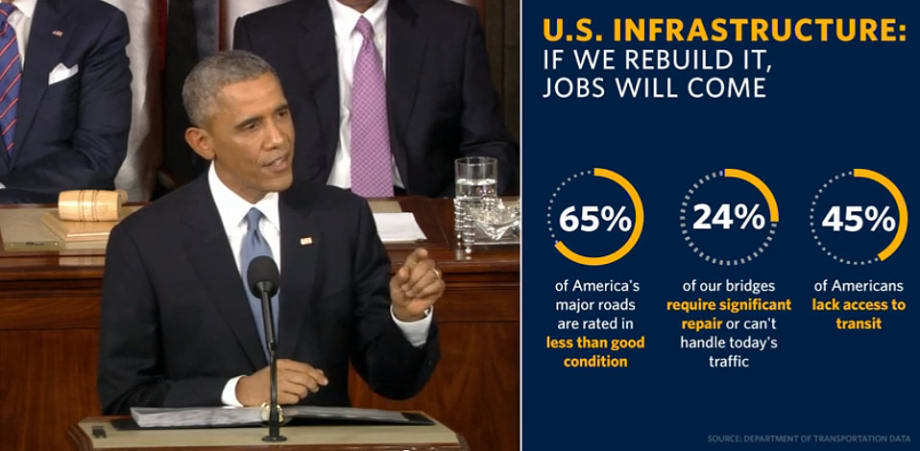
"21st-century businesses need a 21st-century infrastructure." Photo: Whitehouse.gov video screen shot
"21st-century businesses need a 21st-century infrastructure."Photo: Whitehouse.gov video screen shot
UPDATED -- President Obama used his State of the Union address Tuesday night to repeat his call to reform corporate taxes and spend some of the proceeds on a long-term highway bill.
His infrastructure message came in the context of a broader populist appeal for reforms that increase taxes on the wealthiest and ease the burden on the less well off.
“We need a tax code that truly helps working Americans trying to get a leg up in the new economy,” he said.
Even in a divided Congress, there is bipartisan support for investment in infrastructure, he said. “Members of both parties have told me so.”
The money for the highway program, which is due for renewal in May, should come from closing tax loopholes that encourage businesses to keep their profits abroad, he said. “Let’s use those savings to rebuild our infrastructure and make it more attractive for companies to bring jobs home.”
This is the approach to infrastructure funding Obama has been pushing for several years – it echoes almost exactly the language he used in last year’s State of the Union address.
It is similar in some respects to the approach suggested by the former chairman of the House Ways and Means Committee, Rep. Dave Camp, R-Mich., but the new chairman, Rep. Paul Ryan, R-Wis., has not yet said what he has in mind for transportation funding.
Ryan’s counterpart in the Senate, Sen. Orrin Hatch of Utah, chairman of the Finance Committee, has said he opposes the idea of using repatriated tax dollars for infrastructure.
There’s not enough money in the approach, he told Politico. He did say that the Finance Committee is looking for other ways to pay for a multi-year bill.
American Trucking Associations officials voiced disappointment that President Obama failed to more fully flesh out his vision for a well-funded, long-term highway bill.
"Just mentioning infrastructure is not a solution to our nation's critical needs, and by simply bringing the topic up without details, President Obama missed an opportunity to underscore the critical role our highway system plays in our economic well being," said ATA President and CEO Bill Graves in a statement.
"Now is the time, with the Highway Trust Fund set to go bankrupt in May, to show vision and leadership and most importantly, find funding, to keep that from happening," Graves said.
ATA was represented at the State of the Union by First Vice Chairman Pat Thomas, vice president of global public affairs at UPS. Watch this video of Thomas discussing attending President Obama's annual address to Congress:
Updated 2:30 EST to add ATA response
More Operations

Fleet Has a Talent Pipeline Problem. What Comes Next? | AF News Recap
Where will fleet’s next generation of leaders come from? This week, we’re looking at the industry’s talent pipeline, what certification can add to a fleet career, how to build an award-worthy track record, and the return of Automotive Fleet’s Personal Use Survey.
Read More →
Smith System Launches Driver Risk Management Program
Fleets have more driver data than ever, but identifying risky behavior doesn't necessarily correct it. Smith System's new Driver Risk Management program combines monitoring, training, and follow-up coaching to help fleets connect risk signals with driver intervention.
Read More →
Automotive Fleet Opens 2026 Personal Use Survey for Commercial Fleet Managers
Less than two weeks left! Commercial and corporate fleet managers are invited to share how their organizations handle company vehicle personal-use policies, charges, and driver eligibility.
Read More →
From AI Prompts to AI-Generated Safety Songs | AF News Recap
Can better prompts make AI more useful for fleet managers? This week, we’re breaking down smarter fleet analysis, an AI-assisted experiment that turned safety training into music, and what happened to fuel prices in August.
Read More →
How to Write Better AI Prompts for Fleet Analysis
Include these six elements in your fleet prompts to generate more relevant analysis and accurate answers.
Read More →
Fleet Meets: Eric Kilgore
This edition of the Fleet Meets series features one of the industry's best leaders driving multi-market and national operations.
Read More →
Why Reactive Fleet Management Is Becoming Too Expensive to Sustain
Research highlights a growing need for proactive management strategies to address rising costs in fleet operations effectively.
Read More →
What Your Fleet KPIs Aren’t Telling You
Tracking fleet metrics is only useful when the data leads to better decisions. This guide helps fleet leaders assess cost, utilization, and downtime more accurately, identify performance gaps, and prioritize the actions that can improve operational results.
Read More →
Hidden in Plain Sight: Fleet Compliance Risks
Fleet compliance isn't just about having policies — it's about consistently enforcing them. This practical guide reveals six hidden compliance risks common in public sector and shared fleet operations and outlines proven strategies to improve visibility, accountability, and audit readiness
Read More →
Turning Fleet Payment Data into Executive Insights
Does data alone drive results in operations?
Read More →