




NYC Receives $20M for Connected-Vehicle Project
Together, New York City, Tampa and Wyoming will receive up to $42 million to pilot next-generation safety technology in vehicles and infrastructure.
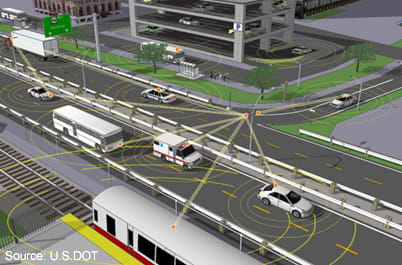
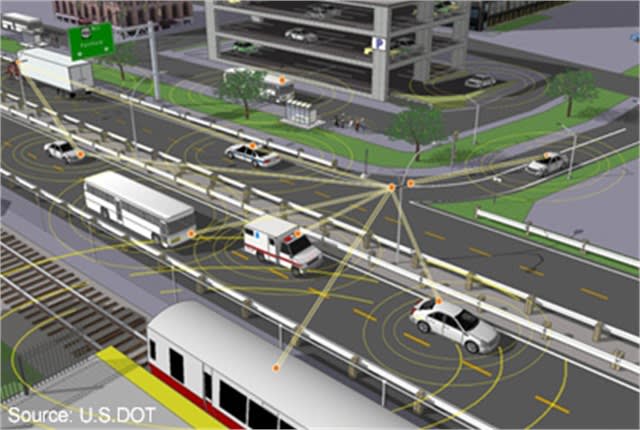
As part of a federal pilot program, New York City will install vehicle-to-vehicle (V2V) technology in vehicles that frequently travel in Midtown Manhattan, and vehicle-to-infrastructure (V2I) technology throughout Midtown.
New York City will receive up to $20 million to advance these technologies as part of a U.S. Department of Transportation program.
New York City, along with Tampa, Fla., and Wyoming, was selected in a competitive process to develop and deploy vehicles that can anonymously communicate critical vehicle information – not only with each other, but also with surrounding infrastructure such as stoplights.
Together, New York City, Tampa and Wyoming will receive up to $42 million to pilot this next-generation technology in vehicles and infrastructure.
U.S. Transportation Secretary Anthony Foxx announced details about the connected-vehicle pilot programs at the New York City Joint Management Traffic Center on Sept. 14.
“It has been a core mission of the Department to support promising new technologies, and through these types of smart investments we are opening the door to a safer and cleaner network and expanding how future generations travel,” Foxx said.
The New York City project will include upgrading traffic signals with V2I technology along avenues between 14th Street and 66th Street in Manhattan. This same technology will also be installed in Brooklyn.
Up to 10,000 cars, buses and limousines will eventually be retrofit with the technology in hopes of reducing traffic congestion, curbing greenhouse gas emissions, and making drivers and pedestrians safer on the roads.
Finally, roadside units will be equipped with connected-vehicle technology along the FDR Drive between 50th Street and 90th Street. This site was selected primarily for the potential to make pedestrians and drivers safer there.
Research indicates that connected-vehicle technology could reduce unimpaired vehicle crashes by 80 percent, while also reducing the 4.8 billion hours that Americans spend in traffic annually, according to the U.S. Department of Transportation.
“I am honored that USDOT chose New York City to participate in this cutting-edge connected vehicle pilot program,” said DOT Commissioner Trottenberg. “We look forward to testing this exciting safety technology on some of the toughest streets in the world.”
U.S. DOT also awarded $17 million to use the technology to address rush-hour congestion in downtown Tampa and to protect the city’s pedestrians by equipping their smartphones with the same connected technology. Tampa also committed to measuring the program’s environmental benefits.
In Wyoming, the project focus is on movement of freight through the I-80 east-west corridor, which is critical to commercial heavy-duty vehicles moving across the northern portion of the country. Approximately 11,000 to 16,000 vehicles travel this corridor every day. Through V2V and V2I, Wyoming DOT will both collect information and disseminate it to vehicles not equipped with the new technologies.
In 2012, the U.S. DOT tested connected vehicles and demonstrated the technology’s life-saving potential in a pilot program involving more than 2,700 equipped vehicles operating in Ann Arbor, Mich. Participating vehicles used V2V safety technology to help everyday drivers avoid crashes as they traveled along their normal routes. Safety apps provided driver alerts about such concerns as braking vehicles ahead, vehicles in their blind spots, and impending red-light violations.
The U.S. DOT said its goals for the new connected-vehicle technology programs are straightforward: advance deployment, measure impact, and uncover and address the technical and non-technical barriers to deployment in a hands-on way.
The DOT announced in May plans to accelerate its timetable on a proposed rulemaking that will require the installation of V2V communications equipment in all new vehicles. The proposal is expected by the end of this year. New cars with connected-vehicle technology could be in dealer showrooms as early as 2016, according to the DOT.
More Safety
IIHS Crash Avoidance Tests Reveal Safety Gaps in Cargo Vans and Work Trucks
New crash-avoidance ratings from the Insurance Institute for Highway Safety reveal inconsistent performance among commercial vehicles, with several popular cargo vans and heavy-duty pickups struggling to avoid collisions with other vehicles and pedestrians.
Read More →
What’s Next for Fleet? Safety, AI & Industry Recognition | AF News Recap
Could your company's culture be encouraging distracted driving? This week, we're exploring how workplace expectations affect driver safety, what AI, EVs, and autonomous vehicles could mean for the future of fleet management, and how fleet professionals can strengthen their award nominations.
Read More →
Does Your Fleet's Culture Encourage Distracted Driving?
What happens when the people responsible for enforcing safety rules are the ones setting the wrong example? The answer may reveal why some of the biggest risks to fleet drivers have little to do with what's written in the employee handbook.
Read More →
Fleet Manager’s Ultimate Playbook: Navigating the New Standard in OEM Connectivity
Rising operating costs, driver safety concerns, and unplanned downtime are putting unprecedented pressure on modern fleets. Discover how fleet managers use embedded OEM connectivity and real-time vehicle data to cut TCO, prevent downtime, and protect drivers without aftermarket telematics hardware.
Read More →
From Driver Well-Being to EV Charging | AF News Recap
Mental health belongs in the fleet safety conversation. This week, we’re looking at five ways fleets can support employee well-being before a crisis, plus Holman’s expansion in Mexico, new one-day Fleet Forward passes, and why EV charging demand is outpacing infrastructure growth.
Read More →
Nexar-Nauto Merger Aims to Give Fleets Better Safety Intelligence Through Larger Driving Dataset
Stefan Heck tells Automotive Fleet that combining more than 10 billion miles of driving history with Nexar's AI models will give fleets deeper insights into driver risk and roadway conditions than either company could provide independently.
Read More →
Don't Wait for a Crisis: 5 Ways to Build Mental Health Into Your Fleet Safety Program
For Suicide Prevention Month, fleet and safety leaders have an opportunity to put mental health where it belongs: at the center of workplace safety.
Read More →
How Camera Data Can Strengthen a Fleet’s Insurance Renewal
Insights from a commercial insurance carrier and a broker show how fleets can turn video telematic data, driver coaching, and improved claims results into a stronger case at insurance renewal.
Read More →
The Safest Fleets Aren’t the Ones with the Most Technology
You’ve made the telematics investment. Here’s how to capture the other half of its value and build the safest fleet on the road.
Read More →
Hidden in Plain Sight: Fleet Compliance Risks
Fleet compliance isn't just about having policies — it's about consistently enforcing them. This practical guide reveals six hidden compliance risks common in public sector and shared fleet operations and outlines proven strategies to improve visibility, accountability, and audit readiness
Read More →