




NSF to Launch Automotive Aftermarket Collision Parts Distributor Certification Program
LAS VEGAS - NSF International is developing a one-of-a-kind automotive aftermarket collision parts distributor certification program that will close the gap in the supply chain between part manufacturers and body shops.
LAS VEGAS - NSF International is developing a one-of-a-kind automotive aftermarket collision parts distributor certification program that will close the gap in the supply chain between part manufacturers and body shops. The Automotive Body Parts Association (ABPA) is working closely with NSF to identify the key features that will form the basis of the new program, which is scheduled to launch in the first quarter of 2011.
The NSF Automotive Aftermarket Collision Parts Distributor Certification Program will be open to all distributors and will require them to have quality systems in place that address traceability and quality issues for both certified and non-certified parts. The NSF Distributor Certification Program will be designed to meet the needs of collision repair shops, insurers and ultimately consumers. To earn NSF Automotive Aftermarket Collision Parts Distributor Certification, some of the requirements that distributors will be required to meet include:
an ISO 9001 certified quality management system,
a part complaint process for defective parts, and
the ability to recall structural parts.
Distributors meeting NSF's rigorous certification requirements will be authorized to utilize the NSF Mark on their website and promotional materials indicating they are an NSF Certified distributor.* The certified distributor will appear on NSF's certification listings webpage.
"The NSF Automotive Aftermarket Collision Parts Distributor Certification Program closes the gap between the parts manufacturer and the body shop by ensuring that certified distributors have the procedures in place to address traceability and quality issues," said Bob Frayer, Director of NSF International's Automotive Aftermarket Certification Programs and NSF's Engineering Laboratories. "The new program will complement the existing NSF Automotive Aftermarket Parts Certification Program, which verifies that an automotive aftermarket part meets rigid quality, safety and performance standards in terms of form, fit and function."
To maintain certification, all NSF Certified distributors will undergo ongoing facility inspections.
"The Automotive Service Association is pleased that ABPA and NSF International have chosen NACE 2010 as the venue to announce the development of the NSF Automotive Aftermarket Collision Parts Distributor Certification Program. ASA appreciates the outreach from ABPA and NSF to include ASA member collision repair shops in the dialog and process that has culminated in this commitment to address the issues of traceability, safety and quality," said Ron Pyle, President and Chief Staff Officer of the Automotive Service Association.
"As an industry, we believe there is a great need for top quality, independent entrepreneurs to provide a competitive choice for the collision repairers and their customers," said ABPA Board Chairman Charlie Hogarty. "This new NSF program raises the bar and assures that those who comply can provide the kind of quality service the collision industry deserves."
For more information about the NSF Automotive Aftermarket Collision Parts Distributor Certification Program, contact Bob Frayer at 734-827-6825 or autocert@nsf.org or visit www.nsfautomotive.com.
* Since this is a distributor certification program, not a parts certification program, distributors will not be authorized to apply the NSF Mark to products.
About NSF International: The NSF International Automotive Aftermarket Collision Parts Distributor Certification Program will cover all parts sold by a distributor (www.nsf.org). NSF also provides management systems registrations delivered through NSF International Strategic Registrations, Ltd. (NSF-ISR).
As one of the first registrars to be recognized by the International Automotive Task Force (IATF) to conduct audits to ISO/TS 16949, NSF-ISR is a world leader in quality and environmental management systems registration serving the automotive industry. NSF-ISR also is accredited by the American National Standards Institute (ANSI)-ASQ National Accreditation Board (ANAB) to perform aerospace industry management system registration audits for AS9100, AS9110, AS9120, and AS9003. Located near Detroit, the automotive manufacturing capital of the world, NSF International has more than 1,100 automotive clients, more than 900 employees and certifies more than 275,000 products.
NSF International, an independent not-for-profit organization, certifies products and writes standards for food, water and consumer goods to minimize adverse health effects and protect the environment. Founded in 1944, NSF is committed to protecting human health and safety worldwide and operates in more than 120 countries. NSF is a World Health Organization Collaborating Centre for Food and Water Safety and Indoor Environment. Additional NSF services include NSF Environmental Sustainability Solutions, NSF Standards and Protocol Development, and NSF Training and Education programs.
More Safety

Nexar-Nauto Merger Aims to Give Fleets Better Safety Intelligence Through Larger Driving Dataset
Stefan Heck tells Automotive Fleet that combining more than 10 billion miles of driving history with Nexar's AI models will give fleets deeper insights into driver risk and roadway conditions than either company could provide independently.
Read More →
Don't Wait for a Crisis: 5 Ways to Build Mental Health Into Your Fleet Safety Program
For Suicide Prevention Month, fleet and safety leaders have an opportunity to put mental health where it belongs: at the center of workplace safety.
Read More →
How Camera Data Can Strengthen a Fleet’s Insurance Renewal
Insights from a commercial insurance carrier and a broker show how fleets can turn video telematic data, driver coaching, and improved claims results into a stronger case at insurance renewal.
Read More →
The Safest Fleets Aren’t the Ones with the Most Technology
You’ve made the telematics investment. Here’s how to capture the other half of its value and build the safest fleet on the road.
Read More →
Hidden in Plain Sight: Fleet Compliance Risks
Fleet compliance isn't just about having policies — it's about consistently enforcing them. This practical guide reveals six hidden compliance risks common in public sector and shared fleet operations and outlines proven strategies to improve visibility, accountability, and audit readiness
Read More →
NETS Sets 2026 Fleet Safety Benchmark Conference for Indianapolis
The Sept. 15–17 program will feature fleet benchmarking data, case studies, emerging technologies, and implementation strategies while running alongside the NSC Safety Congress & Expo.
Read More →
Off-the-Job Crashes Account for 43% of Employers’ $61.7 Billion Crash Burden
NETS quantifies costs dispersed across fleet, risk, HR, and other departments while providing new per-crash benchmarks for employers.
Read More →
Ram Recalls More Than 1.27 Million 1500 Pickups for Seat Belt Anchor Issue
The recall affects certain 2019-2026 Ram 1500 pickups that may have improperly attached second-row seat belt buckle anchors.
Read More →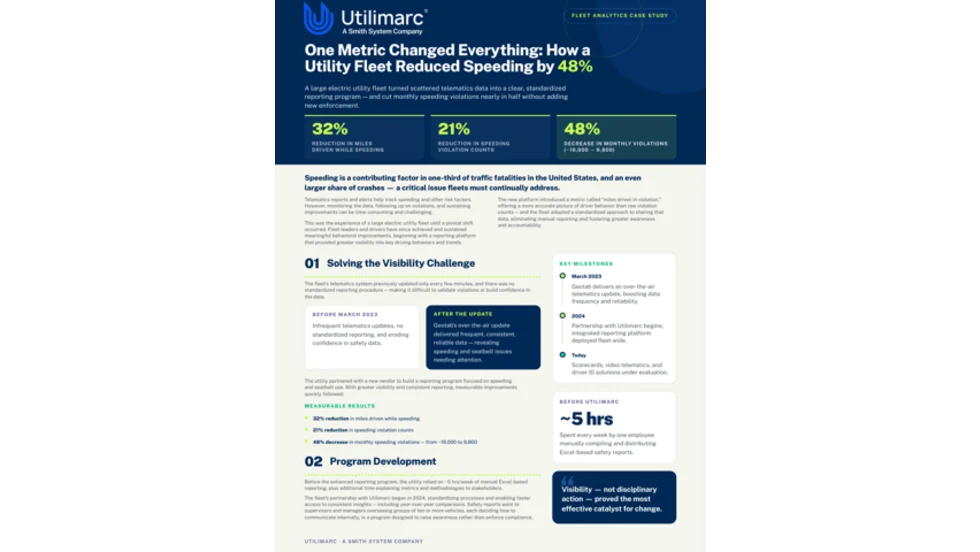
How Better Visibility Cut Speeding Violations by 48%
Fleet leaders don't need more data, they need clearer visibility into what the data is saying. This case study explores how one utility replaced speeding-event counts with a single metric — miles driven in violation — to strengthen safety and significantly reduce speeding violations.
Read More →
Operation Safe Driver Week: Why the Industry's Oldest Safety Campaign Still Matters to Fleets
A look at how a 2007 enforcement initiative became one of the most consequential weeks on the fleet safety calendar, and what it means for your drivers in 2026.
Read More →