




Nissan to Offer Gasoline-Powered V-8 for Titan XD
Nissan's new engine features four valves per cylinder, variable valve timing and direct fuel injection, and is rated at 390 hp at 5,800 rpm and 401 lb.-ft. of torque at 4,000 rpm.
by Staff
December 15, 2015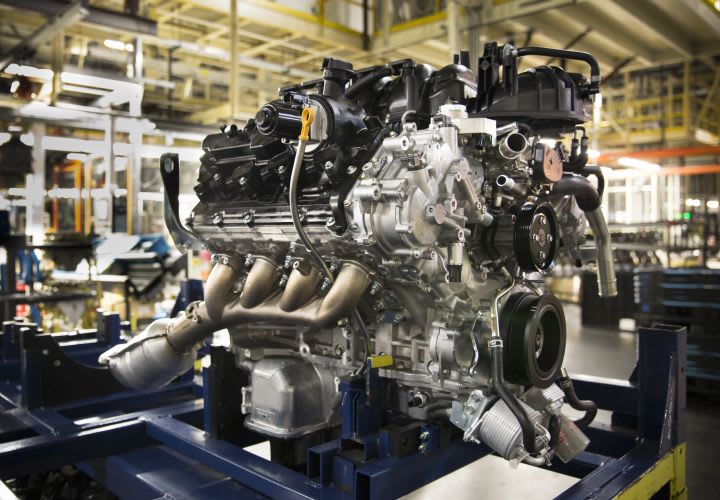
Nissan's advanced 5.6-liter Endurance gasoline V-8 is being built in southern Tennessee.
2 min to read
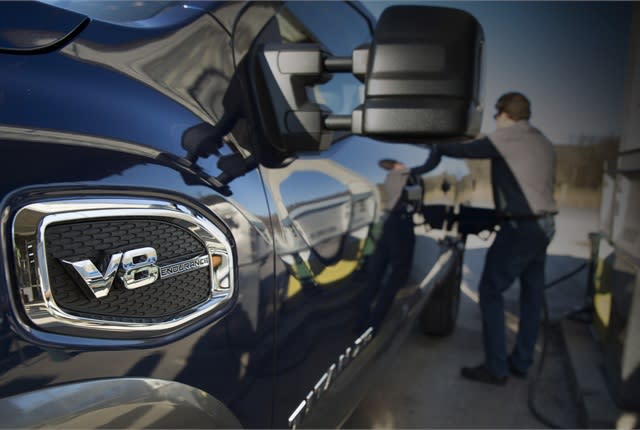
Gasoline power, available in early spring, will reduce the purchasing cost of the Titan XD full-size pickup. Photos: Nissan North America
Nissan North America will offer its Titan XD pickup with a 5.6-liter Endurance gasoline-fueled V-8 that will also power the revised 2016 regular Titan that will go on sale by spring of next year.
The gasoline option for the XD joins the Cummins ISV5.0L Turbo Diesel V-8 that’s already been released and shown to press reporters early this month (read a Road Test of the diesel-powered XD here).
The new engine, assembled in Decherd, Tenn., features four valves per cylinder, variable valve timing and direct fuel injection, and is rated at 390 hp at 5,800 rpm and 401 lb.-ft. of torque at 4,000 rpm.
The gasoline V-8 will become available in early spring 2016. It rounds out the engine offerings for the new XD pickup, whose beefed-up chassis claims a unique position in the segment between traditional heavy-duty and light-duty trucks.
"With this new engine, Nissan Titan XD customers will have the opportunity to make the choice that is best for their towing and hauling needs – either the all-new Endurance V-8 or the Cummins diesel – two offerings that you won't find on any other truck on the market today," said Rich Miller, chief product specialist for the Titan. "It's going to be a tough decision for Titan XD customers between these two very durable, capable engines."
While the new Endurance V-8 shares its 5.6L (342-cubic-inch) displacement with the previous-generation V-8, it is much advanced with 73 more horsepower and 16 more pound-feet of torque, Miller said.
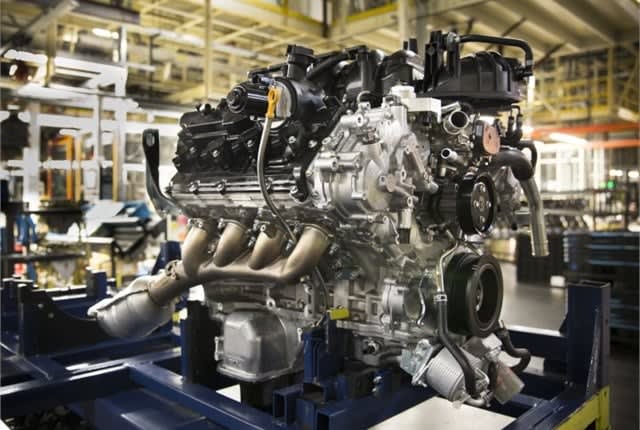
Nissan's advanced 5.6-liter Endurance gasoline V-8 is being built in southern Tennessee.
Nissan's VVEL, for Variable Valve Event & Lift, combines hydraulic-controlled variable valve timing and electronically controlled variable valve lift on the intake and exhaust sides to provide high performance and crisp response.
Throttle response is enhanced by directly controlling the intake valve, rather than using the traditional method of controlling intake with a throttle valve, and valve timing and opening with non-variable camshafts.
A Direct Injection Gas (DIG) system provides better wide-open throttle performance and improved fuel economy and emissions performance compared to an indirect-injection system. DIG reduces engine knock, improving combustion stability and offering precise injection control.
An 11.2 to 1 compression ratio, compared to the previous engine’s 9.8 to 1, aids overall engine efficiency and performance. And a Multi Control Valve (MCV) assists in managing the engine's thermal efficiency better than a traditional thermostat.
Titan XD models equipped with the Endurance V-8 will be outfitted with a new 7-speed automatic transmission that features Adaptive Shift Control and Downshift Rev Matching, Miller said. More information on the gasoline powertrain will be released closer to its early spring on-sale date.
More Operations

Fleet Has a Talent Pipeline Problem. What Comes Next? | AF News Recap
Where will fleet’s next generation of leaders come from? This week, we’re looking at the industry’s talent pipeline, what certification can add to a fleet career, how to build an award-worthy track record, and the return of Automotive Fleet’s Personal Use Survey.
Read More →
Smith System Launches Driver Risk Management Program
Fleets have more driver data than ever, but identifying risky behavior doesn't necessarily correct it. Smith System's new Driver Risk Management program combines monitoring, training, and follow-up coaching to help fleets connect risk signals with driver intervention.
Read More →
Automotive Fleet Opens 2026 Personal Use Survey for Commercial Fleet Managers
Less than two weeks left! Commercial and corporate fleet managers are invited to share how their organizations handle company vehicle personal-use policies, charges, and driver eligibility.
Read More →
From AI Prompts to AI-Generated Safety Songs | AF News Recap
Can better prompts make AI more useful for fleet managers? This week, we’re breaking down smarter fleet analysis, an AI-assisted experiment that turned safety training into music, and what happened to fuel prices in August.
Read More →
How to Write Better AI Prompts for Fleet Analysis
Include these six elements in your fleet prompts to generate more relevant analysis and accurate answers.
Read More →
Fleet Meets: Eric Kilgore
This edition of the Fleet Meets series features one of the industry's best leaders driving multi-market and national operations.
Read More →
Why Reactive Fleet Management Is Becoming Too Expensive to Sustain
Research highlights a growing need for proactive management strategies to address rising costs in fleet operations effectively.
Read More →
Sponsored•August 12, 2026
What Your Fleet KPIs Aren’t Telling You
Tracking fleet metrics is only useful when the data leads to better decisions. This guide helps fleet leaders assess cost, utilization, and downtime more accurately, identify performance gaps, and prioritize the actions that can improve operational results.
Read More →
Sponsored•August 7, 2026
Hidden in Plain Sight: Fleet Compliance Risks
Fleet compliance isn't just about having policies — it's about consistently enforcing them. This practical guide reveals six hidden compliance risks common in public sector and shared fleet operations and outlines proven strategies to improve visibility, accountability, and audit readiness
Read More →
Turning Fleet Payment Data into Executive Insights
Does data alone drive results in operations?
Read More →