




Nissan Titan XD Tows 12,314 Pounds
Nissan's diesel-powered 2016 Titan XD pickup will tow 12,314 pounds and offers a maximum payload capacity of 2,091 pounds, according to new details released by Nissan.
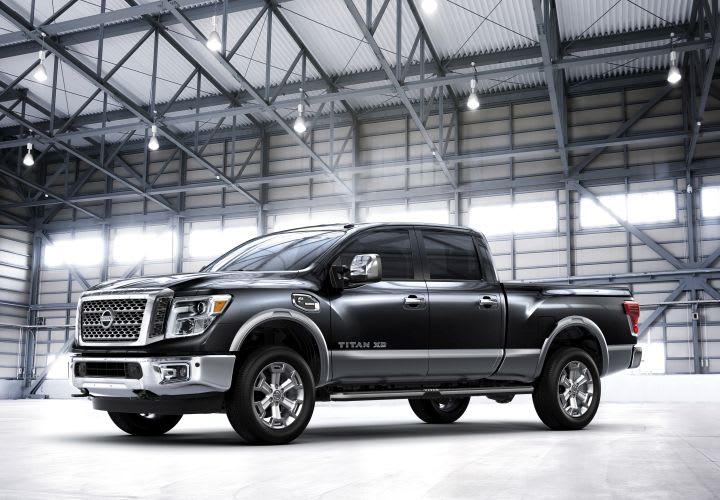
Photo of 2016 Titan XD courtesy of Nissan.
Photo of 2016 Titan XD courtesy of Nissan.
Nissan's diesel-powered 2016 Titan XD pickup will tow 12,314 pounds and offers a maximum payload capacity of 2,091 pounds, according to new details released by Nissan.
The vehicle is also expected to arrive with a gross vehicle weight rating above 8,500 pounds, meaning it won't go through emissions testing by the U.S. Environmental Protection Agency.
The Titan XD is powered by a Cummins 5.0L V-8 turbo diesel that makes 310 hp and 555 lb.-ft. of torque. A gasoline engine will also be available.
To aid towing, the Titan XD will include Integrated Trailer Brake Controller, Trailer Sway Control (TSC), Tow/Haul Mode with Downhill Speed Control and a Trailer Light Check system that allows the driver to check turn signals, brake lights and running or clearance lights remotely.
The truck will also offer a back-up camera with trailer guides, available Around View Monitor for a 360-degree view, and Moving Object Detection. The truck will meet SAE J2807 towing standards.
The truck will initially arrive as a crew cab, but eventually be available in three cab configurations, two frame sizes, three powertrain offerings, and five grade levels.
The longer Titan will arrive with a 151.6-inch wheelbase, which will be 20 inches longer than non-XD Titan models. The rear differential measures 13 inches with 3.5-inch axle tubes, while the front differential on 4x4 models measures 9.25 inches. Nissan is also offering an electronic locking rear differential.
The Titan XD rides on 17-, 18- or 20-inch aluminum-alloy wheels with LT245/75R17, LT275/65R18 or LT265/60R20 all-weather tires.
More Operations

Here's When You Should Make an Exception to Fleet Policy
Fleet policies are designed to create consistency, but not every driver or situation fits neatly within standard rules.
Read More →
AI-Native or AI-Acquired: What Should Fleet Managers Look for in an AI Platform?
Six questions can help fleet managers look beyond AI marketing claims to evaluate integration, data access, and real-world operational performance.
Read More →
A buyer's guide to fleet management software in 2027
Buying fleet management software in 2027 means looking beyond features and price. As fleet operations, technology and expectations evolve, this guide explores what today’s fleet professionals should consider when choosing a system that can deliver value now and adapt to what comes next.
Read More →

What Will Shape the Next Era of Fleet Management?
EVs, AI, and autonomous vehicles are reshaping fleet management. Discover what’s ahead—and how fleet leaders can prepare for the next era.
Read More →
How Fleets Can Recruit and Train Veterans for Technician Roles
Here's how the technician shortage has affected uptime for fleets, and what to do about it.
Read More →
Avis Budget Group Deploys Neology Toll Management Technology Across Major Brands
Neology’s neoFleet platform will manage toll transactions and toll-authority operations for vehicles across Avis, Budget, Payless, Budget Truck and Zipcar.
Read More →
Fleet Personal-Use Charges Edge Higher in 2026
Nearly eight in 10 surveyed fleets allow personal use of company vehicles, while just over half of respondents report charging employees for the privilege.
Read More →
The Future of Fleet + What’s Changing Right Now | AF News Recap
Could developments overseas offer a preview of what’s coming for U.S. fleets? This week, we’re looking at the future of AI, autonomy, and electrification, plus Ford Pro’s new certified pre-owned program, smarter vehicle offboarding, and a new way for fleets to manage toll expenses.
Read More →
How to Handle Vehicle Offboarding
What do fleet managers need to do when a driver leaves?
Read More →
Fleet Manager’s Ultimate Playbook: Navigating the New Standard in OEM Connectivity
Rising operating costs, driver safety concerns, and unplanned downtime are putting unprecedented pressure on modern fleets. Discover how fleet managers use embedded OEM connectivity and real-time vehicle data to cut TCO, prevent downtime, and protect drivers without aftermarket telematics hardware.
Read More →