




Nissan Improves Altima MPG to 31 Combined for 2013 Model-Year
NEW YORK - Nissan said it will offer the 2013-MY Altima in four 2.5L engine equipped models (2.5, 2.5 S, 2.5 SV, and 2.5 SL), and three 3.5L V-6 equipped models (3.5 S, 3.5 SV, and 3.5 SL).

The 2013-MY Nissan Altima.

The 2013-MY Nissan Altima.
NEW YORK – Nissan showed its 2013-MY Nissan Altima at the New York International Auto Show. The new sedan goes on sale in July, 2012, at a starting MSRP of $21,500. Nissan said it will offer the 2013-MY Altima in four 2.5L engine equipped models (2.5, 2.5 S, 2.5 SV, and 2.5 SL), and three 3.5L V-6 equipped models (3.5 S, 3.5 SV, and 3.5 SL).
You can view a photo gallery of the 2013-MY Altima here.
The big change in the 2013-MY Altima’s powertrain over previous models is the addition of Nissan’s next-generation Xtronic continuously variable transmission (CVT). The automaker said it redesigned 70% of the parts and reduced internal friction by 40% compared with the previous transmission. Other changes include new control logic and more gear ratio coverage, which Nissan said helps improve fuel economy and reduce noise.
For the 2013 model-year, Nissan changed its 2.5L QR25 engine somewhat in the new Altima, making it lighter, adding variable valve timing on the exhaust and intake camshafts, changing the intake system so it opens the valves at a higher rpm to help flatten the torque curve, and making it lighter. The engine can now produce 182 hp (up from 175 hp), while torque is the same, an estimated 180 lb.-ft. The other engine choice is Nissan’s 3.5L DOHC V-6 (270 horsepower, est., and 258 lb.-ft. of torque, est.).
The new Altima also has a lighter body design, weighing 80 lbs. less than the previous model, achieved via the use of high-strength and ultra-high-strength steel and new support struts in the front and back. Other fuel efficiency features include tires with reduced rolling resistance and a new regenerative alternator that runs when the vehicle is coasting.
These changes allow the Altima to achieve better fuel economy than the previous version, with Nissan saying targeted fuel economy for the Altima 2.5L four-cylinder/CVT combination is 27 mpg city, 38 mpg highway, and 31 mpg combined. Fuel economy for the 3.5L V-6/CVT Altima is rated at 22 mpg city, 30 mpg highway, and 25 mpg combined.
Beyong the powertrain, Nissan redesigned the Altima’s exterior for the 2013 model-year, with a wider front and rear track (by 1.4 inches) and deeper fenders (0.8 inches), new grille design, and seamless bumper and projector-type headlights. The new sedan also has a longer roofline and raised trunk, compared with the previous model, large taillights, and eight exterior color choices. Nissan added that changes to the sedan’s aerodynamic characteristics have given it a lower coefficient of drag.
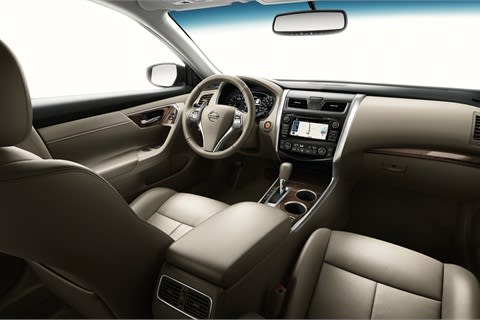
The new Altima offers the automaker's NissanConnect infotainment system, which features Bluetooth and available navigation.
Other features for the 2013-MY Altima include standard Bluetooth, streaming audio, the available NissanConnect and NissanConnect Navigation systems, with a range of Bluetooth connectivity features, Pandora playback, real-time Google POI search and more. Features fleets may be interested in include Easy Fill Tire Alert, Nissan’s next generation of its Safety Shield Technologies, including its Blind Spot Warning (BSW), Lane Departure Warning (LDW) and Moving Object Detection (MOD) systems.
Nissan also upgraded the interior for the 2013 model-year, with “NASA-inspired zero-gravity” front seats, available in leather, and a new standard Advanced Drive Assist Display. This display can show navigation information, text messaging notifications, and audio data.
More Operations

How Fleets Can Recruit and Train Veterans for Technician Roles
Here's how the technician shortage has affected uptime for fleets, and what to do about it.
Read More →
Avis Budget Group Deploys Neology Toll Management Technology Across Major Brands
Neology’s neoFleet platform will manage toll transactions and toll-authority operations for vehicles across Avis, Budget, Payless, Budget Truck and Zipcar.
Read More →
Fleet Personal-Use Charges Edge Higher in 2026
Nearly eight in 10 surveyed fleets allow personal use of company vehicles, while just over half of respondents report charging employees for the privilege.
Read More →
The Future of Fleet + What’s Changing Right Now | AF News Recap
Could developments overseas offer a preview of what’s coming for U.S. fleets? This week, we’re looking at the future of AI, autonomy, and electrification, plus Ford Pro’s new certified pre-owned program, smarter vehicle offboarding, and a new way for fleets to manage toll expenses.
Read More →
How to Handle Vehicle Offboarding
What do fleet managers need to do when a driver leaves?
Read More →
Fleet Manager’s Ultimate Playbook: Navigating the New Standard in OEM Connectivity
Rising operating costs, driver safety concerns, and unplanned downtime are putting unprecedented pressure on modern fleets. Discover how fleet managers use embedded OEM connectivity and real-time vehicle data to cut TCO, prevent downtime, and protect drivers without aftermarket telematics hardware.
Read More →
U.S. Bank Adds Verra Mobility Toll Management to Voyager Fleet Platform
The integration allows U.S. Bank Voyager fleet customers to manage toll payments and violations alongside fuel, EV charging and maintenance expenses.
Read More →
ADAS Prevents Crashes. But Repairs Cost More | AF News Recap
ADAS-equipped vehicles may crash less often, but they can cost more when they do. This week, we’re breaking down what that tradeoff means for fleets, plus Subaru’s first Forester Wilderness Hybrid, Nissan’s new e-POWER Rogue, and why Calstart has become Catalyst Mobility.
Read More →
Moventum Fleet Management Names Mark Iorillo Head of Sales
Iorillo brings nearly 20 years of fleet management and sales experience to the role, including previous positions at Element Fleet Management, CEI, Donlen and Ryder.
Read More →
Fleet Has a Talent Pipeline Problem. What Comes Next? | AF News Recap
Where will fleet’s next generation of leaders come from? This week, we’re looking at the industry’s talent pipeline, what certification can add to a fleet career, how to build an award-worthy track record, and the return of Automotive Fleet’s Personal Use Survey.
Read More →