




New Study Addresses Impact of Traffic Congestion
COLLEGE STATION, TX --- Though it might have been hard to notice, traffic congestion across the country took a break from its worsening trend even before the current recession, with high gas prices in the last half of 2007 bringing about a slight reduction in traffic.
COLLEGE STATION, TX --- Though it might have been hard to notice, traffic congestion across the country took a break from its worsening trend even before the current recession, with high gas prices in the last half of 2007 bringing about a slight reduction in traffic. Less traffic means less driver stress and generally fewer fender benders.
The recession that took hold soon after could prolong that effect, but experts warn that the slowdown in congestion growth will be temporary. When the economy rebounds, expect traffic problems to do the same.
The most current information on the nation's traffic picture is outlined in the 2009 Urban Mobility Report, published recently by the Texas Transportation Institute. This year's installment tracks a quarter-century of traffic patterns in 439 U.S. urban areas from 1982 through 2007. The report was prepared by researchers David Schrank and Tim Lomax.
Travelers spent one hour less stuck in traffic in 2007 than they did the year before and wasted one gallon less gasoline than the year before. The differences are small, but they represent a rare break in near-constant growth in traffic over 25 years.
"This is a very small change," said Schrank. "No one should expect to be driving the speed limit on their way to work because of this." That's because the average traveler still needs 25 percent more time for those trips.
Other highlights from the research illustrate the effects of the nation's traffic problems.
The overall cost (based on wasted fuel and lost productivity) reached $87.2 billion in 2007 -- more than $750 for every U.S. traveler.
The total amount of wasted fuel topped 2.8 billion gallons -- three weeks' worth of gas for every traveler.
The amount of wasted time totaled 4.2 billion hours -- nearly one full work week (or vacation week) for every traveler.
Researchers recommend a balanced and diversified approach to reducing traffic congestion -- one that focuses on more of everything. Their strategies include:
Get as much use as possible out of the transportation system we have.
Add roadway and public transportation capacity in the places where it is needed most.
Change our patterns, employing ideas like ridesharing and flexible work times to avoid traditional "rush hours."
Provide more choices, such as alternate routes, telecommuting and toll lanes for faster and more reliable trips.
Diversify land development patterns, to make walking, biking and mass transit more practical.
Adopt realistic expectations, recognizing for instance that large urban areas are going to be congested, but they don't have to stay that way all day long.
"The best solutions are going to be those in which actions by transportation agencies are complemented by businesses, manufacturers and commuters," Lomax said. "There's a mindset that says that this is a city government's job or a state DOT's job, but the problem is far too big for transportation agencies alone to address it adequately."
And even though the problem has leveled off somewhat, we shouldn't expect it to be a trend, the researchers said, because an otherwise steady trend over 25 years has been interrupted only by -- you guessed it -- a recession. "The northeastern states and Texas in the mid-1980s and California in the '90s are three regions that give us an idea what to expect," Lomax said. "In each of those cases, when the economy rebounded, so did the traffic problem."
The Texas Transportation Institute, founded in 1950, is an agency of the Texas A&M University System.
To view the full report: http://mobility.tamu.edu.
More Safety

Nexar-Nauto Merger Aims to Give Fleets Better Safety Intelligence Through Larger Driving Dataset
Stefan Heck tells Automotive Fleet that combining more than 10 billion miles of driving history with Nexar's AI models will give fleets deeper insights into driver risk and roadway conditions than either company could provide independently.
Read More →
Don't Wait for a Crisis: 5 Ways to Build Mental Health Into Your Fleet Safety Program
For Suicide Prevention Month, fleet and safety leaders have an opportunity to put mental health where it belongs: at the center of workplace safety.
Read More →
How Camera Data Can Strengthen a Fleet’s Insurance Renewal
Insights from a commercial insurance carrier and a broker show how fleets can turn video telematic data, driver coaching, and improved claims results into a stronger case at insurance renewal.
Read More →
The Safest Fleets Aren’t the Ones with the Most Technology
You’ve made the telematics investment. Here’s how to capture the other half of its value and build the safest fleet on the road.
Read More →
Hidden in Plain Sight: Fleet Compliance Risks
Fleet compliance isn't just about having policies — it's about consistently enforcing them. This practical guide reveals six hidden compliance risks common in public sector and shared fleet operations and outlines proven strategies to improve visibility, accountability, and audit readiness
Read More →
NETS Sets 2026 Fleet Safety Benchmark Conference for Indianapolis
The Sept. 15–17 program will feature fleet benchmarking data, case studies, emerging technologies, and implementation strategies while running alongside the NSC Safety Congress & Expo.
Read More →
Off-the-Job Crashes Account for 43% of Employers’ $61.7 Billion Crash Burden
NETS quantifies costs dispersed across fleet, risk, HR, and other departments while providing new per-crash benchmarks for employers.
Read More →
Ram Recalls More Than 1.27 Million 1500 Pickups for Seat Belt Anchor Issue
The recall affects certain 2019-2026 Ram 1500 pickups that may have improperly attached second-row seat belt buckle anchors.
Read More →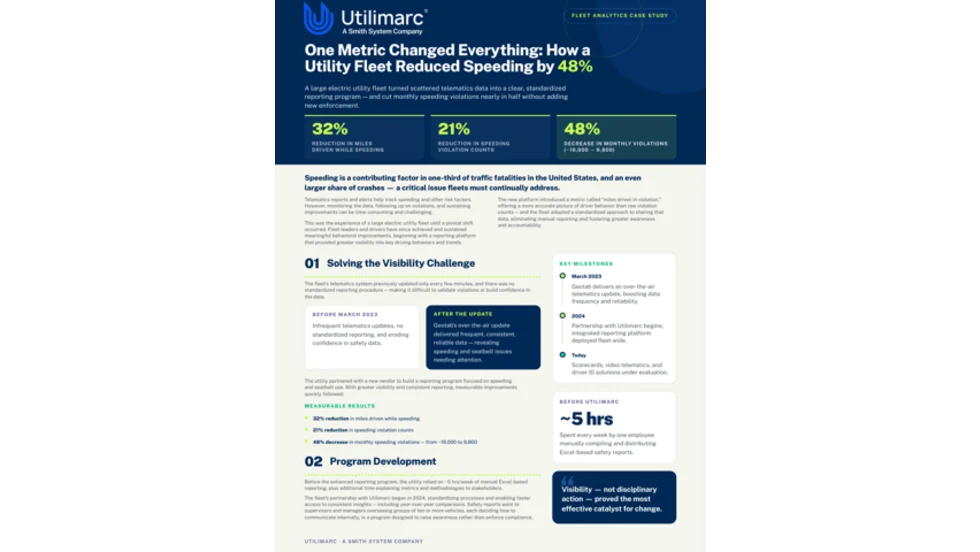
How Better Visibility Cut Speeding Violations by 48%
Fleet leaders don't need more data, they need clearer visibility into what the data is saying. This case study explores how one utility replaced speeding-event counts with a single metric — miles driven in violation — to strengthen safety and significantly reduce speeding violations.
Read More →
Operation Safe Driver Week: Why the Industry's Oldest Safety Campaign Still Matters to Fleets
A look at how a 2007 enforcement initiative became one of the most consequential weeks on the fleet safety calendar, and what it means for your drivers in 2026.
Read More →