





Related news: Ford Outlines EV, Tech, Customer Growth Strategy
New Ford Service Aims To Boost Customer Uptime, Lower Costs
The new company within Ford will offer bundled financing for vehicles, services, and EV charging as well as hardware and software solutions for public, depot, and overnight home charging of EVs.
May 26, 2021
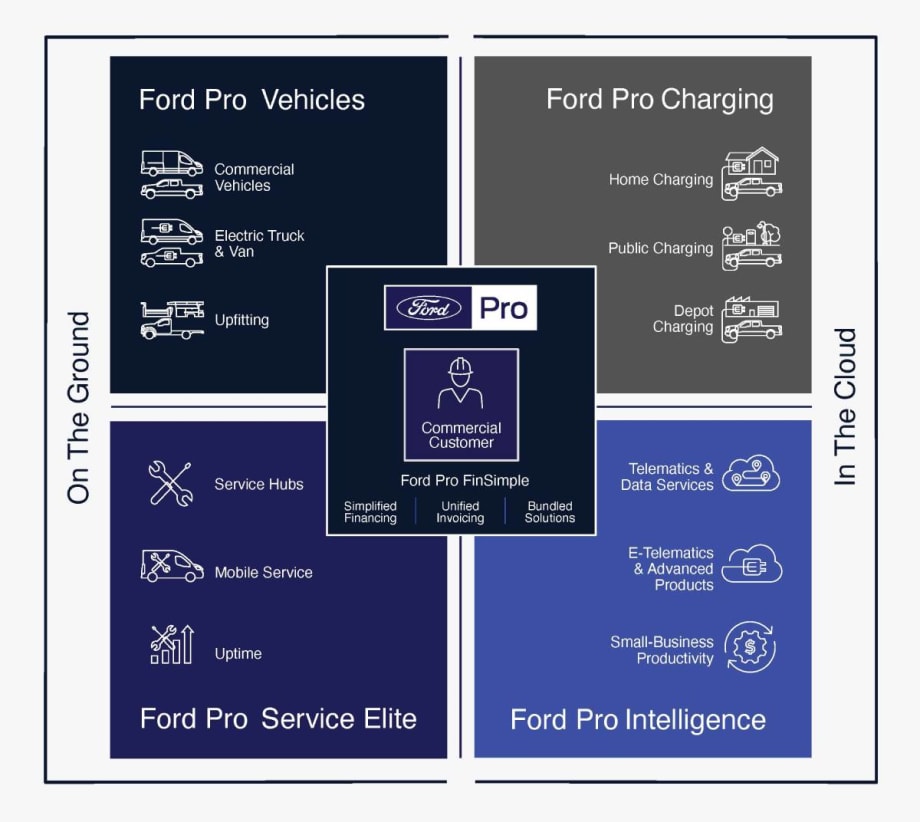
An overview of the services and products of the new Ford Pro, a new separate business within Ford Motor Co.
Photo: Ford
3 min to read
Ford is launching Ford Pro, a global vehicle services and distribution business that wants to help customers increase uptime and reduce ownership costs while improving their productivity and performance.
The new business, separate within Ford, evolves from the Ford+ plan for long-term growth announced May 26. Ford+ is based on building always-on customer relationships.
“We’re creating a one-stop shop to help those customers increase uptime and productivity while reducing complexity and the total cost of ownership,” said Ford CEO Jim Farley.
Ford Pro is focused on the range of F-Series and Ranger trucks, as well as Transit and the upfitting of all of them. Soon, Ford will start making high-volume electric vehicles, including the E-Transit later this year and the F-150 Lightning Pro in mid-2022, which Ford Pro will pair with commercially focused charging solutions.
Ford Pro anticipates its growing capabilities and appeal to generate $45 billion in revenue from hardware and adjacent and new services by 2025 – up from $27 billion in 2019. In North America, Ford’s share of Class 1 through Class 7 full-size trucks and vans today exceeds 40%. In Europe, Ford has been the leading commercial vehicle brand for six consecutive years, according to the automaker.
Farley said Ford Pro will be led by Ted Cannis as CEO. Cannis will collaborate with Hans Schep, general manager of commercial vehicles for Ford of Europe, and other regional leaders. Cannis heads Ford’s North America CV business and previously was leader of the Team Edison electric-vehicle development group.

Ford Pro will be led by Ted Cannis as CEO. He now heads Ford’s North America CV business and previously was leader of the Team Edison electric-vehicle development group.
Photo: Ford
Redefining, Unlocking Commercial Customer Value
Ford Pro, which will implement new services in phases, is aimed at helping commercial customers work better, with productive, durable and smart vehicles and connected services.
Ford today has relationships with nearly 125,000 commercial and government fleet customers in North America and thousands more in Europe and elsewhere. Ford Pro is designed to even more rapidly and feasibly anticipate and address their needs and those of new customers.
Ford Pro will integrate, digitize and simplify transportation with capabilities spanning:
Ford Pro Vehicles: Including Ford’s broad lineup of combustion-engine and hybrid commercial vehicles and, soon, all-electric versions of the company’s vans and full-size pickup trucks developed for commercial use.
Ford Pro Charging: Hardware and software solutions for public, depot and overnight home charging of EVs so they’re ready to work again the next day.
Ford Pro Intelligence: Digital services, with distinct features integrated in their vehicles that enable customers to better manage and maintain their fleets.
Ford Pro Services Elite: Expanding Ford’s strong network of CV centers by adding 120 dedicated, large-bay service hubs across the U.S. with extended hours and rapid turnaround, plus introducing 1,200 mobile service vehicles by 2025 to meet customers where they are, save them money and get them back in business, and
Ford Pro FinSimple: Bundled financing for vehicles, services and EV charging.
Some elements of Ford Pro commercial services have already been introduced and are growing in Europe, among them the recently launched Ford Fleet Management and Ford Pro Liive. The latter is a connected uptime system expected to reduce downtime of customer fleets by up to 60%. Such enhanced services are generating higher levels of customer satisfaction and loyalty, and growth for Ford.
Ford Pro will initially launch in North America and Europe.
Originally posted on Charged Fleet
More Operations
Here's When You Should Make an Exception to Fleet Policy
Fleet policies are designed to create consistency, but not every driver or situation fits neatly within standard rules.
Read More →
AI-Native or AI-Acquired: What Should Fleet Managers Look for in an AI Platform?
Six questions can help fleet managers look beyond AI marketing claims to evaluate integration, data access, and real-world operational performance.
Read More →
Sponsored•October 14, 2026
A buyer's guide to fleet management software in 2027
Buying fleet management software in 2027 means looking beyond features and price. As fleet operations, technology and expectations evolve, this guide explores what today’s fleet professionals should consider when choosing a system that can deliver value now and adapt to what comes next.
Read More →

What Will Shape the Next Era of Fleet Management?
EVs, AI, and autonomous vehicles are reshaping fleet management. Discover what’s ahead—and how fleet leaders can prepare for the next era.
Read More →
How Fleets Can Recruit and Train Veterans for Technician Roles
Here's how the technician shortage has affected uptime for fleets, and what to do about it.
Read More →
Avis Budget Group Deploys Neology Toll Management Technology Across Major Brands
Neology’s neoFleet platform will manage toll transactions and toll-authority operations for vehicles across Avis, Budget, Payless, Budget Truck and Zipcar.
Read More →
Fleet Personal-Use Charges Edge Higher in 2026
Nearly eight in 10 surveyed fleets allow personal use of company vehicles, while just over half of respondents report charging employees for the privilege.
Read More →
The Future of Fleet + What’s Changing Right Now | AF News Recap
Could developments overseas offer a preview of what’s coming for U.S. fleets? This week, we’re looking at the future of AI, autonomy, and electrification, plus Ford Pro’s new certified pre-owned program, smarter vehicle offboarding, and a new way for fleets to manage toll expenses.
Read More →
How to Handle Vehicle Offboarding
What do fleet managers need to do when a driver leaves?
Read More →
Sponsored•October 1, 2026
Fleet Manager’s Ultimate Playbook: Navigating the New Standard in OEM Connectivity
Rising operating costs, driver safety concerns, and unplanned downtime are putting unprecedented pressure on modern fleets. Discover how fleet managers use embedded OEM connectivity and real-time vehicle data to cut TCO, prevent downtime, and protect drivers without aftermarket telematics hardware.
Read More →