




DEARBORN, MI — The new mid-size cars from Ford and Mercury are at the top of the list of low-emissions vehicles. The standard Duratec 23 I-4 with automatic transaxle on the Fusion and Milan will be rated as a Partial Zero Emissions Vehicle (PZEV) in states that have adopted California’s emissions regulations. In addition, the Duratec 30 V-6 option is the cleanest Duratec 30 ever produced, qualifying for Ultra Low Emissions Vehicle (ULEV) II tailpipe emissions. Federal Tier 1 emission standards are the basic standards in the United States, while the updated Tier 2 standards started a phase-in process in 2004 and should be fully implemented in 2007 for light-duty vehicles. The PZEV designation means that the Fusion, Zephyr, and Milan must meet the Super Ultra Low Emission Vehicle (SULEV) standards plus eliminate fuel system evaporative emissions and include a powertrain limited warranty ensuring that these stringent criteria will be met for an extended lifetime of 15 years or 150,000 miles. While the 23 I-4 meets California’s stringent standards, outside of California, the PZEV has slightly higher tailpipe emissions — even though the car’s electronics, powertrain, and emissions equipment are identical — because other states have not adopted Cali-fornia’s clean-fuels program. The Duratec 30 V-6 will meet federal Low Emissions Vehicle (LEV) II standards and ULEV II tailpipe emissions in California. To achieve the emissions control, the Ford engineers began by implementing a number of improvements to the induction, calibration, and exhaust systems of the Duratec 23 to achieve LEV II certification. From that platform, the powertrain team targeted ignition and evaporative emissions to qualify for PZEV certification. Changes to decrease emissions at startup include a Ported Electronic Thermactor Air system, which injects warmer air and additional oxygen into the intake manifold to enable more combustion and decrease the amount of unconsumed gasoline in the system. In addition, recycling cold-start exhaust back through the engine provides a second opportunity to trap emissions after the catalysts reach operating temperature. To help the catalysts reach operating temperature faster, the team installed a stainless steel, dual-walled manifold that heats up faster than the standard Duratec 23 cast-iron manifold.
New Ford Mid-Size Cars Are Tops for Low Emissions
DEARBORN, MI — The new mid-size cars from Ford and Mercury are at the top of the list of low-emissions vehicles.
More Operations

BBL Fleet Acquires Velcor Leasing Corporation
BBL Fleet expanded its footprint in the fleet management industry with the acquisition of Velcor Leasing Corporation of Madison through a stock purchase agreement finalized Feb. 27, 2026.
Read More →
Lytx Introduces New AI Fleet Technologies at Protect 2026
The company introduced new AI-driven fleet safety and operations technologies during its annual user conference.
Read More →
Fleet Costs Are Rising: Here’s How Leaders Are Responding
Fleet leaders are under pressure to reduce costs, adapt to economic uncertainty, and make smarter decisions. See how peers across North America are responding with real data, proven strategies, and forward-looking insights. Download the 2026 Market Pulse Report to benchmark your strategy and uncover where you can gain an edge.
Read More →
From Waffle House to AI: Fleet Trends You Need to Know
In this AF news recap, host Faith Howell covers how Waffle House stepped up during disaster response and new AI tech on the market.
Read More →
Fleet Operations in the Age of AI: Navigating Ethical and Legal Challenges
AI is no longer a future concept for fleets—it’s already embedded in the tools, data, and decisions that operators rely on every day. In this episode of the Fleet Forward Podcast, recorded live at Fleet Forward, industry leaders take the conversation beyond hype to examine what responsible AI adoption really looks like in fleet operations.
Read More →
Factory Installed vs. Aftermarket: Choosing the Right Telematics Path & Managing the Data
As fleets rethink how they capture, manage, and act on vehicle data, telematics is at a major inflection point. In this episode of the Fleet Forward Podcast, we dive deep into one of the most pressing questions facing fleet leaders today: Should you rely on OEM factory-installed connectivity, aftermarket devices, or a hybrid of both?
Read More →
What Real-Time Data Reveals About EV Cost, Performance, and Scalability
Experts from telematics analytics, fleet-as-a-service operations, and national EV benchmarking share how real-time data is reshaping fleet strategy—dispelling assumptions, validating best practices, and exposing costly missteps.
Read More →
Planning Through Policy Shifts: What Fleets Must Track in 2026
A powerhouse panel featuring experts from the American Automotive Leasing Association, CalSTART, and municipal fleet leadership dives into the realities of navigating shifting emissions rules, regulatory waivers, federal agency actions, the future of the EPA’s endangerment finding, and the push for unified standards. They also examine the impacts of tariffs, autonomous vehicle policy, battery innovation, and the accelerating global EV market.
Read More →
Managing Market Turbulence with Strategic Fleet Insights
This episode kicks off with a deep dive into the technologies and market forces reshaping today’s fleet landscape. Host Chris Brown is joined by Laolu Adeola (Leke Services), Tyson Jomini (J.D. Power), and Richard Hall (ZappiRide) to break down real-world data, shifting incentives, and practical strategies fleet leaders can use right now.
Read More →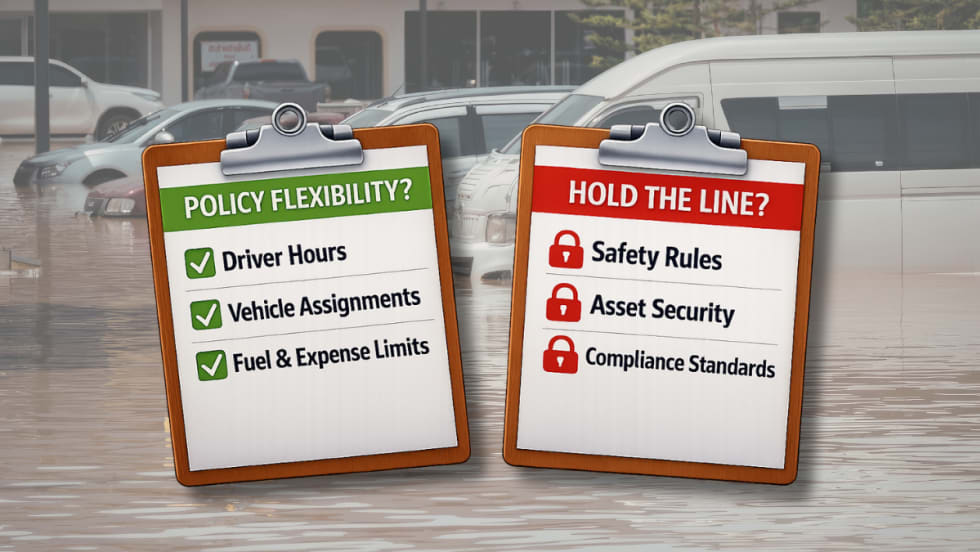
Adapting Fleet Policy When Disasters Strike
In the middle of natural disasters fleet managers must shift priorities to protect people and assets. What policy items should be loosened, and when should the line be held?
Read More →