Automotive Fleet
MenuMENU
SearchSEARCH

NCSFA Adopts NAFA's CAFM Program

PRINCETON, NJ – NAFA and the National Conference of State Fleet Administrators (NCSFA) have joined forces to offer NAFA's Certified Automotive Fleet Manager (CAFM) program to NCSFA members.

by Staff
December 14, 2007
3 min to read


PRINCETON, NJ – NAFA and the National Conference of State Fleet Administrators (NCSFA) have joined forces to offer NAFA’s Certified Automotive Fleet Manager (CAFM) program to NCSFA members.

The NAFA CAFM program is designed to identify and recognize exceptional fleet management professionals. Established more than two decades ago as the Certified Fleet Management program with the University of Pennsylvania’s Wharton School of Business and now administered solely by NAFA, the CAFM program is the most comprehensive fleet certification program available, requiring an ongoing five year recertification cycle and including material for both public service and private fleets.

Ad Loading...

“Our members are very excited; it’s one of the best things to ever happen to NCSFA,” said Steve Saltzgiver, NCSFA Executive Director. “Being able to participate in a certification program, especially one as well established as NAFA’s, is exactly what our members have been looking for. I know it’s the beginning of a long and productive collaboration.”

NCSFA chose the CAFM program because it is the oldest, largest and most rigorous in the industry, providing a complete curriculum and requiring an ongoing five year recertification cycle. The CAFM program certifies expertise in the fleet management profession and requires a commitment to continuous education.

Under the terms of the partnership agreement, NAFA will offer member enrollment rates to NCSFA members, as well as a group rate for larger enrollments from NCSFA. NAFA has also modified its recertification point system to allow more points for participation at NCSFA events and for NCSFA volunteer service. NCSFA will solely endorse and market the CAFM program to its members and appoint a qualified graduate advisor to NAFA’s Certification Board.

“NAFA’s partnership with NCSFA is another example of the great esteem the entire industry has for the CAFM program,” explained NAFA Executive Director Phillip E. Russo, CAE. “This partnership instantly enables NCSFA members to enroll in the program and take advantage of the comprehensive curriculum it offers.”

NAFA delivers fleet management education through a variety of instructor-led and reference products. At the pinnacle of NAFA’s education system stands the CAFM program. Successful completion of the CAFM program requires passing all eight disciplines in NAFA’s core competency model within a three-year period. The eight disciplines are: Asset Management, Business Management, Financial Management, Fleet Information Management, Maintenance Management, Risk Management, Vehicle Fuel Management and Professional Development.

Ad Loading...

The NCSFA was established to encourage communication between state officials involved in fleet administration. Through NCSFA, these administrators have established a nationwide network for information exchange facilitated by an annual conference, a quarterly newsletter, national surveys, and a compilation of fleet-related data and experience. NCSFA members are the primary decision-makers in their respective organizations on matters of fleet and fuel management.

Both organizations recognize a mutual commitment to excellence in their common pursuit of the development and advancement of the fleet management profession. Each organization recognizes that members of both organizations can benefit from the synergies of a strategic alliance.


Topics:Operations

More Operations

Handshake graphic featuring BBL Fleet and Velcor Leasing Corporation logos announcing BBL Fleet’s acquisition of Velcor to expand fleet management services nationwide.
Operationsby News/Media ReleaseMay 8, 2026

BBL Fleet Acquires Velcor Leasing Corporation

BBL Fleet expanded its footprint in the fleet management industry with the acquisition of Velcor Leasing Corporation of Madison through a stock purchase agreement finalized Feb. 27, 2026.

Read More →
Graphic reading “What’s New From Lytx at Protect 2026?” over a blue digital network background highlighting Lytx fleet technology and AI-powered safety solutions.
Operationsby News/Media ReleaseMay 6, 2026

Lytx Introduces New AI Fleet Technologies at Protect 2026

The company introduced new AI-driven fleet safety and operations technologies during its annual user conference.

Read More →
Cover image for the “5th Annual Market Pulse Report” by Element titled “Navigating fleet management in 2026: Data and insights shaping the future of fleet and mobility.” The design features an aerial view of a cable-stayed bridge with vehicles traveling on a highway beside a dense green forest. A teal graphic panel overlays the lower portion of the image, with the Element logo and tagline “Intelligence in motion” at the bottom.
SponsoredMay 6, 2026

Fleet Costs Are Rising: Here’s How Leaders Are Responding

Fleet leaders are under pressure to reduce costs, adapt to economic uncertainty, and make smarter decisions. See how peers across North America are responding with real data, proven strategies, and forward-looking insights. Download the 2026 Market Pulse Report to benchmark your strategy and uncover where you can gain an edge.

Read More →
Ad Loading...
A blue Automotive Fleet graphic representing the weekly AF News Recap series.
Operationsby Faith HowellMay 4, 2026

From Waffle House to AI: Fleet Trends You Need to Know

In this AF news recap, host Faith Howell covers how Waffle House stepped up during disaster response and new AI tech on the market.

Read More →
OperationsApril 30, 2026

Fleet Operations in the Age of AI: Navigating Ethical and Legal Challenges

AI is no longer a future concept for fleets—it’s already embedded in the tools, data, and decisions that operators rely on every day. In this episode of the Fleet Forward Podcast, recorded live at Fleet Forward, industry leaders take the conversation beyond hype to examine what responsible AI adoption really looks like in fleet operations.

Read More →
OperationsApril 30, 2026

Factory Installed vs. Aftermarket: Choosing the Right Telematics Path & Managing the Data

As fleets rethink how they capture, manage, and act on vehicle data, telematics is at a major inflection point. In this episode of the Fleet Forward Podcast, we dive deep into one of the most pressing questions facing fleet leaders today: Should you rely on OEM factory-installed connectivity, aftermarket devices, or a hybrid of both?

Read More →
Ad Loading...
OperationsApril 30, 2026

What Real-Time Data Reveals About EV Cost, Performance, and Scalability

Experts from telematics analytics, fleet-as-a-service operations, and national EV benchmarking share how real-time data is reshaping fleet strategy—dispelling assumptions, validating best practices, and exposing costly missteps.

Read More →
OperationsApril 30, 2026

Planning Through Policy Shifts: What Fleets Must Track in 2026

A powerhouse panel featuring experts from the American Automotive Leasing Association, CalSTART, and municipal fleet leadership dives into the realities of navigating shifting emissions rules, regulatory waivers, federal agency actions, the future of the EPA’s endangerment finding, and the push for unified standards. They also examine the impacts of tariffs, autonomous vehicle policy, battery innovation, and the accelerating global EV market.

Read More →
OperationsApril 30, 2026

Managing Market Turbulence with Strategic Fleet Insights

This episode kicks off with a deep dive into the technologies and market forces reshaping today’s fleet landscape. Host Chris Brown is joined by Laolu Adeola (Leke Services), Tyson Jomini (J.D. Power), and Richard Hall (ZappiRide) to break down real-world data, shifting incentives, and practical strategies fleet leaders can use right now.

Read More →
Ad Loading...
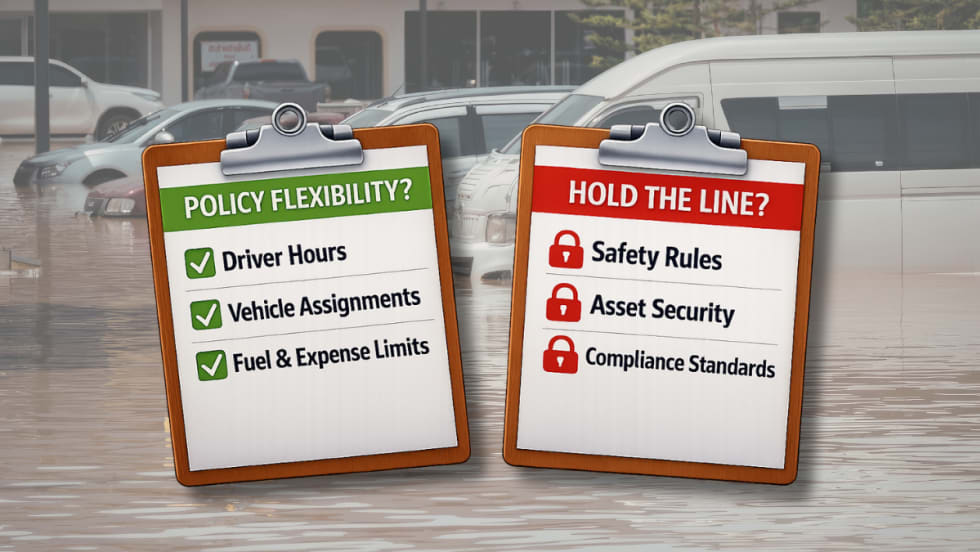
Clipboards with flooded cars in background.
Disaster Responseby Chris BrownApril 30, 2026

Adapting Fleet Policy When Disasters Strike

In the middle of natural disasters fleet managers must shift priorities to protect people and assets. What policy items should be loosened, and when should the line be held?

Read More →