




Navistar Details Medium-Duty Deal with GM
The Class 4/5 trucks that will be jointly developed by Navistar and General Motors will provide opportunities for both OEMs “to gain share in markets that we have not participated in for a number of years,” said Navistar's Bill Kozek.

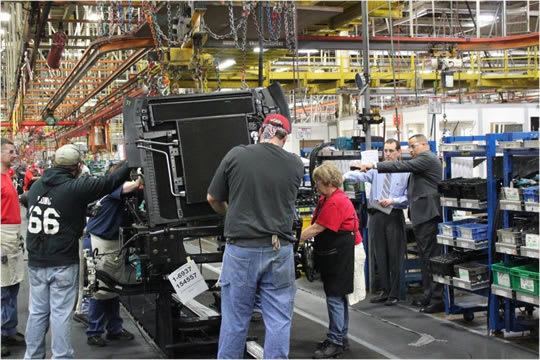
The jointly engineered Class 4/5 trucks will be built in Navistar's Springfield, OH, assembly plant, starting in 2018. Photo: Dept. of Labor
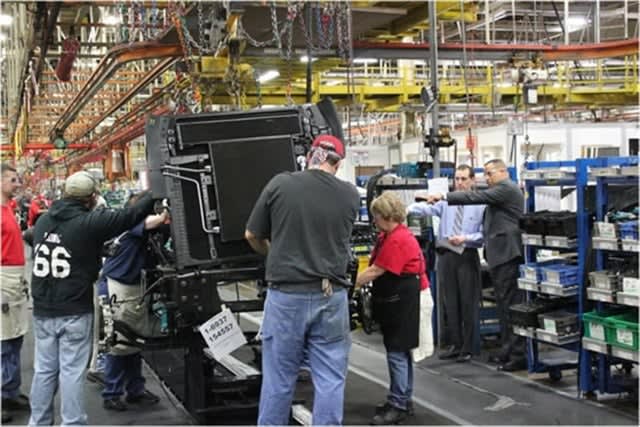
The jointly engineered Class 4/5 trucks will be built in Navistar's Springfield, OH, assembly plant, starting in 2018.Photo: Dept. of Labor
The Class 4/5 trucks that will be jointly developed by Navistar and General Motors for production in 2018 will provide opportunities for both OEMs “to gain share in markets that we have not participated in for a number of years,” Bill Kozek, president, Truck and Parts, Navistar, said during a Sept. 30 conference call held by Navistar a few hours after the agreement was announced.
Kozek said the new trucks will be jointly engineered to leverage Navistar’s manufacturing expertise and GM’s expertise in commercial components and engines.
He remarked that, with production slated to begin in 2018, it was too early to discuss specifics but allowed that “diesel engines will be offered.”
As for how the trucks will be badged, he explained that “they will be branded as Chevrolets, under GM’s plan, and for us as Internationals. From our standpoint, the trucks will push more toward the Class 5 category— they could be box trucks or used or tree service [or other work-truck uses]....primarily in the construction segment. On the Chevy side, they will move toward Class 4; more of a pickup-type vehicle.”
He said the new model will replace the current TerraStar, a Class 4/5 truck, in the International lineup in 2018.
“We’re reluctant to describe these trucks as [combining] a GM-developed powertrain with a Navistar-developed chassis,” Kozek said. “Really, this will be a jointly developed product.”
The cab for the new conventionals, to be co-developed by Navistar and GM, will have "a different look to it” than those currently offered, said Kozek, who noted that the two truck makers “may look at [developing] cabovers down the road.”
He also advised that while the two OEMs have “not had any discussions to date” on jointly developing trucks for other weight classes, that “certainly could happen” at some point.
The new trucks will be manufactured at Navistar’s facility in Springfield, Ohio. Kozek said the OEM plans to add 300 jobs and invest more than $12 million in facility and equipment at the plant to produce the new vehicles.
More Operations
A buyer's guide to fleet management software in 2027
Buying fleet management software in 2027 means looking beyond features and price. As fleet operations, technology and expectations evolve, this guide explores what today’s fleet professionals should consider when choosing a system that can deliver value now and adapt to what comes next.
Read More →
What Will Shape the Next Era of Fleet Management?
EVs, AI, and autonomous vehicles are reshaping fleet management. Discover what’s ahead—and how fleet leaders can prepare for the next era.
Read More →
How Fleets Can Recruit and Train Veterans for Technician Roles
Here's how the technician shortage has affected uptime for fleets, and what to do about it.
Read More →

Avis Budget Group Deploys Neology Toll Management Technology Across Major Brands
Neology’s neoFleet platform will manage toll transactions and toll-authority operations for vehicles across Avis, Budget, Payless, Budget Truck and Zipcar.
Read More →
Fleet Personal-Use Charges Edge Higher in 2026
Nearly eight in 10 surveyed fleets allow personal use of company vehicles, while just over half of respondents report charging employees for the privilege.
Read More →
The Future of Fleet + What’s Changing Right Now | AF News Recap
Could developments overseas offer a preview of what’s coming for U.S. fleets? This week, we’re looking at the future of AI, autonomy, and electrification, plus Ford Pro’s new certified pre-owned program, smarter vehicle offboarding, and a new way for fleets to manage toll expenses.
Read More →
How to Handle Vehicle Offboarding
What do fleet managers need to do when a driver leaves?
Read More →
Fleet Manager’s Ultimate Playbook: Navigating the New Standard in OEM Connectivity
Rising operating costs, driver safety concerns, and unplanned downtime are putting unprecedented pressure on modern fleets. Discover how fleet managers use embedded OEM connectivity and real-time vehicle data to cut TCO, prevent downtime, and protect drivers without aftermarket telematics hardware.
Read More →
U.S. Bank Adds Verra Mobility Toll Management to Voyager Fleet Platform
The integration allows U.S. Bank Voyager fleet customers to manage toll payments and violations alongside fuel, EV charging and maintenance expenses.
Read More →
ADAS Prevents Crashes. But Repairs Cost More | AF News Recap
ADAS-equipped vehicles may crash less often, but they can cost more when they do. This week, we’re breaking down what that tradeoff means for fleets, plus Subaru’s first Forester Wilderness Hybrid, Nissan’s new e-POWER Rogue, and why Calstart has become Catalyst Mobility.
Read More →