




National Safety Council Grants Help Prevent Roadway Deaths
The National Safety Council's Road to Zero Coalition has awarded its annual grants to support organizations with innovative concepts to make roadways safer and eliminate preventable roadway deaths.

Photo via Minesweeper/Wikipedia.

Photo via Minesweeper/Wikipedia.
The National Safety Council's Road to Zero Coalition has awarded its annual grants to support organizations with innovative concepts to make roadways safer and eliminate preventable roadway deaths.
The winners of the 2018 Safe System Innovation grants came from a pool of 81 applicants.
The grants are funded by the National Highway Traffic Safety Administration at the Department of Transportation, provide $1 million annually and $3 million for three years (2017-2019). The NSC is providing $1 million in-kind toward the program over three years. The Federal Highway Administration has pledged an additional $500,000 toward the program.
Officials at the Department of Transportation and the Centers for Disease Control and Prevention rated all grant applications. The 2018 grant recipients include the following eight organizations:
America Walks: Accelerating adoption of safer systems for all road users
Bicycle Colorado: Bicycle-friendly driver and confident commuting program
Center for Latino Progress - CPRF: Cooperative community crash reduction in Hartford, Conn.
City of Boston Mayor's Office of New Urban Mechanics: Boston's safest driver
Lorain County Public Health: Lorain active transportation collaborative
National Opinion Research Center (NORC) at the University of Chicago: Underutilized strategies in traffic safety
Texas A&M University Department of Industrial and Systems Engineering, in collaboration with Houston Methodist Hospital: A systems approach to reduce drowsy driving among night-shift nurses
University of Alabama at Birmingham, in collaboration with Safe Kids Worldwide: Improving child restraint installation in rural America through interactive virtual presence
Actual amounts of the grants for each recipient vary and will be announced sometime next month, according to the NSC who manages the program.
Essentially, grant recipients reflect the coalition's mission of eliminating roadway deaths by 2050. Applicants must meet specific criteria in order to earn a Safe System Innovation grant. To qualify, an organization must clearly explain how its program will improve safety on the roadways, set a timeframe for the reduction, outline how the program will be evaluated and detail how the organization intends to reach its target audience, among other elements.
"We had an impressive pool of applicants, but the creativity and carefully considered strategies of the grant recipients set them apart. We look forward to working with them on our shared journey toward zero deaths," said Deborah A.P. Hersman, president and CEO of the National Safety Council.
Preliminary estimates indicate that some 40,000 people were killed in 2017 in motor vehicle accidents. The Safe System Innovation grants are one more way the coalition is working to end roadway fatalities.
The Road to Zero Coalition was launched in October 2016 as a joint effort between the National Highway Traffic Safety Administration, the Federal Highway Administration, the Federal Motor Carrier Safety Administration and NSC.
More Safety

Nexar-Nauto Merger Aims to Give Fleets Better Safety Intelligence Through Larger Driving Dataset
Stefan Heck tells Automotive Fleet that combining more than 10 billion miles of driving history with Nexar's AI models will give fleets deeper insights into driver risk and roadway conditions than either company could provide independently.
Read More →
Don't Wait for a Crisis: 5 Ways to Build Mental Health Into Your Fleet Safety Program
For Suicide Prevention Month, fleet and safety leaders have an opportunity to put mental health where it belongs: at the center of workplace safety.
Read More →
How Camera Data Can Strengthen a Fleet’s Insurance Renewal
Insights from a commercial insurance carrier and a broker show how fleets can turn video telematic data, driver coaching, and improved claims results into a stronger case at insurance renewal.
Read More →
The Safest Fleets Aren’t the Ones with the Most Technology
You’ve made the telematics investment. Here’s how to capture the other half of its value and build the safest fleet on the road.
Read More →
Hidden in Plain Sight: Fleet Compliance Risks
Fleet compliance isn't just about having policies — it's about consistently enforcing them. This practical guide reveals six hidden compliance risks common in public sector and shared fleet operations and outlines proven strategies to improve visibility, accountability, and audit readiness
Read More →
NETS Sets 2026 Fleet Safety Benchmark Conference for Indianapolis
The Sept. 15–17 program will feature fleet benchmarking data, case studies, emerging technologies, and implementation strategies while running alongside the NSC Safety Congress & Expo.
Read More →
Off-the-Job Crashes Account for 43% of Employers’ $61.7 Billion Crash Burden
NETS quantifies costs dispersed across fleet, risk, HR, and other departments while providing new per-crash benchmarks for employers.
Read More →
Ram Recalls More Than 1.27 Million 1500 Pickups for Seat Belt Anchor Issue
The recall affects certain 2019-2026 Ram 1500 pickups that may have improperly attached second-row seat belt buckle anchors.
Read More →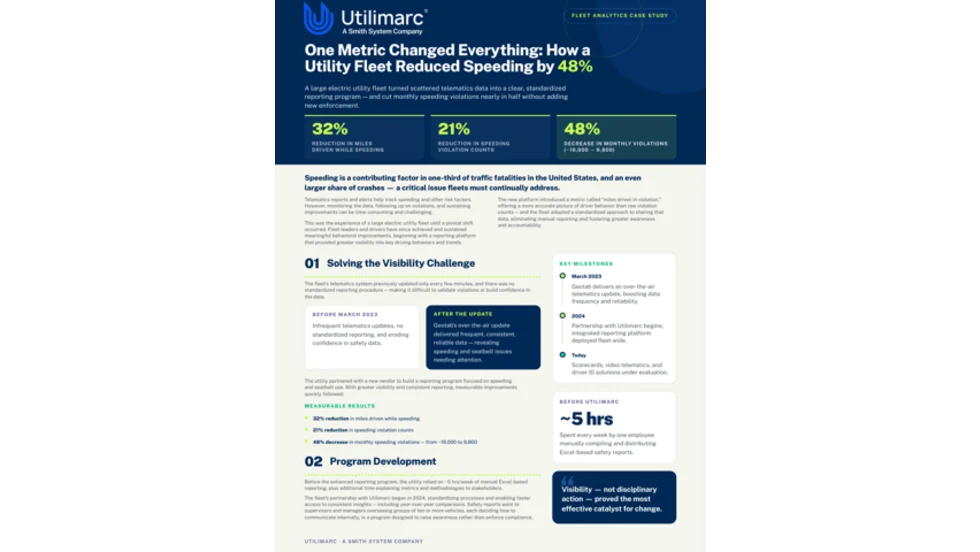
How Better Visibility Cut Speeding Violations by 48%
Fleet leaders don't need more data, they need clearer visibility into what the data is saying. This case study explores how one utility replaced speeding-event counts with a single metric — miles driven in violation — to strengthen safety and significantly reduce speeding violations.
Read More →
Operation Safe Driver Week: Why the Industry's Oldest Safety Campaign Still Matters to Fleets
A look at how a 2007 enforcement initiative became one of the most consequential weeks on the fleet safety calendar, and what it means for your drivers in 2026.
Read More →