





Related: IIHS Developing Ratings for Advanced Driver Assistance Systems
Mobileye, Geotab Technology Tested by Insurance Institute
Retrofitting older vehicles with a collision warning system and a telematics device can significantly improve driver behavior and enhance safety, according to a new study from the Insurance Institute for Highway Safety.
November 6, 2018
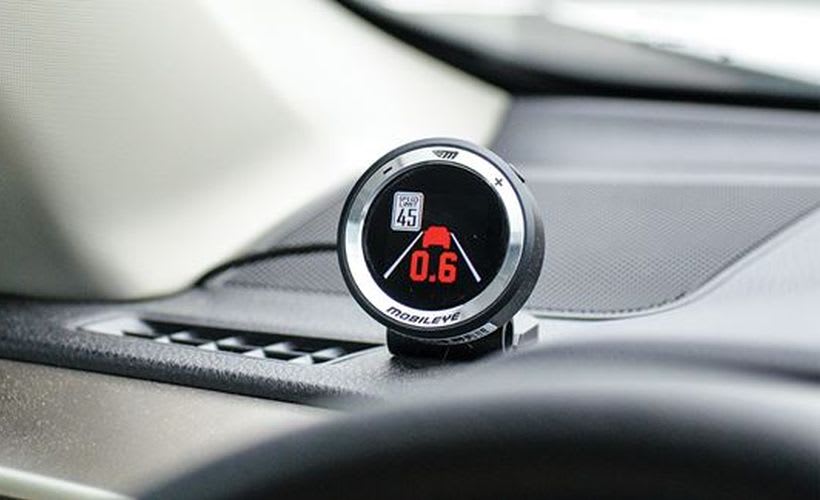
During a study of Mobileye and Geotab technology, drivers used turn signals more often and increased following distances after receiving alerts.
Photo courtesy of IIHS.
3 min to read
Retrofitting older vehicles with a collision warning system and a telematics device can significantly improve driver behavior and enhance safety, according to a new study from the Insurance Institute for Highway Safety.
Motorists demonstrated safer driving behaviors across the study period, according to the institute. For example, drivers used turn signals more often and increased following distances after receiving alerts. Speeding, however, did not change dramatically between the baseline and the alert periods.
The findings could be reassuring and serve as an added safety precaution for fleets that rely on older models.
For the study, 22 volunteers signed up to have their personal vehicles outfitted with a Mobileye aftermarket collision warning system, and 17 of them also agreed to have their driving monitored by a Geotab in-vehicle telematics unit.
The Mobileye package featured an in-vehicle display and included forward collision warning; urban forward collision warning, which operates at speeds below 20 mph; pedestrian collision warning; headway monitoring and warning, which measures following distance at speeds above 19 mph; lane departure warning; and a speed limit indicator, which displays the posted speed limit.
The thresholds for triggering the various crash warning alerts were fixed; drivers couldn't disable or customize alerts.
In a post-study survey, some 62% of the volunteers said the Mobileye system helped boost their safety behind the wheel. Drivers evaluated forward collision warning as the most useful system, followed by lane departure warning, headway monitoring and the speed limit indicator.
The study assessed driving behavior over two periods: a four week baseline when the systems were active, but did not issue alerts, and an eight-week period when the crash system alerts were continually issued.
During the baseline period, the telematics devices in equipped vehicles logged GPS locations, hard braking and cornering, travel speed and Mobileye alerts that would have been issued if the system were active.
Volunteers than drove for eight weeks receiving alerts and a weekly Mobileye "safety score."
Key findings include:
As drivers grew accustomed to the system between the baseline and alert periods, the rate of forward collision alerts decreased 45% among rural drivers and 30% among urban drivers.
The opposite was true for lane departure warning. Urban drivers saw a bigger decline—70%-- in the rate of alerts than the rural drivers (54%) between the baseline and treatment periods.
Warnings about following too closely also decreased. Headway alerts fell 63% for rural drivers and 39% for urban drivers between the baseline and treatment periods.
The IIHS points to one study takeaway of particular interest to fleet managers who use aftermarket collision warning systems and telematics devices to monitor driving performance.
"Fleet drivers who travel congested roads would be more likely to encounter situations that trigger forward collision and headway warnings than drivers who log more miles in sparsely populated areas," said Ian Reagan, a senior research scientist with IIHS and the author of the new study. "Their managers should take into account external factors such as traffic density when comparing drivers on safety measures across geographical regions."
More Safety

What’s Next for Fleet? Safety, AI & Industry Recognition | AF News Recap
Could your company's culture be encouraging distracted driving? This week, we're exploring how workplace expectations affect driver safety, what AI, EVs, and autonomous vehicles could mean for the future of fleet management, and how fleet professionals can strengthen their award nominations.
Read More →
Does Your Fleet's Culture Encourage Distracted Driving?
What happens when the people responsible for enforcing safety rules are the ones setting the wrong example? The answer may reveal why some of the biggest risks to fleet drivers have little to do with what's written in the employee handbook.
Read More →
Sponsored•October 1, 2026
Fleet Manager’s Ultimate Playbook: Navigating the New Standard in OEM Connectivity
Rising operating costs, driver safety concerns, and unplanned downtime are putting unprecedented pressure on modern fleets. Discover how fleet managers use embedded OEM connectivity and real-time vehicle data to cut TCO, prevent downtime, and protect drivers without aftermarket telematics hardware.
Read More →
From Driver Well-Being to EV Charging | AF News Recap
Mental health belongs in the fleet safety conversation. This week, we’re looking at five ways fleets can support employee well-being before a crisis, plus Holman’s expansion in Mexico, new one-day Fleet Forward passes, and why EV charging demand is outpacing infrastructure growth.
Read More →
Nexar-Nauto Merger Aims to Give Fleets Better Safety Intelligence Through Larger Driving Dataset
Stefan Heck tells Automotive Fleet that combining more than 10 billion miles of driving history with Nexar's AI models will give fleets deeper insights into driver risk and roadway conditions than either company could provide independently.
Read More →
Don't Wait for a Crisis: 5 Ways to Build Mental Health Into Your Fleet Safety Program
For Suicide Prevention Month, fleet and safety leaders have an opportunity to put mental health where it belongs: at the center of workplace safety.
Read More →
How Camera Data Can Strengthen a Fleet’s Insurance Renewal
Insights from a commercial insurance carrier and a broker show how fleets can turn video telematic data, driver coaching, and improved claims results into a stronger case at insurance renewal.
Read More →
The Safest Fleets Aren’t the Ones with the Most Technology
You’ve made the telematics investment. Here’s how to capture the other half of its value and build the safest fleet on the road.
Read More →
Sponsored•August 7, 2026
Hidden in Plain Sight: Fleet Compliance Risks
Fleet compliance isn't just about having policies — it's about consistently enforcing them. This practical guide reveals six hidden compliance risks common in public sector and shared fleet operations and outlines proven strategies to improve visibility, accountability, and audit readiness
Read More →
NETS Sets 2026 Fleet Safety Benchmark Conference for Indianapolis
The Sept. 15–17 program will feature fleet benchmarking data, case studies, emerging technologies, and implementation strategies while running alongside the NSC Safety Congress & Expo.
Read More →