




Mercedes 2012-MY M-Class Features Diesel and Gasoline Models
MONTVALE, NJ – Mercedes has introduced its third-generation Mercedes M-Class. The 2012-MY M-Class includes two models, the ML350 4MATIC and ML350 BlueTEC.

At launch, Mercedes said there will be two models available in the U.S., the diesel-powered ML350 BlueTEC and gasoline-fueled ML350 4MATIC.

MONTVALE, NJ – Mercedes has introduced its third-generation Mercedes M-Class. The 2012-MY M-Class will debut at retail in September 2011 and includes two models, the ML350 4MATIC and ML350 BlueTEC.
Performance and Handling
At launch, Mercedes said there will be two models available in the U.S. The ML350 BlueTEC 4MATIC produces 240 hp and 455 lb.-ft. of torque, with an estimated mpg of 20 city, 25 highway. With 302 hp and 273 lb.-ft. of torque, the gasoline-engine ML350 4MATIC has an estimated fuel economy of 17/22. The ML350 BlueTEC model uses a redesigned 3.0L V-6 diesel engine, which meets emissions standards in all 50 states, Mercedes stated.
Mercedes added the Agility Control adaptive damping system to the M-Series models, which is designed to enhance passenger comfort on uneven roads. The automaker said that during hard driving or abrupt evasive maneuvers, the shock absorbers become firmer to ensure stability. The ML350 BlueTEC 4MATIC and ML350 4MATIC feature traction systems as part of their standard equipment, including the permanent 4MATIC all-wheel drive system and the electronic traction control system ETS, as well as an off-road button that activates an off-road transmission mode.
Other features include Hill Start Assist and the Hold function, which help the driver pull away on a slope. Downhill Speed Regulation, or DSR, enables the M-Class to automatically maintain the speed set via the cruise control lever.
The optional Dynamic Handling Package features active roll stabilization using the company’s new Active Curve System combined with Airmatic air suspension, Adaptive Damping System (ADS) and 20-inch 5-spoke alloy wheels.
The automaker also offers an “ON&OFFROAD” package for the M-Class, which uses six transmission modes to optimize handling for on- and off-road driving conditions. One automatic mode, two dedicated off-road modes, and three on-road modes are available.
Exterior

Mercedes said it optimized the design of the front bumper, roof spoiler, and A-pillars for low wind resistance. In the U.S., available wheels range from standard 19-inch Twin-Spoke alloy wheels to 20-inch wheels.
Interior
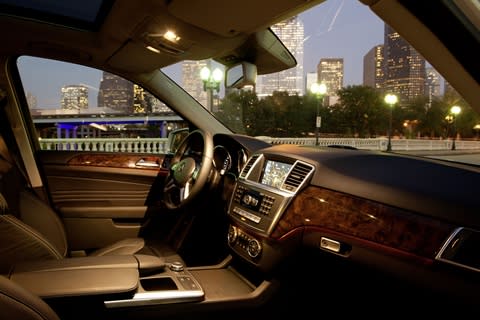
The M-Series’ interior offers more interior room than in previous model years, with 1.34 inches more in the front, .98 inches in the rear. Interior trim comes in four wood finishes or aluminum. The instrument cluster features a 4.5-inch display between the dials. Occupants can adjust the driver and passenger seats’ seat height, backrest rake, seat cushion angle, and reach. Interior colors come in black, almond beige, and grey. With the Sport Interior package, a microfiber and leather combination is available along with premium or two-tone leather.
The new M-Class comes standard with a new audio head unit with a 7-inch color display, Bluetooth audio streaming and telephony, phonebook download, 6-disc CD/DVD/MP3/ AM/FM /weather band radio, HD Radio, album cover art, auxiliary input, and a USB port. As part of the optional Premium 1 package, customers receive hard-drive based navigation, SIRIUS traffic and weather, 3D city models, intermediate navigation destinations, and area avoidance.
Safety
The M-Series comes with nine standard airbags, which includes a knee-level airbag for the driver; side-impact airbags for the driver, front passenger, and the rear row of seats; and window-level airbags across both rows of seats from the A to the C-pillar.
Other systems include a number of those available on Mercedes’ S- and E-Class models. Standard equipment includes the drowsiness detection system Attention Assist, the anticipatory safety system Pre-Safe, a tire pressure loss warning system, and Brake Assist (BAS). The optional lighting package comes with Night View Assist Plus, with pedestrian detection; Lane Keeping Assist (active/passive); Blind Spot Assist (active/passive); Distronic Plus, and BAS Plus (which works with Distronic Plus); Active Park Assist and a rear-view camera.
More Operations

Moventum Fleet Management Names Mark Iorillo Head of Sales
Iorillo brings nearly 20 years of fleet management and sales experience to the role, including previous positions at Element Fleet Management, CEI, Donlen and Ryder.
Read More →
Fleet Has a Talent Pipeline Problem. What Comes Next? | AF News Recap
Where will fleet’s next generation of leaders come from? This week, we’re looking at the industry’s talent pipeline, what certification can add to a fleet career, how to build an award-worthy track record, and the return of Automotive Fleet’s Personal Use Survey.
Read More →
Smith System Launches Driver Risk Management Program
Fleets have more driver data than ever, but identifying risky behavior doesn't necessarily correct it. Smith System's new Driver Risk Management program combines monitoring, training, and follow-up coaching to help fleets connect risk signals with driver intervention.
Read More →
Automotive Fleet Opens 2026 Personal Use Survey for Commercial Fleet Managers
Less than two weeks left! Commercial and corporate fleet managers are invited to share how their organizations handle company vehicle personal-use policies, charges, and driver eligibility.
Read More →
From AI Prompts to AI-Generated Safety Songs | AF News Recap
Can better prompts make AI more useful for fleet managers? This week, we’re breaking down smarter fleet analysis, an AI-assisted experiment that turned safety training into music, and what happened to fuel prices in August.
Read More →
How to Write Better AI Prompts for Fleet Analysis
Include these six elements in your fleet prompts to generate more relevant analysis and accurate answers.
Read More →
Fleet Meets: Eric Kilgore
This edition of the Fleet Meets series features one of the industry's best leaders driving multi-market and national operations.
Read More →
Why Reactive Fleet Management Is Becoming Too Expensive to Sustain
Research highlights a growing need for proactive management strategies to address rising costs in fleet operations effectively.
Read More →
What Your Fleet KPIs Aren’t Telling You
Tracking fleet metrics is only useful when the data leads to better decisions. This guide helps fleet leaders assess cost, utilization, and downtime more accurately, identify performance gaps, and prioritize the actions that can improve operational results.
Read More →
Hidden in Plain Sight: Fleet Compliance Risks
Fleet compliance isn't just about having policies — it's about consistently enforcing them. This practical guide reveals six hidden compliance risks common in public sector and shared fleet operations and outlines proven strategies to improve visibility, accountability, and audit readiness
Read More →