




Johnson & Johnson’s Global Safety Program Lowers Accidents by 37%
HIGH WYCOMBE, UK - The Johnson & Johnson global SAFE Fleet program, which educates and trains employees about safe driving techniques and injury prevention strategies, has led to significant reductions in fleet crashes and injury rates.
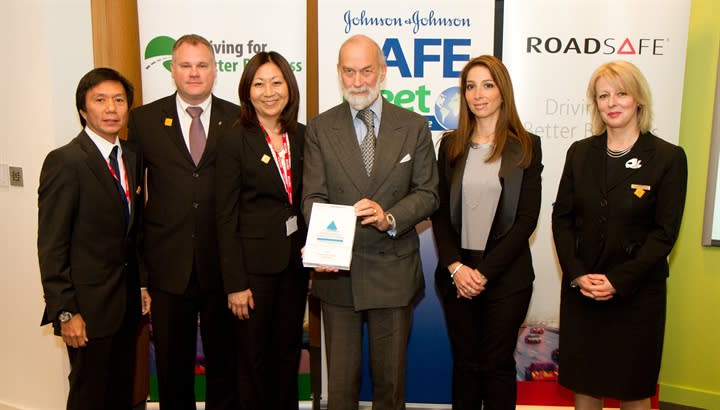
Johnson & Johnson team with HRH Prince Michael of Kent GCVO, (l-r) Rodrigo Fuentes (director, Asia Pacific Health & Safety), Gabriel Kardos (SAFE Fleet manager, Europe, Middle East & Africa), Sandra Lee (director Worldwide SAFE Fleet), HRH Prince Michael of Kent GCVO, Lina Uribe (SAFE Fleet manager, Latin America & Caribbean), and Jane Griffiths (Company Group Chairman, Janssen Europe, Middle East & Africa).
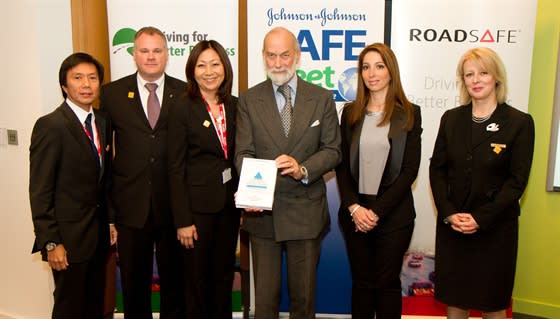
HIGH WYCOMBE, UK - Johnson & Johnson was recently awarded the Prince Michael International Road Safety Award for its long-standing commitment to road safety.
The Johnson & Johnson global SAFE Fleet program, which educates and trains employees about safe driving techniques and injury prevention strategies, has led to significant reductions in fleet crashes and injury rates. Since SAFE Fleet was first introduced in 1994, the company's crashes per million miles driven (CPMM) rate has decreased by 37 percent globally, according to Johnson & Johnson.
"The goal of SAFE Fleet is to ensure that our drivers around the world return home safely at the end of each day - to their benefit and the benefit of their families and communities," said Alex Gorsky, vice chairman, Executive Committee, Johnson & Johnson, and executive sponsor of SAFE Fleet.
Each year, the Prince Michael International Road Safety Award publicly recognizes the most outstanding achievements and innovations designed to improve road safety. The award was presented by HRH Prince Michael of Kent GCVO during a special ceremony at the Johnson & Johnson High Wycombe facility.
SAFE Fleet is just one of many programs designed to protect employees, families, customers, and communities. Johnson & Johnson has set new internal performance targets for SAFE Fleet as part of its five-year sustainability goals, which will be announced later this year.
More Safety

Top 50 Executive Fleets
It is that time of year again! Time for the 2026 list of the Top 50 Executive Fleets, presented by Automotive Fleet and Volvo as part of its annual Fleet 500. Download now to see this year's list of companies!
Read More →
How Better Visibility Cut Speeding Violations by 48%
Fleet leaders don't need more data, they need clearer visibility into what the data is saying. This case study explores how one utility replaced speeding-event counts with a single metric — miles driven in violation — to strengthen safety and significantly reduce speeding violations.
Read More →
Operation Safe Driver Week: Why the Industry's Oldest Safety Campaign Still Matters to Fleets
A look at how a 2007 enforcement initiative became one of the most consequential weeks on the fleet safety calendar, and what it means for your drivers in 2026.
Read More →
Nexar-Nauto Merger Aims to Give Fleets Better Safety Intelligence Through Larger Driving Dataset
Stefan Heck tells Automotive Fleet that combining more than 10 billion miles of driving history with Nexar's AI models will give fleets deeper insights into driver risk and roadway conditions than either company could provide independently.
Read More →
From Silos to Solutions: Relationship Management for Safer Fleets
From telematics adoption and driver accountability to policy consistency and risk mitigation, this episode breaks down what it really takes to build a safer fleet culture without slowing business down.
Read More →
IIHS Launches First Commercial Vehicle Safety Evaluations
The Insurance Institute for Highway Safety has begun evaluating heavy-duty pickups and cargo vans for driver protection. Which models earned top marks?
Read More →
Reducing Risk by Eliminating Phone Use Behind the Wheel
Hosted with the cofounder of Lifesaver Mobile, this episode addresses phone use behind the wheel and how to design a driving environment that actually helps prevents accidents.
Read More →
Cameras, Safety and Insurance: From Reactive Claims to Real-Time Prevention (Part 2 of 2)
Part Two: Commercial auto remains one of the most challenging and costly lines of coverage for fleet operators and insurers alike. Continue learning more about how to effectively address these issues from Onur Aksan, Enterprise Business Development Executive, Geotab
Read More →
How 5-Second Telematics Data Is Changing Fleet Safety
This episode connects with Steve Santostasi of Ford Pro and covers how a few seconds of data can make a difference in fleet safety.
Read More →
The Two Biggest Summer Downtime Threats for Fleets
A conversation with a maintenance expert reveals the two most common summer maintenance pains and how to prevent them.
Read More →