




J.D. Power’s Initial Quality Study Shows Year-Over-Year Auto Quality Gains
WESTLAKE VILLAGE, CA – J.D. Power released its 2012 U.S. Initial Quality Study (IQS), which showed an overall quality improvement of 5 problems per 100 vehicles (PP100) to an average of 102 PP100 in 2012, which is an improvement of 5 percent from 2011.
WESTLAKE VILLAGE, CA – J.D. Power released its 2012 U.S. Initial Quality Study (IQS), which showed an overall quality improvement of 5 problems per 100 vehicles (PP100) to an average of 102 PP100 in 2012, which is an improvement of 5 percent from 2011.
The study ranked 34 brands ranked in the 2012 IQS. Out of that number, 26 improved from 2011, five have declined, one scored the same as in 2011, and two weren’t included in the 2011 study. Out of the 185 models ranked in the 2012 and 2011 IQS, 65% showed improvement. Also, the average quality of all-new or redesigned models improved 12% when compared with 2011. Out of that number, 11 all-new or redesigned models performed better than their segment average.
In terms of which areas showed improvement, said there are year-over-year gains in most initial quality areas save for audio, entertainment, and navigation problems, which increased 8% from 2011.
This area continues to be a source of issues for automakers, as J.D. Power reported that problems in this category increased by 45% since 2006 whereas other categories improved by 24%, on average. The report said these issues are partially due to adding new technology to these systems.
"Until recently, this type of sophisticated technology was found primarily on high-end models" said David Sargent, vice president of global automotive at J.D. Power and Associates. "However, over the past few years it has rapidly found its way into the automotive mainstream. For example, in 2012, more than 80 percent of owners indicate that their new vehicle has some form of hands-free technology."
The report found that the number of owner-reported problems with factory-installed hands-free communication devices has increased 137% during the past four years, and that hands-free devices not recognizing commands is the most-often-reported problem.
For the specific brands, Lexus ranked highest, averaging 73 PP100. Cadillac, at a PP100 score of 80, and Honda, at 83 PP100, were also in the top five. Ford and Lexus each received three awards out of 21 model-level segment awards. Ford earned awards for the Expedition, Mustang and Taurus, and Lexus for the ES 350, LS, and RX. Toyota received two awards for the Corolla and Yaris; Infiniti received two awards for the EX-Series and M-Series; and Nissan received two awards for the Frontier and Quest. Other vehicles that received awards include the the Buick Enclave; Cadillac Escalade; Chevrolet Malibu; GMC Sierra LD; Honda CR-V; Kia Soul; Mazda MX-5 Miata; and Volvo C70.
More Operations

Fleet Meets: Eric Kilgore
This edition of the Fleet Meets series features one of the industry's best leaders driving multi-market and national operations.
Read More →
Why Reactive Fleet Management Is Becoming Too Expensive to Sustain
Research highlights a growing need for proactive management strategies to address rising costs in fleet operations effectively.
Read More →
What Your Fleet KPIs Aren’t Telling You
Tracking fleet metrics is only useful when the data leads to better decisions. This guide helps fleet leaders assess cost, utilization, and downtime more accurately, identify performance gaps, and prioritize the actions that can improve operational results.
Read More →


Hidden in Plain Sight: Fleet Compliance Risks
Fleet compliance isn't just about having policies — it's about consistently enforcing them. This practical guide reveals six hidden compliance risks common in public sector and shared fleet operations and outlines proven strategies to improve visibility, accountability, and audit readiness
Read More →
Turning Fleet Payment Data into Executive Insights
Does data alone drive results in operations?
Read More →
Automotive Fleet Opens 2026 Personal Use Survey for Commercial Fleet Managers
Commercial and corporate fleet managers are invited to share how their organizations handle company vehicle personal-use policies, charges, and driver eligibility.
Read More →
Gary Van Orden Retires After Nearly Four Decades in Commercial Fleet
From answering customer calls at Ford Motor Company to leading fleet sales across multiple OEMs and a fleet management company, Gary Van Orden's career reflects nearly four decades of leadership in commercial fleet.
Read More →
How Stellantis Plans to Get Ahead of Fleet Downtime
Vehicle acquisition may grab the headlines, but fleet uptime increasingly determines operating success. Darren Bradshaw of Mopar North America gives the details.
Read More →
Hyundai Releases 2027 Commercial Program Incentives
The 2027 Model Year "Fleet Street Incentives" are available to commercial and government fleets.
Read More →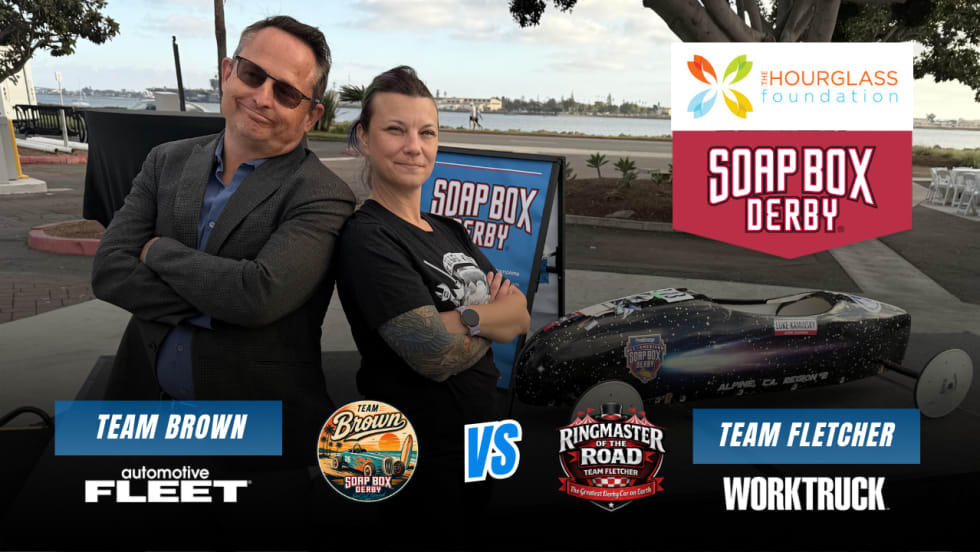
It's All Downhill from Here! Fleet Industry Raises $22,000 for Skilled Trades Scholarships
Work Truck’s Lauren Fletcher and Automotive Fleet’s Chris Brown turned a friendly racing rivalry into $22,000 for automotive technology and skilled trades scholarships.
Read More →