




Hyundai Introduces 2013-MY Santa Fe and Santa Fe Sport CUVs
NEW YORK – Earlier this month Hyundai revealed its all-new 2013-MY Hyundai Santa Fe, which will come in a five-passenger model, the Santa Fe Sport, and a long wheelbase (LWB) seven-passenger model called the Santa Fe.
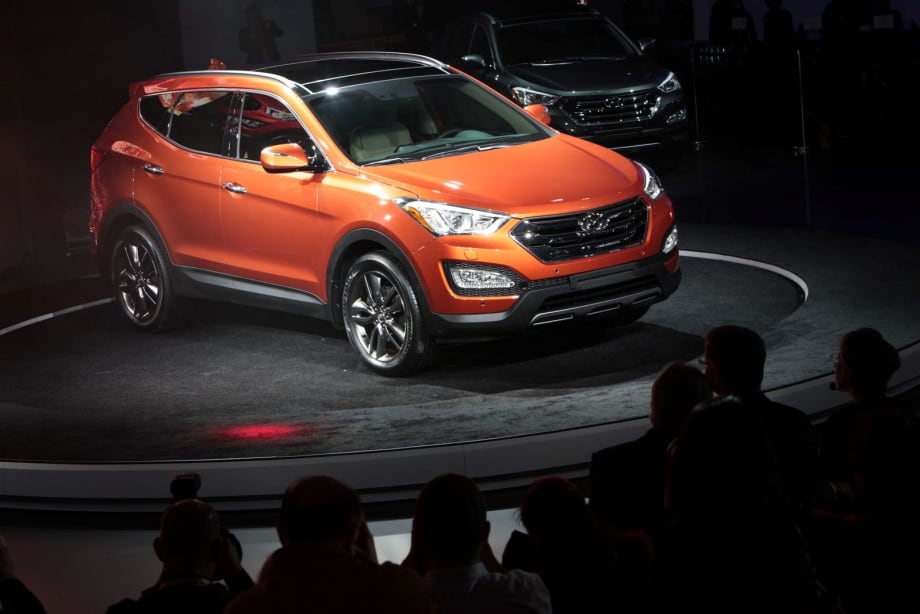
Hyundai revealed the Santa Fe Sport at the New York Auto Show.
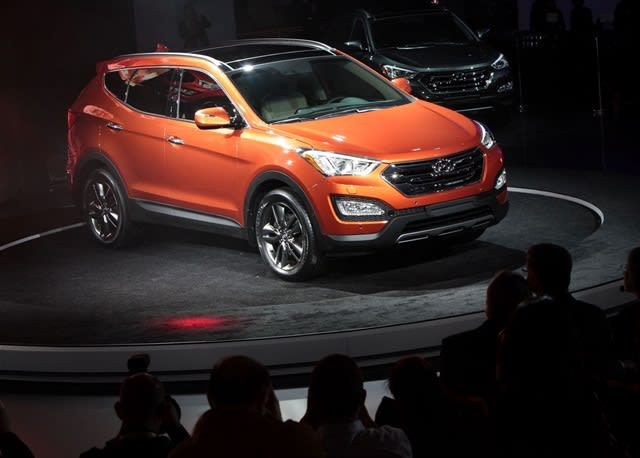
Hyundai revealed the Santa Fe Sport at the New York Auto Show.
NEW YORK – Earlier this month Hyundai revealed its all-new 2013-MY Hyundai Santa Fe, which will come in a five-passenger model, the Santa Fe Sport, and a long wheelbase (LWB) seven-passenger model called the Santa Fe.
Performance
The 2013-MY Santa Fe Sport model offers two four-cylinder engine choices. First is the Theta II 2.4L Gasoline Direct Injection (GDI), capable of producing 190 hp and 181 lb. ft. of torque. This engine gets an estimated mpg of 23 city, 33 highway. Next up is the Theta II 2.0L turbocharged GDI engine, capable of producing up to 264 hp with an estimated fuel economy of 23 city, 31 highway, 25 combined mpg (FWD A/T). The Santa Fe (the long wheelbase version) comes with a Lambda II 3.3L GDI V-6 engine (the same as in the Azera) that can produce 290 hp. These engines are matched with a six-speed automatic transmission, and Hyundai said all models have an Active ECO System that boosts fuel economy.
The Santa Fe Sport, Santa Fe Sport 2.0T and the Santa Fe (LWB model) come with a MacPherson strut front suspension and a fully independent multi-link rear suspension. The Santa Fe Sport rides on 17-inch wheels and P235/65 R17 tires. The Santa Fe Sport 2.0T sits on 19-inch wheels with P235/55R19 lower profile tires. The LWB Santa Fe comes with 18- or 19-inch wheels.
In terms of driving performance and handling, the Santa Fe features new driver selectable steering modes, Comfort, Normal, and Sport. The Comfort mode is designed for urban driving and parking areas, Normal is for mixed driving conditions, and Sport is for optimized for higher-speed freeways or winding roads (steering requires 10 percent more effort in this mode). The Santa Fe Sport features a 35.76 ft. turning radius even though this model has a longer wheelbase than the previous generation of the vehicle.
Exterior
The Santa Fe Sport has a 106.3-inch wheelbase, an overall length of 184.6 inches, a height of 66.1 inches and width of 74.0 inches. The larger Santa Fe sits on a 110.2-inch wheelbase (3.9 inches longer than the Santa Fe Sport’s wheelbase) and has an overall length of 193.1 inches (compared with Santa Fe Sport’s length of 184.6 inches). The 74.2-inch width is slightly wider than Santa Fe Sport. The LWB Santa Fe’s overall height is 66.5 inches, which is 0.4 inches higher than Santa Fe Sport.
Additional exterior design features include standard chrome grille and door handle accents, bodycolor mirrors, rear spoiler, aggressive exhaust outlets as well as lower bumper, wheel arches and door trim in contrasting paints.
Hyundai reduced the weight of the new models when compared with previous generations. The Santa Fe Sport 2.4L FWD weighs 266 lbs. less than the 2012 Santa Fe four-cylinder model. The Santa Fe Sport 2.0T is 300 lbs. less than the 2012 Santa Fe V-6 FWD.
Interior
The Santa Fe Sport features two rows of seats inside and the Santa Fe comes with three rows of seats. Hyundai said the long wheelbase for both models allows for added comfort, for example more second row legroom. The Santa Fe (LWB) features cargo volume of 41 cu ft.
Both Santa Fe models feature a range of standard storage features, including an overhead console sunglass holder, two front and two rear seat cupholders, door bottle holders, an enlarged central storage console, a front storage bin, front seat- back pockets, and under-floor cargo storage.
The vehicles provide dual-zone climate controls that incorporate an automatic defogging system, which detects humidity levels using a sensor and removes it from the windshield. Another premium feature is a CleanAir Ionizer that automatically cleans the air when the heater or air conditioner is running.
A multifunction eight-inch touch-screen display with navigation is an option on each Santa Fe model. The system features a simpler interface, according to Hyundai, and improved voice recognition technology. The automaker integrated HD Radio technology into the displays in the Santa Fe.
Each model features four audio system choices, though an AM/FM/Satellite Radio/CD/MP3 audio system with six-speakers and iPod/USB/auxiliary input jacks is standard. The upgraded audio system provides a 4.3-inch full color LCD screen with HD Radio and rear- view camera. The next system upgrade offers a Gen 3.0 navigation unit with an improved sound system, and the premium level features a navigation system and an Infinity 550-watt, Logic 7 audio system with 12 speakers, among other features.
A Bluetooth hands-free phone system with voice recognition, address book download and audio streaming is also standard. Both navigation systems integrate rear-view camera output. Hyundai Blue Link telematics is standard on all Santa Fe models with up to a one-year complimentary trial period.

The Santa Fe (as opposed to the Santa Fe Sport) is a seven-passenger model with three rows orf seats.
Safety
The 2013 Santa Fe models feature a wide range of safety features, including Hyundai’s Hillstart Assist Control (HAC) and Downhill Brake Control (DBC), a standard Vehicle Stability Management (VSM) system (which includes Electronic Stability Control, ESC, and the Motor-Driven electric Power Steering, MDPS), seven airbags, and rollover sensors for the side curtain airbags.
For braking, the Santa Fe gives ABS, Brake Assist (which provides extra braking force when needed), and Electronic Brake Force Distribution, which adjusts braking force to front and rear axles based on the vehicle’s load.
Inside, the Santa Fe models feature a Lower Anchors and Tethers for Children (LATCH) system for children’s seats and three-point seatbelts.
More Operations

Fleet Has a Talent Pipeline Problem. What Comes Next? | AF News Recap
Where will fleet’s next generation of leaders come from? This week, we’re looking at the industry’s talent pipeline, what certification can add to a fleet career, how to build an award-worthy track record, and the return of Automotive Fleet’s Personal Use Survey.
Read More →
Smith System Launches Driver Risk Management Program
Fleets have more driver data than ever, but identifying risky behavior doesn't necessarily correct it. Smith System's new Driver Risk Management program combines monitoring, training, and follow-up coaching to help fleets connect risk signals with driver intervention.
Read More →
Automotive Fleet Opens 2026 Personal Use Survey for Commercial Fleet Managers
Less than two weeks left! Commercial and corporate fleet managers are invited to share how their organizations handle company vehicle personal-use policies, charges, and driver eligibility.
Read More →
From AI Prompts to AI-Generated Safety Songs | AF News Recap
Can better prompts make AI more useful for fleet managers? This week, we’re breaking down smarter fleet analysis, an AI-assisted experiment that turned safety training into music, and what happened to fuel prices in August.
Read More →
How to Write Better AI Prompts for Fleet Analysis
Include these six elements in your fleet prompts to generate more relevant analysis and accurate answers.
Read More →
Fleet Meets: Eric Kilgore
This edition of the Fleet Meets series features one of the industry's best leaders driving multi-market and national operations.
Read More →
Why Reactive Fleet Management Is Becoming Too Expensive to Sustain
Research highlights a growing need for proactive management strategies to address rising costs in fleet operations effectively.
Read More →
What Your Fleet KPIs Aren’t Telling You
Tracking fleet metrics is only useful when the data leads to better decisions. This guide helps fleet leaders assess cost, utilization, and downtime more accurately, identify performance gaps, and prioritize the actions that can improve operational results.
Read More →
Hidden in Plain Sight: Fleet Compliance Risks
Fleet compliance isn't just about having policies — it's about consistently enforcing them. This practical guide reveals six hidden compliance risks common in public sector and shared fleet operations and outlines proven strategies to improve visibility, accountability, and audit readiness
Read More →
Turning Fleet Payment Data into Executive Insights
Does data alone drive results in operations?
Read More →