




Hybrid Electric Vehicles Join UPS Fleet in Philadelphia
PHILADELPHIA - UPS announced its fleet of alternative-fuel vehicles had expanded with the deployment of 50 next-generation hybrid electric delivery trucks to Philadelphia.
PHILADELPHIA - UPS announced its fleet of alternative-fuel vehicles had expanded with the deployment of 50 next-generation hybrid electric delivery trucks to Philadelphia.
Currently, 50 UPS hybrid electric vehicles (HEVs) operate in Atlanta, Dallas, Houston and Phoenix. The 50 trucks deployed here are part of 200 new HEVs deployed recently to eight U.S. cities. They join the roughly 20,000 low-emission and alternative-fuel vehicles already in use by UPS. The 200 new trucks will operate in Austin, Houston, Philadelphia, Chicago, Washington, D.C., Long Island, Minneapolis, and Louisville.
The 200 new HEV package cars are expected to reduce fuel consumption by roughly 176,000 gallons over the course of a year compared to an equivalent number of traditional diesel trucks. The hybrids also should reduce the amount of CO2 gases released annually into the atmosphere by 1,786 metric tons. Since 2000, UPS's fleet of alternative-fuel vehicles has traveled more than 165 million miles.
The UPS alternative fuel fleet utilizes multiple technologies, including compressed natural gas, liquefied natural gas, propane, electricity and hydraulic hybrid technology. These green vehicles provide the "last mile" of service to deliver packages in the most environmentally sustainable way possible. The alternative fuel fleet, however, is just one part of UPS's larger sustainability program. UPS provides its delivery services through an integrated network, meaning it uses only one vehicle to deliver all types of packages going to the same address. And unlike other competitors, UPS has developed a network that can leverage all modes of transportation from rail to truck to aircraft, optimizing package routes and improving fuel efficiency.
"We're proud of this large HEV deployment to major cities in the United States," said Bob Stoffel, UPS senior vice president of supply chain, strategy, engineering and sustainability. "Collectively, this new HEV fleet can yield a 35 percent fuel savings, the equivalent of what's used in a year to power 100 conventional delivery vehicles."
The new hybrid power system utilizes a conventional diesel engine combined with a battery pack, saving fuel and reducing pollution-causing emissions. The small diesel is used to recharge the battery pack and to add power when necessary.
HEVs use regenerative braking. The energy generated from applying the brakes is captured and returned to the battery as electricity. The combination of clean diesel power and electric power, supplemented by regenerative braking, allows dramatic improvements in fuel savings and emissions reductions.
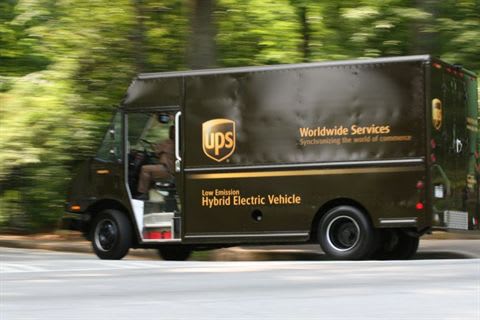
The HEVs use a Freightliner Custom Chassis Corporation body and a hybrid power system from Eaton Corporation. The external truck bodies are identical to UPS's other signature brown trucks, although they feature additional labeling identifying them as hybrid electrics. The trucks use lithium ion batteries, which offer a faster re-charging capability and last longer than previous generation HEV batteries. Additionally, these vehicles are much quieter than conventional UPS trucks.
UPS was the first package delivery company to introduce a HEV into daily operations with a research program it launched in early 1998. In 2001, the company deployed the industry's first hybrid electric package car into regular service in Huntsville, Ala., where the truck worked a 31-mile route with about 160 pickups and deliveries each day. UPS then introduced its second generation HEV to its Kalamazoo, Mich., fleet in 2004, while at the same time deploying the first hydrogen fuel cell delivery trucks into regular service.
"The wide variety of technologies in our green fleet is indicative of UPS's 'rolling laboratory' approach to energy efficiency and reduced fuel consumption," Stoffel said. "Our goal is to reduce dependence on fossil fuels, but there is no silver bullet technology to achieve this. It will only happen by combining technology with logistics expertise to optimize the network's performance."
Next page, 10 Things You May Not Know About UPS' Environmental Initiatives
[PAGEBREAK]
Ten Things You May Not Know About UPS' Environmental Initiatives
1. UPS has 99,869 vehicles, 2,900 facilities and is the ninth largest airline worldwide, but as early as the 1930s, UPS has experimented with environmental innovation and improvements. What else would you expect from a company that started out on bicycles?
2. UPS's alternative fuel vehicle fleet totals more than 2,000 vehicles, the largest fleet in the industry, and since 2000, has driven more than 165 million miles!
3. UPS's alternative fuel vehicle fleet is diverse, with 527 propane-powered vehicles in Canada, more than 1,100 Compressed Natural Gas (CNG) vehicles (the largest private fleet in the United States), 250 Hybrid Electric Vehicles in Washington D.C., Long Island, Minneapolis, Philadelphia, Austin, Louisville, Dallas, Houston, Phoenix and Atlanta, 11 Liquefied Natural Gas (LNG) tractor-trailers, 11 Liquefied Petroleum Gas (LPG) in Korea, two zero-emissions vehicles in Manhattan, NY and 11 electric vehicles in Europe.
4. UPS's Delivery Information Acquisition Devices (DIADs) which electronically record delivery information have saved 89 million sheets of paper each year, the equivalent of 7,308 trees annually.
5. UPS has given customers the opportunity to save even more trees by switching to Paperless Billing and Paperless Invoice. Approximately 124 million sheets of paper could be eliminated annually if UPS customers went paperless with their billing statements and 86 million sheets of paper could be eliminated if international UPS customers converted to Paperless Invoice!
6. UPS has invested more than US$15 million to deploy significant numbers of alternative fuel vehicles in its fleet.
7. UPS has recycled 24.5 million pounds of electronic equipment since 2000.
8. Beyond saving fuel, UPS saves motor oil too. In fact, UPS has saved 330,000 quarts of it since implementing Preventative Maintenance Inspections (PMIs), saving the company almost US$3 million annually.
9. UPS has set up 11,000 computers at four facilities with "sleep" software to conserve energy when not in use, saving US$145,000 annually, as part of the ENERGY STAR Million Monitor Drive program.
10. UPS's Palm Springs, Calif., facility uses 145 solar panels as its primary power source.
More Green Fleet

EV Charging Use Is Outpacing Infrastructure Growth
ChargePoint’s 2026 Charging Forward Report points to rising charger use, higher-powered charging, commercial vehicle electrification, and energy-management technology. Here’s what fleets should know.
Read More →
Merchants Fleet Reports 290M EV Miles as Fleets Navigate Changing Electrification Market
From millions in operating savings to hundreds of millions of EV miles, Merchants Fleet’s latest report reveals what’s working and what’s changing in fleet electrification.
Read More →
The EV Breakdown Nobody's Talking About: Why Most Electric Vehicle Roadside Calls Aren't Mechanical Failures
Here's why EV breakdowns are widely misunderstood.
Read More →
ChargePoint Now Available in Energy Pass
ChargePoint and additional planned charging network integrations were added to GM's Energy Pass.
Read More →

First Look: Slate Auto's Electric Fleet Pickup
Could an affordable, modular EV pickup make electrification more practical for fleets?
Read More →
Slate Debuts Colorful, Unique EV Models
A recent media and client event, studded with electric vehicles dressed up on platforms, planted a new position for the manufacturer in the wider EV market. Fleets will find cost-saving advantages.
Read More →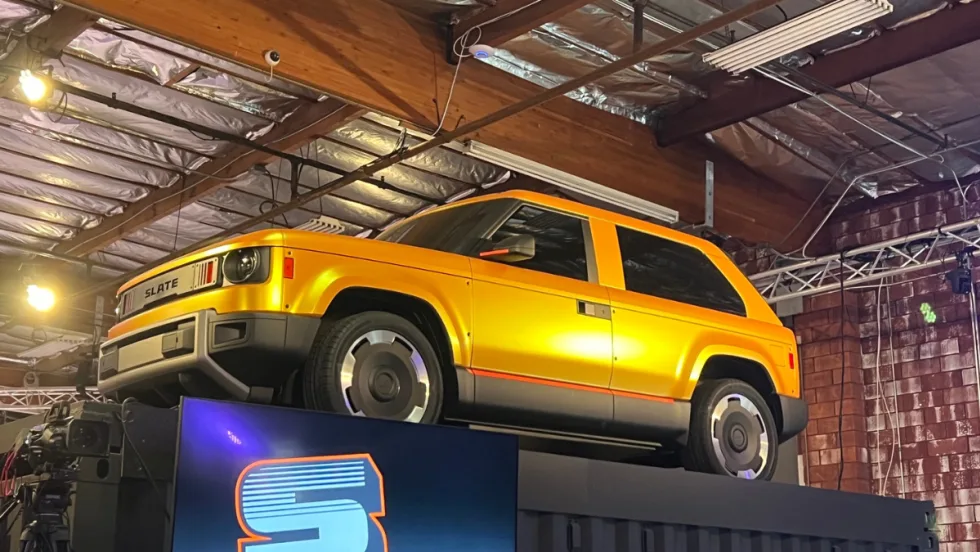
Slate Electric SUV, Pickup Switchable Model Aims For Light-Duty Fleets
Everything about this EV is counterintuitive and understated, making it stand out from the crowd.
Read More →
Inspiration Mobility Acquires Key Electrada Assets
Inspiration Mobility Group has acquired select assets of Electrada, adding the fleet electrification provider's team, technology, and charging infrastructure development capabilities to its energy management business.
Read More →
Turning Connected Vehicle Data Into Decisions That Matter
Fleet leaders have more data than ever, but turning that data into clear, actionable decisions remains a challenge. This white paper shows how leading organizations are using connected vehicle data to improve safety, reduce costs, and optimize fleet performance. Learn how to turn insight into action across your fleet.
Read More →