




Honda to Add Advanced Air Bag to 2020 Vehicles
Honda has developed new passenger front air-bag technology that features an unconventional design specifically crafted to better protect occupants in a wide range of frontal collision scenarios, including angled crashes between vehicles or a vehicle and another object.

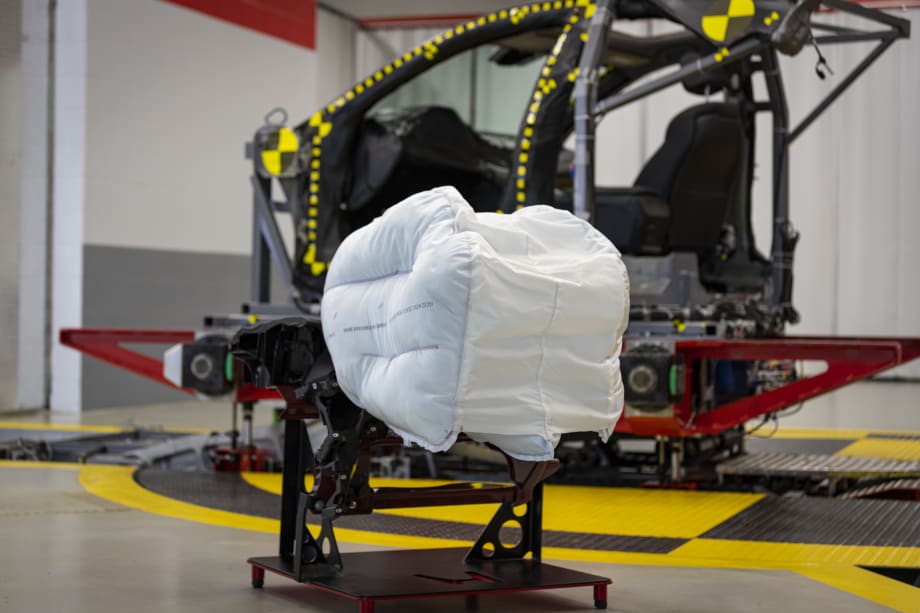
Honda's advanced air-bag system will arrive in 2020 with a new approach to cushioning the human body during crashes.
Photo courtesy of Honda.
Honda has developed new passenger front air-bag technology that features an unconventional design specifically crafted to better protect occupants in a wide range of frontal collision scenarios, including angled crashes between vehicles or a vehicle and another object.
Engineers at Honda R&D Americas, Inc. in Ohio partnered with Autoliv, one of the company's safety systems suppliers, to spearhead the development and testing. The automaker intends to roll out its advanced air-bag design in new products in the U.S. in 2020.
The next-generation air bag is engineered to reduce the potential for injuries that can occur in a wider variety of frontal impacts. It's particularly beneficial in angled frontal impacts in which lateral collision forces can cause an occupant's head to rotate severely or slide off the airbag, increasing the chance of serious injury, according to the company.
Here's how it works. While conventional air-bag systems rely on a single inflatable compartment, the new Honda system utilizes four major components: three inflated compartments — a center chamber and two outward-projecting side chambers that create a wide base across the dash — along with a "sail panel" that stretches between the two side chambers at their outermost edge.
Operating something like a baseball catcher's mitt, the sail panel catches and decelerates the occupant's head while also engaging the side chambers, pulling them inward to cradle and protect the head, mitigating the potential for injury.
This latest effort to advance airbag technology is in keeping with Honda’s long-term initiative, "Safety for Everyone.”
The automaker also is working to develop and deploy advanced passive safety and active safety systems that can reduce the severity of a collision or help avoid it entirely.
For example, Honda is aggressively deploying its Honda Sensing and AcuraWatch suites of safety and driver-assistive systems. Today, more than 2.5 million vehicles on U.S. roadways are utilizing these technologies, which are now standard or available on all 2019 and newer Honda models and standard on all 2019 and newer Acura sedans and SUVs. The company has committed to making this broad suite of technologies standard on nearly all of its vehicles by 2022.
Data from the National Highway Traffic Safety Administration shows that in 2017 alone more than 37,000 people lost their lives on U.S. roadways as a result of motor vehicle traffic crashes, a slight decrease from the previous two years.
More Safety
IIHS Crash Avoidance Tests Reveal Safety Gaps in Cargo Vans and Work Trucks
New crash-avoidance ratings from the Insurance Institute for Highway Safety reveal inconsistent performance among commercial vehicles, with several popular cargo vans and heavy-duty pickups struggling to avoid collisions with other vehicles and pedestrians.
Read More →
What’s Next for Fleet? Safety, AI & Industry Recognition | AF News Recap
Could your company's culture be encouraging distracted driving? This week, we're exploring how workplace expectations affect driver safety, what AI, EVs, and autonomous vehicles could mean for the future of fleet management, and how fleet professionals can strengthen their award nominations.
Read More →
Does Your Fleet's Culture Encourage Distracted Driving?
What happens when the people responsible for enforcing safety rules are the ones setting the wrong example? The answer may reveal why some of the biggest risks to fleet drivers have little to do with what's written in the employee handbook.
Read More →
Fleet Manager’s Ultimate Playbook: Navigating the New Standard in OEM Connectivity
Rising operating costs, driver safety concerns, and unplanned downtime are putting unprecedented pressure on modern fleets. Discover how fleet managers use embedded OEM connectivity and real-time vehicle data to cut TCO, prevent downtime, and protect drivers without aftermarket telematics hardware.
Read More →
From Driver Well-Being to EV Charging | AF News Recap
Mental health belongs in the fleet safety conversation. This week, we’re looking at five ways fleets can support employee well-being before a crisis, plus Holman’s expansion in Mexico, new one-day Fleet Forward passes, and why EV charging demand is outpacing infrastructure growth.
Read More →
Nexar-Nauto Merger Aims to Give Fleets Better Safety Intelligence Through Larger Driving Dataset
Stefan Heck tells Automotive Fleet that combining more than 10 billion miles of driving history with Nexar's AI models will give fleets deeper insights into driver risk and roadway conditions than either company could provide independently.
Read More →
Don't Wait for a Crisis: 5 Ways to Build Mental Health Into Your Fleet Safety Program
For Suicide Prevention Month, fleet and safety leaders have an opportunity to put mental health where it belongs: at the center of workplace safety.
Read More →
How Camera Data Can Strengthen a Fleet’s Insurance Renewal
Insights from a commercial insurance carrier and a broker show how fleets can turn video telematic data, driver coaching, and improved claims results into a stronger case at insurance renewal.
Read More →
The Safest Fleets Aren’t the Ones with the Most Technology
You’ve made the telematics investment. Here’s how to capture the other half of its value and build the safest fleet on the road.
Read More →
Hidden in Plain Sight: Fleet Compliance Risks
Fleet compliance isn't just about having policies — it's about consistently enforcing them. This practical guide reveals six hidden compliance risks common in public sector and shared fleet operations and outlines proven strategies to improve visibility, accountability, and audit readiness
Read More →