




Honda Joins V2G Technology Project
Honda recently joined a demonstration project for experimental vehicle-to-grid (V2G) technology aimed at providing a potentially valuable energy storage resource to the nation's electrical grid.
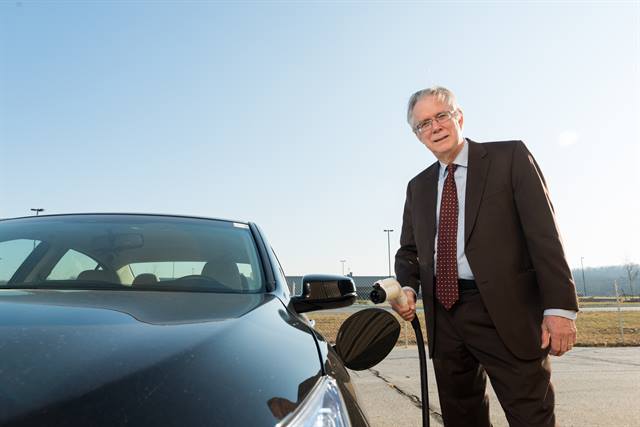
Willett Kempton, Director of the University of Delaware’s Center for Carbon-Free Power Integration, shown with a 2014 Honda Accord Plug-in Hybrid Vehicle. Photo courtesy of Honda.
Honda recently joined a demonstration project for experimental vehicle-to-grid (V2G) technology aimed at providing a potentially valuable energy storage resource to the nation's electrical grid while providing for more cost-effective ownership of plug-in electric vehicles.
The Honda technology builds off of the research conducted by the University of Delaware and supported by NRG Energy, Inc., who, through a joint venture, came online early in 2013 with the world's first revenue-generating vehicle-to-grid project, demonstrating the controls, regulatory requirements, and market participation rules for selling energy storage from vehicles into the PJM Interconnection Regulation Market. Honda is supplying an Accord Plug-In Hybrid with added V2G capabilities to the University's Science, Technology and Advanced Research (STAR) Campus to jointly investigate the potential of this technology to benefit the electrical grid, vehicle owners and society.
"This technology has the potential to support both a cleaner and more efficient power grid and a more positive ownership experience for EV customers," said Steven Center, vice president of the Environmental Business Development Office of American Honda Motor Co., Inc. "With V2G technology, a network of PEVs becomes essentially a distributed energy storage system. It makes for an even stronger value equation for plug-in vehicles, with benefits for both the community and the vehicle user."
Using smart grid technology, the V2G system is able to monitor the status of the grid to determine whether the grid requires additional power sources that can respond rapidly, or the grid requires power demands that can absorb transitional power supply. Such a system has the potential to reduce or eliminate the fluctuation of the grid, which can occur more frequently when renewable energy sources are introduced to the grid. Electric vehicle owners potentially benefit from supporting a more stable power grid, which can lead to reduced utility costs for the vehicle owner.
"As the U.S. adds more intermittent resources to the grid, finding a lower cost energy storage technology that also benefits electric vehicle drivers is a great opportunity," said Denise Wilson, NRG Executive Vice President and President, New Businesses. "We see this demonstration by Honda as an important step in the development of vehicle to grid technology."
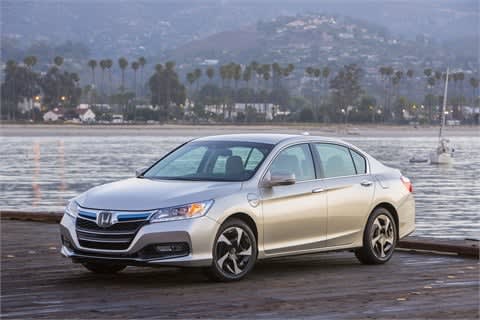
2014_Honda_Accord_PHEV. Photo courtesy of Honda.
The Honda Accord Plug-In Hybrid demonstration vehicle is equipped with a bi-directional on-board charger, which allows the vehicle propulsion battery to both charge from and discharge to the electrical grid. With an additional communication device, the vehicle receives signals from a grid operator via a charging station, and controls charge and discharge in accordance with the signals. When electric power is requested by the grid, the vehicle will discharge power from its battery. When the grid power supply exceeds demand, the vehicle proactively charges its battery.
"The participation of global automakers like Honda will help demonstrate and refine the technology," said Willett Kempton, professor in the College of Earth, Ocean, and Environment and Research Director of the University of Delaware's Center for Carbon-Free Power Integration. "The University of Delaware has been developing the technology so that vehicle batteries can be used not only for mobility but also for grid services. It is a big step toward a future with widespread availability of the technology to have Honda join our demonstration with their V2G-capable car."
More Green Fleet

EV Charging Use Is Outpacing Infrastructure Growth
ChargePoint’s 2026 Charging Forward Report points to rising charger use, higher-powered charging, commercial vehicle electrification, and energy-management technology. Here’s what fleets should know.
Read More →
Merchants Fleet Reports 290M EV Miles as Fleets Navigate Changing Electrification Market
From millions in operating savings to hundreds of millions of EV miles, Merchants Fleet’s latest report reveals what’s working and what’s changing in fleet electrification.
Read More →
The EV Breakdown Nobody's Talking About: Why Most Electric Vehicle Roadside Calls Aren't Mechanical Failures
Here's why EV breakdowns are widely misunderstood.
Read More →
ChargePoint Now Available in Energy Pass
ChargePoint and additional planned charging network integrations were added to GM's Energy Pass.
Read More →

First Look: Slate Auto's Electric Fleet Pickup
Could an affordable, modular EV pickup make electrification more practical for fleets?
Read More →
Slate Debuts Colorful, Unique EV Models
A recent media and client event, studded with electric vehicles dressed up on platforms, planted a new position for the manufacturer in the wider EV market. Fleets will find cost-saving advantages.
Read More →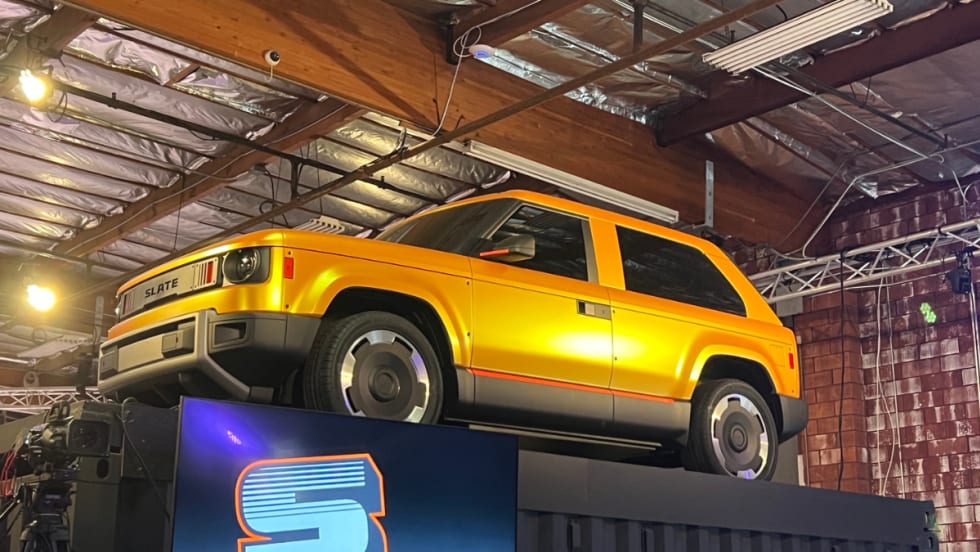
Slate Electric SUV, Pickup Switchable Model Aims For Light-Duty Fleets
Everything about this EV is counterintuitive and understated, making it stand out from the crowd.
Read More →
Inspiration Mobility Acquires Key Electrada Assets
Inspiration Mobility Group has acquired select assets of Electrada, adding the fleet electrification provider's team, technology, and charging infrastructure development capabilities to its energy management business.
Read More →
Turning Connected Vehicle Data Into Decisions That Matter
Fleet leaders have more data than ever, but turning that data into clear, actionable decisions remains a challenge. This white paper shows how leading organizations are using connected vehicle data to improve safety, reduce costs, and optimize fleet performance. Learn how to turn insight into action across your fleet.
Read More →