




Honda Announces Pricing for 2014 CNG Civic
Honda has announced retail pricing for its 2014 Civic Natural Gas compact sedan that it mostly sold to corporate and government fleets during the 2013 model year.
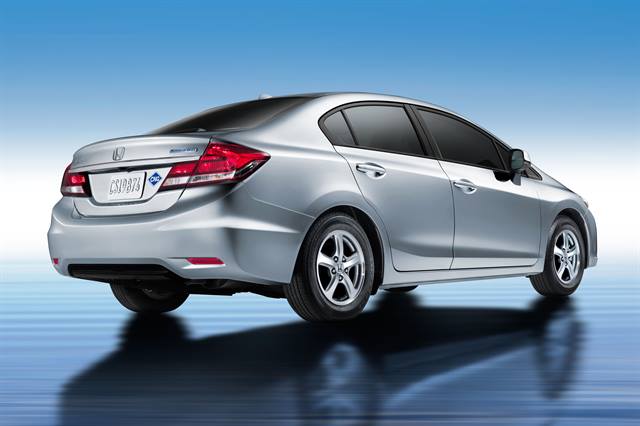
Photo courtesy of Honda.
Honda has announced retail pricing for its 2014 Civic Natural Gas compact sedan that it mostly sold to corporate and government fleets during the 2013 model year.
The base model Civic Natural Gas will retail for $26,640. Adding navigation brings the price to $29,290. The vehicle is the highest priced Civic in Honda's lineup.
In late December, the U.S. Environmental Protection Agency released fuel-economy data on the vehicle. The agency rated the 2014 Civic Natural Gas at 27 miles per gallon city, 38 mpg highway, and 31 mpg combined.
The Civic Natural Gas is powered by a 1.8L, four-cylinder engine that's paired with a five-speed automatic transmission that produces 110 horsepower and 106 lb.-ft. of torque. The engine achieves California's AT-PZEV emissions standards, meaning it's a Super-Ultra-Low-Emission Vehicle (SULEV) with zero evaporative emissions and carries a 15-year, 150,000-mile warranty on its emission equipment.
The CNG-burning Civic was first introduced in 1998.
More Green Fleet

EV Charging Use Is Outpacing Infrastructure Growth
ChargePoint’s 2026 Charging Forward Report points to rising charger use, higher-powered charging, commercial vehicle electrification, and energy-management technology. Here’s what fleets should know.
Read More →
Merchants Fleet Reports 290M EV Miles as Fleets Navigate Changing Electrification Market
From millions in operating savings to hundreds of millions of EV miles, Merchants Fleet’s latest report reveals what’s working and what’s changing in fleet electrification.
Read More →
The EV Breakdown Nobody's Talking About: Why Most Electric Vehicle Roadside Calls Aren't Mechanical Failures
Here's why EV breakdowns are widely misunderstood.
Read More →
ChargePoint Now Available in Energy Pass
ChargePoint and additional planned charging network integrations were added to GM's Energy Pass.
Read More →

First Look: Slate Auto's Electric Fleet Pickup
Could an affordable, modular EV pickup make electrification more practical for fleets?
Read More →
Slate Debuts Colorful, Unique EV Models
A recent media and client event, studded with electric vehicles dressed up on platforms, planted a new position for the manufacturer in the wider EV market. Fleets will find cost-saving advantages.
Read More →
Slate Electric SUV, Pickup Switchable Model Aims For Light-Duty Fleets
Everything about this EV is counterintuitive and understated, making it stand out from the crowd.
Read More →
Inspiration Mobility Acquires Key Electrada Assets
Inspiration Mobility Group has acquired select assets of Electrada, adding the fleet electrification provider's team, technology, and charging infrastructure development capabilities to its energy management business.
Read More →
Turning Connected Vehicle Data Into Decisions That Matter
Fleet leaders have more data than ever, but turning that data into clear, actionable decisions remains a challenge. This white paper shows how leading organizations are using connected vehicle data to improve safety, reduce costs, and optimize fleet performance. Learn how to turn insight into action across your fleet.
Read More →