





FLEET FACT: Who made the first truck? Gottlieb Daimler!
Tracing the Origins: The Birth of the First Truck in 1896
The first truck in the world looked like a cart with an engine and without a drawbar. The engine, called "Phoenix," was a four-horsepower-strong two-cylinder engine located at the rear.
April 9, 2021
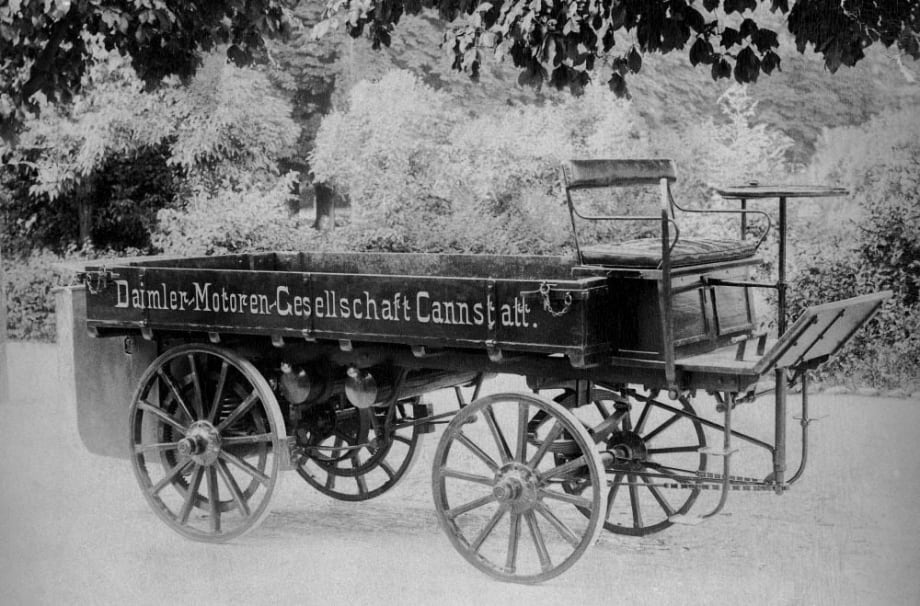
The first truck in the world was designed by Gottlieb Daimler in 1896.
Photo: Daimler Trucks
5 min to read
Do you ever ask yourself, "I wonder when was the first truck made?" You aren't alone! Get a blast from the past when it comes to the history of trucks.
One of the greatest talents of inventor and German engineer Gottlieb Daimler (1834-1900) was finding new areas of application for his engine. He invented the motorcycle, then went to the motorized trolley car, and a motorized firefighting hose.
In the 1880s, he began experimenting with gasoline engines and developed the first high-speed internal combustion engine, which he used to power a two-wheeled vehicle known as the "Reitwagen" or "riding car." In 1896, almost inevitably, Daimler invented the first truck, according to the manufacturer.
What Powered the First Truck?
The first truck in the world looked like a cart with an engine and without a drawbar. The engine, called "Phoenix," was a four-horsepower-strong two-cylinder engine located at the rear, with a displacement of 1.06 liters, originating from a car. Gottlieb Daimler linked it to the rear axle by means of a belt.
There there were two helical springs to protect the engine, which was sensitive to vibrations. The vehicle rolled on hard iron wheels. Gottlieb Daimler steered the leaf-sprung front axle by means of a chain. The driver sat up front on the driving seat as with a carriage.
The engine was at the rear of the vehicle. The fuel consumption was approximately six liters of petrol per 100 kilometers. In the terminology of the day, that would be "0.4 kilogrammes per horsepower and hour."
It is noteworthy that the first truck already anticipated 125 years before the planetary axles that are still common today in construction vehicles: because the belt drive sent the power from the engine to a shaft fitted transversely to the longitudinal axis of the vehicle, both ends of which were fitted with a pinion.
(Today's planetary axle, also known as a planetary gear set or planetary reduction axle, is a type of axle commonly used in heavy-duty work trucks and off-road vehicles. It is designed to handle large loads and provide high torque to the wheels, making it ideal for hauling heavy loads or navigating challenging terrain.)
Each tooth of this pinion meshed with the internal teeth of a ring gear which was firmly connected with the wheel to be driven. This is how the planetary axles of the heavy Mercedes-Benz Trucks up to the current Arocs series have worked in principle.
In 1898, Gottlieb Daimler and Wilhelm Maybach shifted the two-cylinder Phoenix engine of the six-hp vehicle, which had been located at the rear, to a position under the driver's seat, with the four-gear belt drive also being transferred forward. However, this solution still left a certain amount to be desired.
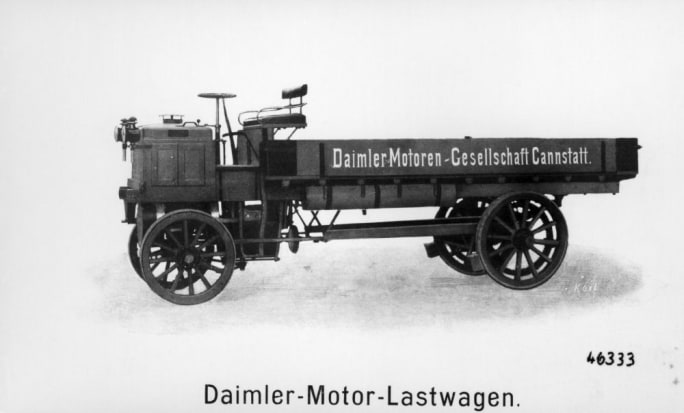
In 1898, Gottlieb Daimler and Wilhelm Maybach shifted the two-cylinder Phoenix engine of the six-hp vehicle, which had been located at the rear, to a position under the driver's seat.
Photo: Daimler Trucks
Making Improvements on the First Truck
In the same year, the first truck was then given the face which clearly distinguished it from the car and was to level the path towards ever-increasing output and payload: the engine was then placed right at the front, in front of the front axle. It conveyed its ten horsepower via a four-gear belt drive and a front-to-rear longitudinal shaft and pinion to the internal ring gears on the iron wheels at the rear.
For these vehicles, Gottlieb Daimler made the crucial improvement not only to the drivetrain, but to the engine itself. Instead of a hot tube ignition, the new low-voltage magnetic ignition from Bosch ignited the petrol-air mixture in the cylinders of the 2.2L two-cylinder engine, and the radiator had a completely new design.
According to reports, Gottlieb Daimler – probably because of the large number of innovations – was cautious at first before presenting his new five-tonner to the public. The vehicle which was highly modern at the time underwent "Customer testing" which is how the test procedure would be called today. For months, he subjected his new five-tonner to the daily grind of work at a brick factory in Heidenheim, and he painstakingly remedied the shortcomings it showed.
Selling & Showing Off the First Daimler Truck
The first purchaser of the first truck came from the home of industrialization: England. There, steam-driven vehicles had long since made the shift from rails to the road, and did not die out until the 1950s.
It was a good thing that the Red Flag Act was abolished in 1896, according to reports from Daimler. Nevertheless, it was not until 1901 that a truck proved itself to be superior to a contemporary steam-driven wagon in a comparison test carried out in Liverpool.
The Daimler truck was a welcome guest in Paris, too. Gottlieb Daimler undertook the long journey to vibrant Paris to publicise his new product at the world exhibition. There, an automobile show was held in the Tuileries park, following a contest organised by the Automobile Association of France on the subject of "motorised vehicles for city travel"; at the exhibition, Gottlieb Daimler presented his new five-tonner and a four-horsepower-strong belt-driven vehicle.
"Huge crowds of people, many vehicles of all kinds and our truck are very popular," Gottlieb Daimler's wife Lina noted with satisfaction in June 1898.
The Daimler Manufacturing Company (DMFG) was an American production company from 1898 to 1907. From 1888 to 1898, the company was known as the Daimler Motor Company (DMC), founded as part of a partnership between Gottlieb Daimler of the Daimler-Motoren-Gesellschaft and William Steinway of the piano manufacturers Steinway & Sons. The company, with its headquarters in Long Island City, Queens, New York City, close to the headquarters of Steinway in Astoria, sold Daimler engines for yachts and launches as well as for commercial vehicles such as buses and trucks.
Growth: A Second-Generation of Trucks
The second generation of Daimler Trucks manufactured from 1899 to 1903 consisted of new basic types with a payload of between 1.25 and 5.0 tonnes, for which two- and four-cylinder engines from four to twelve horsepower were sufficient.
In detail, the almost complete range of the DMG in 1905 comprised: light vans with three payload classes from 500 kg 1000 kg to 1500 kg payload, powered by two-cylinder engines with eight to sixteen hp. Four-cylinder engines with 16 to 35 hp powered the heavy-duty class with 2- to 5-ton payload.
Today, Daimler Trucks has grown to a powerhouse truck manufacturer, connecting over 1 million trucks and buses to a global digital platform.
Originally posted on Work Truck Online
More Vehicle Research
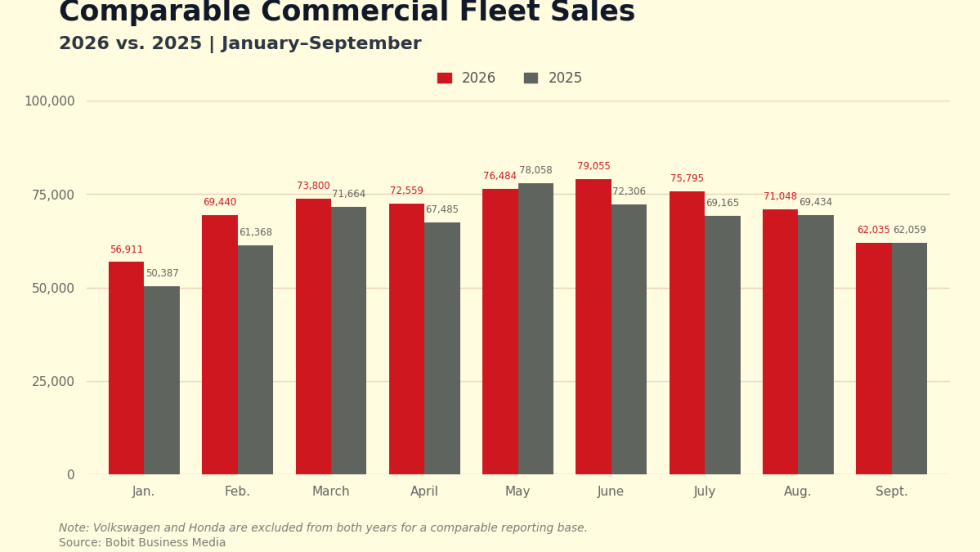
Commercial Fleet Sales Rise 5.8% Through September 2026
September commercial fleet sales were essentially unchanged from a year earlier, slowing year-to-date growth while keeping volume ahead of 2025.
Read More →
Hall of Fame Inductee: John Dmochowsky
The longtime Mondelēz International fleet executive joins the Automotive Fleet Hall of Fame.
Read More →
Hall of Fame Inductee: Lee Miller
After more than four decades at Boehringer Ingelheim, Lee Miller leaves a legacy built on fleet expertise.
Read More →
Hall of Fame Inductee: Mark F. Petersen
From managing fleets of thousands of vehicles to advancing safety and mentoring fellow professionals, Mark F. Petersen made his mark across both the corporate and supplier sides of fleet.
Read More →
When Charger Downtime Becomes a Fleet Availability Problem
As EV deployments move beyond pilot programs, charger reliability can directly affect vehicle readiness, driver productivity and route scheduling.
Read More →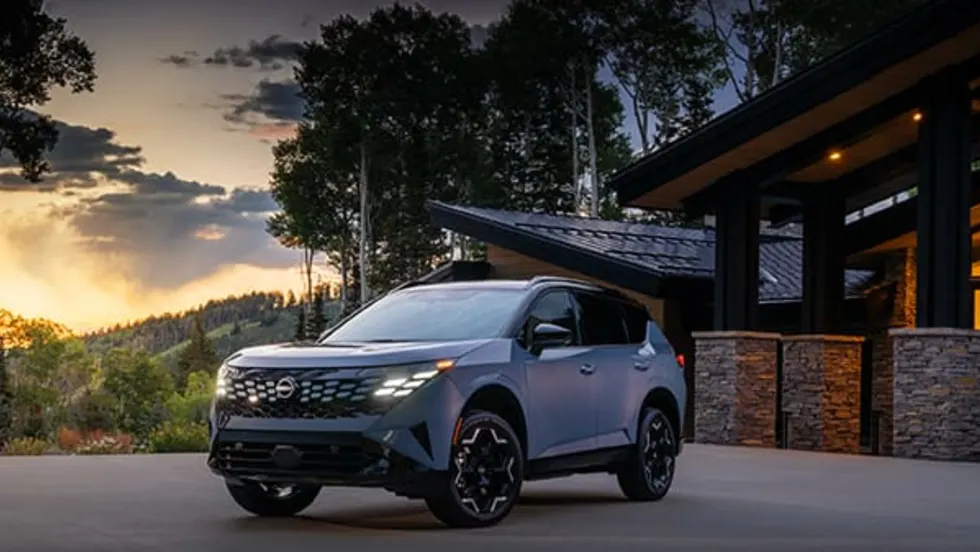
2027 Nissan Rogue Hybrid Adds e-POWER, Standard AWD
The new Rogue Hybrid uses Nissan’s e-POWER system with dual electric motors, offers an estimated 40 mpg and starts at $35,490.
Read More →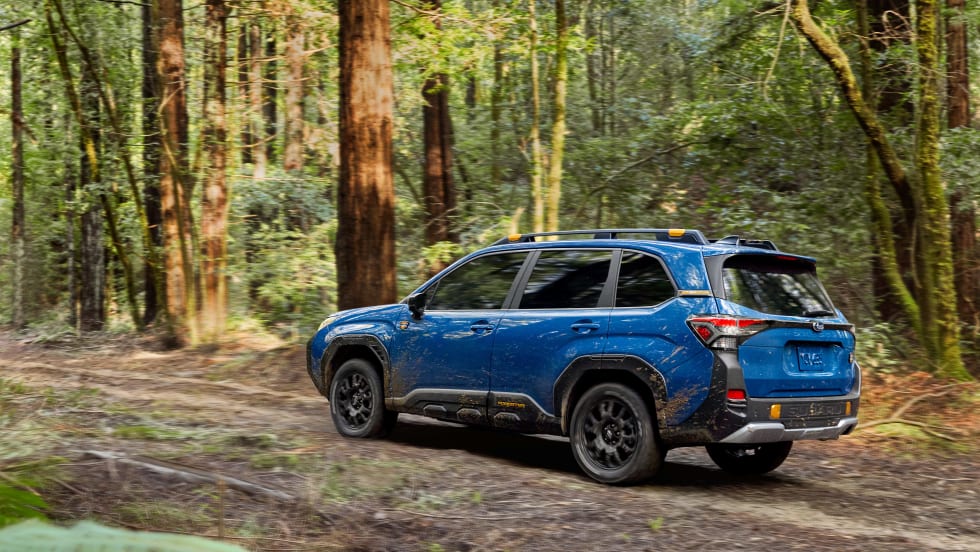
2027 Subaru Forester Adds First Wilderness Hybrid
The 2027 Forester lineup starts at $29,995 and adds a Wilderness Hybrid with 194 combined horsepower and 9.3 inches of ground clearance.
Read More →
EV Realty Names Henrik Holland President as Charging Platform Expands
The former Prologis Mobility and Shell executive will help expand EV Realty’s truck charging business and move its power-first infrastructure model into autonomous vehicle depots and other fleet sectors.
Read More →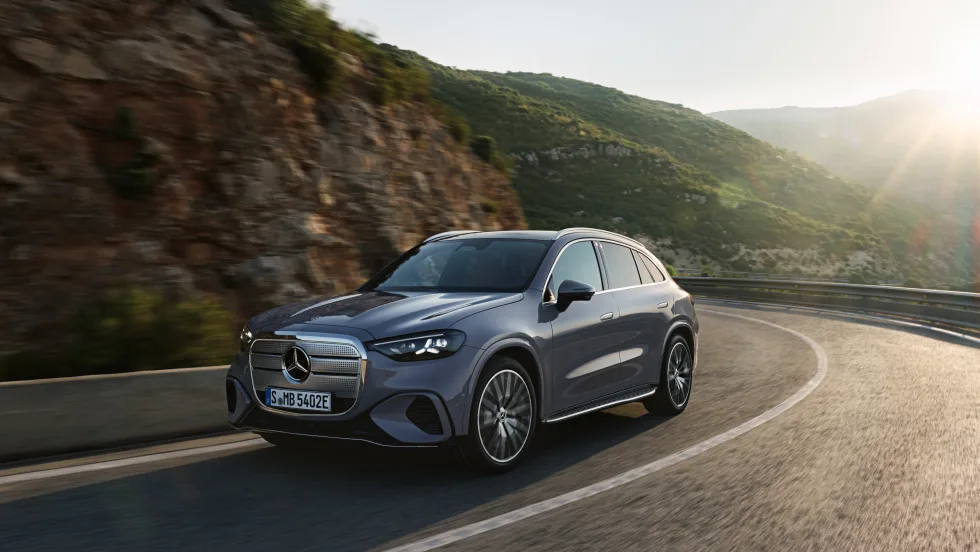
Mercedes-Benz Introduces Electric GLC With Up to 350 Miles of Range
The GLC 400 4MATIC Electric features an 800-volt architecture, 330-kW DC fast charging and a 94-kWh battery, along with Mercedes-Benz's new MB.OS operating system.
Read More →
Fleet Has a Talent Pipeline Problem, not a Talent Problem
Where will the next generation of fleet leaders come from, and what does the industry need to do differently to find them?
Read More →