




Gold Miner Adds First 2015 F-150 Fleet Trucks
Barrick Gold Corp. has begun acquiring Ford's aluminum-body 2015 F-150 pickup trucks for its Nevada gold mining operation. Barrick has placed an initial order for 35 leased pickups and plans to eventually add several hundred to its work truck fleet.
by Staff
February 2, 2015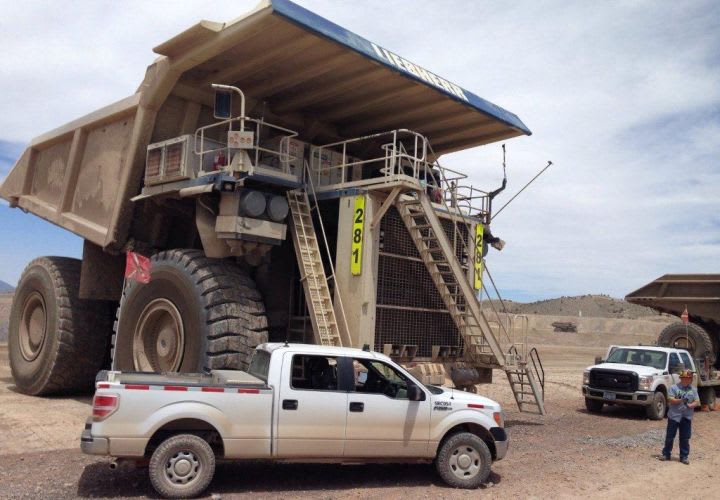
Photo courtesy of Ford.
2 min to read

Photo courtesy of Ford.
Barrick Gold Corp. has begun acquiring Ford's aluminum-body 2015 F-150 pickup trucks for its Nevada gold mining operation after testing prototypes in hard operating conditions.
Barrick has placed an initial order for 35 leased 2015 F-150 pickups and plans to eventually add several hundred to its work truck fleet. Barrick plans to add about 35 per year, according to Louis Schack, Barrick's communications director. The initial F-150s will come as SuperCab four-wheel-drive models with a mix of 3.5-liter V-6 and 5.0-liter V-8 engines.
Rebecca Caudill, Barrick Gold's fleet manager, was impressed with the durability of the lighter trucks during testing that began in 2011.
"The F-150s see tough duty from operations supervisors, exploration field technicians, project managers, maintenance technicians and closure personnel," Caudill said. "Many of the trucks go into extremely rugged conditions during the planning and mapping out of new projects, core drilling and daily mining operations. Our trucks will see 30,000 to 35,000 miles per year, accumulating well over 100,000 miles in the 40-to-45-month lease rotation."
Barrick Gold was one of three fleets selected by Ford for initial testing of the aluminum truck prior to launch. Other prototype vehicles went to Walsh Construction in Holtwood, Pa., and Birmingham, Ala., and a regional utility company in North Carolina.
The Barrick surveying team drove the vehicles through severe terrain at the company's Bald Mountain and Cortez mines, including travel into mine pits before and after blasting. Barrick operates five mines in Nevada.
The fleets weren't told about the aluminum alloy components added to the prototype trucks, which were named X0 and X1. Barrick drivers began to suspect the trucks had incorporated aluminum when they saw scratched-off paint and no rust, said Denis Kansier, a Ford product engineer. The military-grade aluminum alloy contained no steel.
After initial testing of the X0 prototype by Barrick, Ford increased the thickness of the bed to 1.4 millimeters, a 60 percent increase from the 0.85-mm thick steel bed on the 2014 model. The new bed is also 40 percent lighter, Kansier said.
The F-150s were equipped with pintle hitches so they could tow generators, pumps, welders, and equipment trailers.
Barrick operates a fleet of mostly 850 leased vehicles, including 350 F-150s, 225 F-250s, 125 F-350s and larger trucks, 125 SUVs and vans, and 25 other vehicles. Barrick uses Wheels Inc. as its leasing service provider.
More Operations

Fleet Has a Talent Pipeline Problem. What Comes Next? | AF News Recap
Where will fleet’s next generation of leaders come from? This week, we’re looking at the industry’s talent pipeline, what certification can add to a fleet career, how to build an award-worthy track record, and the return of Automotive Fleet’s Personal Use Survey.
Read More →
Smith System Launches Driver Risk Management Program
Fleets have more driver data than ever, but identifying risky behavior doesn't necessarily correct it. Smith System's new Driver Risk Management program combines monitoring, training, and follow-up coaching to help fleets connect risk signals with driver intervention.
Read More →
Automotive Fleet Opens 2026 Personal Use Survey for Commercial Fleet Managers
Less than two weeks left! Commercial and corporate fleet managers are invited to share how their organizations handle company vehicle personal-use policies, charges, and driver eligibility.
Read More →
From AI Prompts to AI-Generated Safety Songs | AF News Recap
Can better prompts make AI more useful for fleet managers? This week, we’re breaking down smarter fleet analysis, an AI-assisted experiment that turned safety training into music, and what happened to fuel prices in August.
Read More →
How to Write Better AI Prompts for Fleet Analysis
Include these six elements in your fleet prompts to generate more relevant analysis and accurate answers.
Read More →
Fleet Meets: Eric Kilgore
This edition of the Fleet Meets series features one of the industry's best leaders driving multi-market and national operations.
Read More →
Why Reactive Fleet Management Is Becoming Too Expensive to Sustain
Research highlights a growing need for proactive management strategies to address rising costs in fleet operations effectively.
Read More →
Sponsored•August 12, 2026
What Your Fleet KPIs Aren’t Telling You
Tracking fleet metrics is only useful when the data leads to better decisions. This guide helps fleet leaders assess cost, utilization, and downtime more accurately, identify performance gaps, and prioritize the actions that can improve operational results.
Read More →
Sponsored•August 7, 2026
Hidden in Plain Sight: Fleet Compliance Risks
Fleet compliance isn't just about having policies — it's about consistently enforcing them. This practical guide reveals six hidden compliance risks common in public sector and shared fleet operations and outlines proven strategies to improve visibility, accountability, and audit readiness
Read More →
Turning Fleet Payment Data into Executive Insights
Does data alone drive results in operations?
Read More →