




GMAC Survey: 16.4% of Licensed Drivers Would Flunk Driving Test
ST. LOUIS --- Results from the 2008 GMAC Insurance National Drivers Test released this month found that 16.4 percent of drivers on the road --- amounting to roughly 33 million licensed Americans --- would not pass a written drivers test if taken today.
ST. LOUIS --- Results from the 2008 GMAC Insurance National Drivers Test released this month found that 16.4 percent of drivers on the road --- amounting to roughly 33 million licensed Americans --- would not pass a written drivers test if taken today.
The fourth annual survey, which polled 5,524 licensed Americans from all 50 states and the District of Columbia, is designed to gauge driver knowledge by administering 20 actual questions taken from state Department of Motor Vehicles (DMV) exams. Kansas drivers ranked first in the nation, with an average test score of 84.0 percent; New Jersey drivers ranked last, with an average score of 69.9 percent.
Overall, findings from the 2008 survey indicate that an alarming number of licensed Americans continue to lack knowledge of basic rules of the road. While the national average score improved slightly to 78.1 percent (from 77.1 percent in 2007), in general, geographical regions ranked similarly to previous years, with the lowest average test scores in the Northeast.
Across the board, respondents continued to have difficulty on questions about yellow lights and safe following distances. Eighty-four percent could not identify the correct action to take when approaching a steady yellow traffic light, and 73 percent could not properly identify a typical safe following distance from the car in front of them.
Additional key findings from the 2008 GMAC Insurance National Drivers Test include:
-- The older the driver, the higher the test score. Drivers 35+ years old were most likely to pass.
-- While average test scores between the genders were similar, women were more likely to fail the test than men (20 percent versus 13 percent)
-- The Northeast had the lowest average test scores (76 percent) and the highest failure rates (19.8 percent)
-- The Midwest had the highest average test scores (81 percent) and the lowest failure rates (11 percent)
-- Kansas replaced Idaho's 2007 ranking as most knowledgeable; New Jersey replaced New York's 2007 ranking as least knowledgeable
-- New York, New Jersey, the District of Columbia and Massachusetts ranked within the last five places for the past three years
-- Fortunately, nearly all respondents (98 percent) know what to do when an emergency vehicle with flashing lights approaches, what to do when hydroplaning and the meaning of a solid yellow line.
"It's encouraging to see that scores are beginning to get better, but there is still a lot of room for improvement," said Wade Bontrager, vice president of marketing for GMAC Insurance. "To do this, we all need to make safety our top priority, review the basic road rules and put them into practice every day. By announcing these results and offering a venue to learn proper procedures, it's our goal to help people become more knowledgeable, and therefore safer, drivers."
In addition to the 20-question DMV exam, GMAC Insurance posed subsequent questions exploring drivers' opinions on the current testing process. Bontrager said that each year, people write in asking why there isn't a standard, national written driver's test.
"While each state has their own rules and regulations, we wanted to find out what people really think about the whole process," he said. "We asked if testing should be standardized, if rules should be the same in every state, if you should have to retake an exam, and if so, after what age and how often. While this is sure to spark a healthy debate, it's all in the name of bringing safe driving procedures to the forefront in our minds."
These findings reveal:
-- Approximately three in five (58 percent) believe that permit or license applicants should be required to take a standard, national written drivers test with questions applying to all 50 states
-- Seventy-eight percent believe that each state should have the same basic traffic safety regulations, such as speed limit, parking regulations and pedestrian right-of-way
-- Approximately two in three (63 percent) believe that drivers should be required to re-take the DMV road test after a certain age; 87 percent of those respondents believe it should be no earlier than age 60, and 41 percent think the test should be retaken each year.
More Safety

Nexar-Nauto Merger Aims to Give Fleets Better Safety Intelligence Through Larger Driving Dataset
Stefan Heck tells Automotive Fleet that combining more than 10 billion miles of driving history with Nexar's AI models will give fleets deeper insights into driver risk and roadway conditions than either company could provide independently.
Read More →
Don't Wait for a Crisis: 5 Ways to Build Mental Health Into Your Fleet Safety Program
For Suicide Prevention Month, fleet and safety leaders have an opportunity to put mental health where it belongs: at the center of workplace safety.
Read More →
How Camera Data Can Strengthen a Fleet’s Insurance Renewal
Insights from a commercial insurance carrier and a broker show how fleets can turn video telematic data, driver coaching, and improved claims results into a stronger case at insurance renewal.
Read More →
The Safest Fleets Aren’t the Ones with the Most Technology
You’ve made the telematics investment. Here’s how to capture the other half of its value and build the safest fleet on the road.
Read More →
Hidden in Plain Sight: Fleet Compliance Risks
Fleet compliance isn't just about having policies — it's about consistently enforcing them. This practical guide reveals six hidden compliance risks common in public sector and shared fleet operations and outlines proven strategies to improve visibility, accountability, and audit readiness
Read More →
NETS Sets 2026 Fleet Safety Benchmark Conference for Indianapolis
The Sept. 15–17 program will feature fleet benchmarking data, case studies, emerging technologies, and implementation strategies while running alongside the NSC Safety Congress & Expo.
Read More →
Off-the-Job Crashes Account for 43% of Employers’ $61.7 Billion Crash Burden
NETS quantifies costs dispersed across fleet, risk, HR, and other departments while providing new per-crash benchmarks for employers.
Read More →
Ram Recalls More Than 1.27 Million 1500 Pickups for Seat Belt Anchor Issue
The recall affects certain 2019-2026 Ram 1500 pickups that may have improperly attached second-row seat belt buckle anchors.
Read More →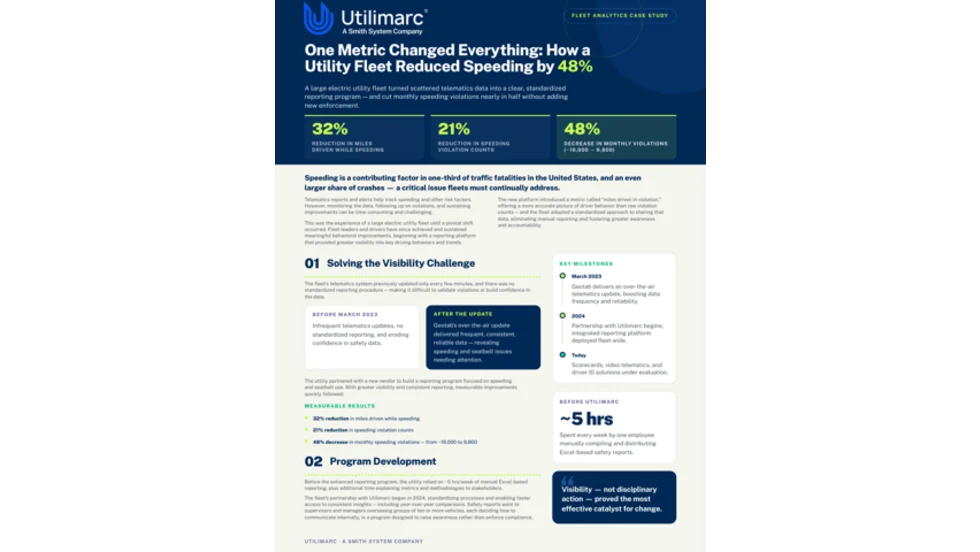
How Better Visibility Cut Speeding Violations by 48%
Fleet leaders don't need more data, they need clearer visibility into what the data is saying. This case study explores how one utility replaced speeding-event counts with a single metric — miles driven in violation — to strengthen safety and significantly reduce speeding violations.
Read More →
Operation Safe Driver Week: Why the Industry's Oldest Safety Campaign Still Matters to Fleets
A look at how a 2007 enforcement initiative became one of the most consequential weeks on the fleet safety calendar, and what it means for your drivers in 2026.
Read More →