




GM Recalls Silverado, Sierra HD Trucks
Six newly announced recalls also include late-model Cadillac ATS and CTS sedans to address a transmission issue.

Photo of 2015 Chevrolet Silverado 2500 HD truck courtesy of General Motors.
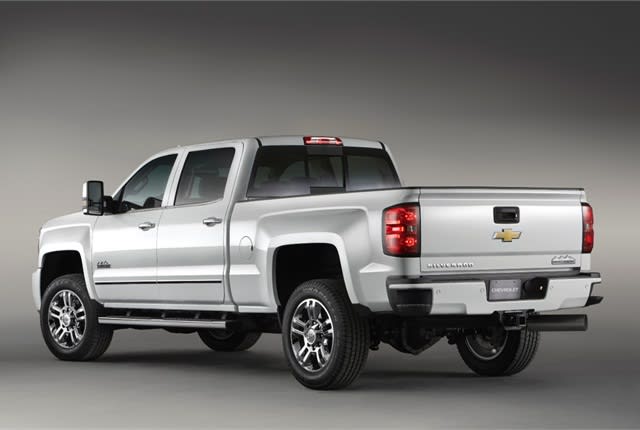
Photo of 2015 Chevrolet Silverado 2500 HD truck courtesy of General Motors.
General Motors has announced six new recalls affecting more than 3.3 million vehicles, including late-model Chevrolet Silverado and GMC Sierra 2500/3500 HD trucks as well as Cadillac ATS and CTS sedans.
The June 16 truck recall affects 57,192 2015 model-year Chevrolet Silverado 2500/3500 HD and GMC Sierra 2500/3500 HD vehicles. Dealers will inspect for proper attachment of the power steering hose clamps to the power steering pump.
If the vehicle is driven with the clamp unattached, the hose may disconnect from the pump or gear, causing a rapid loss of power steering fluid. This will result in a sudden loss of power steering assist and Hydro Boost powered brakes. The vehicle would revert to manual brakes and manual steering.
GM said it knows of no crashes or injuries arising from the condition. Dealers will inspect the power steering hose clamps in two locations to ensure they are properly attached.
A second recall involves 68,887 2013-14 model-year Cadillac ATS sedans and 21,863 2014 model-year Cadillac CTS sedans. In certain vehicles with automatic transmission, the shift cable may not be fully secured to the shifter bracket or transmission bracket. If the shift cable comes out of the brackets, the driver may not be able to shift the transmission in or out of gear. GM said it is unaware of any crashes or injuries related to this condition.
The largest of the six recalls involves GM's plans to modify or replace the ignition keys for about 3.16 million cars in the U.S. because the ignition switch may inadvertently move out of the “run” position. This risk occurs if the key is carrying extra weight and is jostled.
The following cars are recalled:
Buick LaCrosse | MY 2005-2009 |
Chevrolet Impala | MY 2006-2014 |
Cadillac Deville | MY 2000–2005 |
Cadillac DTS | MY 2004–2011 |
Buick Lucerne | MY 2006–2011 |
Buick Regal LS & GS | MY 2004–2005 |
Chevy Monte Carlo | MY 2006–2008 |
The use of a key with a hole, rather than a slotted key, addresses the concern of unintended key rotation arising from a jarring road event, such as striking a pothole or crossing railroad tracks, GM said.
Only one of the models included in this U.S. recall of 3,160,725 cars is still in production – the previous-generation Chevrolet Impala. This model is sold to daily rental fleets as the Impala Limited. The total North America population – U.S., Canada, Mexico and exports – is 3,360,555.
This safety recall follows a review of ignition issues following the recall in February of 2.6 million Chevrolet Cobalts and other small cars. GM said it is aware of eight crashes and six injuries related to this recall.
If the ignition switch moves out of the “run” position, there is an effect on power steering and power braking. In addition, the timing of the key movement out of the “run” position, relative to the activation of the sensing algorithm of a crash event, may result in the air bags not deploying.
In these vehicles, the ignition switch may be unable to handle extra weight hanging on a slotted key. GM will add an insert to the ignition keys to close the slot and leave a 4x6-millimeter hole through which the key ring could be attached.
In vehicles where the key cover has been worn, new keys with holes instead of slots will be provided free of charge.
Rework of the keys – adding key inserts – at GM dealerships is expected to begin in the next few weeks. Until the rework or replacement is completed, owners of the recalled cars are urged to remove additional weight from their key chains and drive with only the ignition key.
A fourth recall covers 184 2014-15 model-year Chevrolet Silverado and GMC Sierra full-size pickups with vinyl floors and accessory all-weather floor mats purchased new with the vehicle. The mats can slip under the driver’s feet because the vinyl floors have no attachments to secure them in place.
Customers are advised to take the floor mats to their dealer for a full refund. GM said it is unaware of any crashes or injuries related to the mats.
A fifth recall covers 16,932 2011 model-year Cadillac CTS sedans with AWD. On some vehicles, a gasket leak where the constant velocity joint meets the rear propeller shaft may cause the rear propeller shaft to separate or become loose. This can lead to contact with the vehicle floor above and cause the rollover sensor to deploy the roof rail air bags. GM said it is aware of 15 unintended deployments, but injury data is unclear.
The sixth recall involves 712 2014 model-year Chevrolet Corvettes with optional Competition Sport Seats. An unbelted child and door trim may block the passenger-seat side air bag vent in a deployment. Dealers will replace the current air bag with a redesigned version. GM said it is unaware of any crashes or injuries related to this condition, but advises customers to not allow small children in the front seat until the vehicle is serviced.
More Safety

Nexar-Nauto Merger Aims to Give Fleets Better Safety Intelligence Through Larger Driving Dataset
Stefan Heck tells Automotive Fleet that combining more than 10 billion miles of driving history with Nexar's AI models will give fleets deeper insights into driver risk and roadway conditions than either company could provide independently.
Read More →
Don't Wait for a Crisis: 5 Ways to Build Mental Health Into Your Fleet Safety Program
For Suicide Prevention Month, fleet and safety leaders have an opportunity to put mental health where it belongs: at the center of workplace safety.
Read More →
How Camera Data Can Strengthen a Fleet’s Insurance Renewal
Insights from a commercial insurance carrier and a broker show how fleets can turn video telematic data, driver coaching, and improved claims results into a stronger case at insurance renewal.
Read More →
The Safest Fleets Aren’t the Ones with the Most Technology
You’ve made the telematics investment. Here’s how to capture the other half of its value and build the safest fleet on the road.
Read More →
Hidden in Plain Sight: Fleet Compliance Risks
Fleet compliance isn't just about having policies — it's about consistently enforcing them. This practical guide reveals six hidden compliance risks common in public sector and shared fleet operations and outlines proven strategies to improve visibility, accountability, and audit readiness
Read More →
NETS Sets 2026 Fleet Safety Benchmark Conference for Indianapolis
The Sept. 15–17 program will feature fleet benchmarking data, case studies, emerging technologies, and implementation strategies while running alongside the NSC Safety Congress & Expo.
Read More →
Off-the-Job Crashes Account for 43% of Employers’ $61.7 Billion Crash Burden
NETS quantifies costs dispersed across fleet, risk, HR, and other departments while providing new per-crash benchmarks for employers.
Read More →
Ram Recalls More Than 1.27 Million 1500 Pickups for Seat Belt Anchor Issue
The recall affects certain 2019-2026 Ram 1500 pickups that may have improperly attached second-row seat belt buckle anchors.
Read More →
How Better Visibility Cut Speeding Violations by 48%
Fleet leaders don't need more data, they need clearer visibility into what the data is saying. This case study explores how one utility replaced speeding-event counts with a single metric — miles driven in violation — to strengthen safety and significantly reduce speeding violations.
Read More →
Operation Safe Driver Week: Why the Industry's Oldest Safety Campaign Still Matters to Fleets
A look at how a 2007 enforcement initiative became one of the most consequential weeks on the fleet safety calendar, and what it means for your drivers in 2026.
Read More →