




GM Recalls 718K More Vehicles
The automaker announces six new recalls involving such models as the Chevrolet Silverado LD and HD, GMC Sierra LD and HD, Buick Regal, and Chevrolet Caprice PPV. The two largest of the six recalls involve seats.
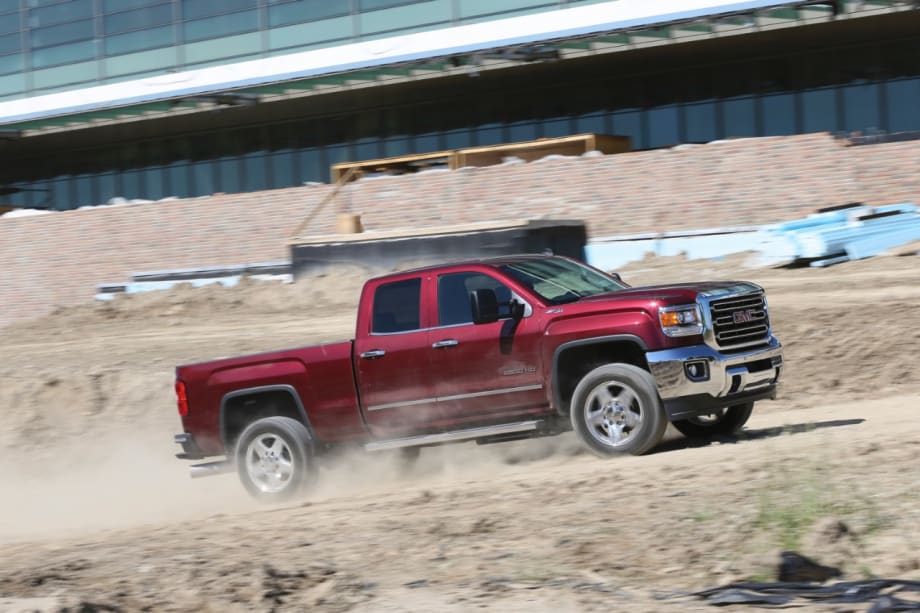
Photo of 2015 Sierra HD truck courtesy of General Motors.
Photo of 2015 Sierra HD truck courtesy of General Motors.
General Motors has announced six new safety recalls involving 717,949 recent-model U.S. vehicles that brings GM's total recalls for 2014 to nearly 25.5 million vehicles.
The largest recall of the six involves 414,333 2010-2012 MY Chevrolet Equinox and GMC Terrain, 2011-2012 MY Buick Regal and LaCrosse, 2011-2012 model-year Chevrolet Camaro, and 2010-2012 MY Cadillac SRX vehicles. They are equipped with power height-adjustable driver or front passenger seat structures.
In these vehicles, the bolt that secures the height-adjuster actuator may become loose or fall out. If the bolt falls out, the seat will move up and down freely because it’s no longer attached at the height adjuster. The vehicles are safe to drive, GM said, but drivers and passengers should not use the power height-adjustable feature until dealers can replace the height-adjuster bolt. GM said it is aware of one crash and three injuries but no fatalities linked to this problem.
The second recall involves 124,007 2014-MY Chevrolet Caprice and Caprice PPV, 2014 MY Chevrolet SS, 2014-2015 MY Chevrolet Silverado LD and HD, 2013-2014 MY Cadillac ATS, 2014 MY Cadillac CTS, 2014 MY Cadillac ELR, 2013-2014 MY Buick Encore, and 2014-2015 MY GMC Sierra LD and HD vehicles.
These vehicles may have an incomplete weld on the seat hook bracket assembly. A loss of power to a laser-welding machine may have resulted in an incomplete weld, according to data collected from the machine between July 2013 and January 2014, GM said.
Dealers will inspect the weld to make certain it’s sufficient. If it’s not, they will replace the lower seat track at no charge. Less than 1 percent of welds are expected to require seat track replacement. GM said it is unaware of any crashes or injuries tied to this issue.
The third recall covers 120,426 2011-2013 MY Buick Regal and 2013 MY Chevrolet Malibu vehicles equipped with front turn signals that use two bulbs in each signal. The driver will get a rapidly flashing turn signal arrow in the instrument cluster when both bulbs in one turn signal burn out. But if only one bulb on either side burns out, there will be no alert to the driver. Dealers will reprogram the body control module to fix the problem. GM said it knows of no crashes, injuries or complaints related to this issue.
The fourth recall affects 57,242 2014-MY Chevrolet Impalas equipped with belt-drive electric power steering. Drivers might experience reduced or no power steering assist at start-up or while driving because of a poor electrical ground connection to the power steering control module. If power steering is lost, a warning message is displayed on the driver information center and a chime sounds. Steering control can be maintained because the vehicle will revert to manual steering mode, but this would require greater driver effort — particularly at low vehicle speeds.
Paint may have seeped behind the nut on the power steering control module ground stud. Dealers will inspect and clean paint from behind the ground nut, re-torque the nut, and update the power steering control module software at no charge. GM said it is aware of one crash but no injuries or fatalities related to this condition.
The fifth recall covers 1,919 2014-2015 MY Chevrolet Sparks imported from Korea that were assembled with a lower control arm bolt not fastened to specification. The condition could result in noise from the front suspension and separation of the lower control arm from the steering knuckle while driving. Loss of steering control can result. Dealers will inspect the left- and right-hand lower control arm attaching bolts to ensure they’re tightened to specification. GM said it knows of no crashes, injuries or fatalities related to this condition.
The sixth recall involves 22 2015-MY Chevrolet Tahoe/Suburban and GMC Yukon/Yukon Denali vehicles in the U.S. In these vehicles, the roof carriers may have been attached with the wrong retaining nuts, resulting in holes or tears in the roof rail air bags if they deploy. Eight of these vehicles are in dealer stock and will be repaired before being sold, GM said.
More Safety

Fleet Manager’s Ultimate Playbook: Navigating the New Standard in OEM Connectivity
Rising operating costs, driver safety concerns, and unplanned downtime are putting unprecedented pressure on modern fleets. Discover how fleet managers use embedded OEM connectivity and real-time vehicle data to cut TCO, prevent downtime, and protect drivers without aftermarket telematics hardware.
Read More →
From Driver Well-Being to EV Charging | AF News Recap
Mental health belongs in the fleet safety conversation. This week, we’re looking at five ways fleets can support employee well-being before a crisis, plus Holman’s expansion in Mexico, new one-day Fleet Forward passes, and why EV charging demand is outpacing infrastructure growth.
Read More →
Nexar-Nauto Merger Aims to Give Fleets Better Safety Intelligence Through Larger Driving Dataset
Stefan Heck tells Automotive Fleet that combining more than 10 billion miles of driving history with Nexar's AI models will give fleets deeper insights into driver risk and roadway conditions than either company could provide independently.
Read More →
Don't Wait for a Crisis: 5 Ways to Build Mental Health Into Your Fleet Safety Program
For Suicide Prevention Month, fleet and safety leaders have an opportunity to put mental health where it belongs: at the center of workplace safety.
Read More →
How Camera Data Can Strengthen a Fleet’s Insurance Renewal
Insights from a commercial insurance carrier and a broker show how fleets can turn video telematic data, driver coaching, and improved claims results into a stronger case at insurance renewal.
Read More →
The Safest Fleets Aren’t the Ones with the Most Technology
You’ve made the telematics investment. Here’s how to capture the other half of its value and build the safest fleet on the road.
Read More →
Hidden in Plain Sight: Fleet Compliance Risks
Fleet compliance isn't just about having policies — it's about consistently enforcing them. This practical guide reveals six hidden compliance risks common in public sector and shared fleet operations and outlines proven strategies to improve visibility, accountability, and audit readiness
Read More →
NETS Sets 2026 Fleet Safety Benchmark Conference for Indianapolis
The Sept. 15–17 program will feature fleet benchmarking data, case studies, emerging technologies, and implementation strategies while running alongside the NSC Safety Congress & Expo.
Read More →
Off-the-Job Crashes Account for 43% of Employers’ $61.7 Billion Crash Burden
NETS quantifies costs dispersed across fleet, risk, HR, and other departments while providing new per-crash benchmarks for employers.
Read More →
Ram Recalls More Than 1.27 Million 1500 Pickups for Seat Belt Anchor Issue
The recall affects certain 2019-2026 Ram 1500 pickups that may have improperly attached second-row seat belt buckle anchors.
Read More →