




GM Leads in J.D. Power 2013 Initial Quality Study
JD Power released findings from its 2013 U.S. Initial Quality Study (IQS), which details the problems new-vehicle owners experience within the first 90 days of ownership.
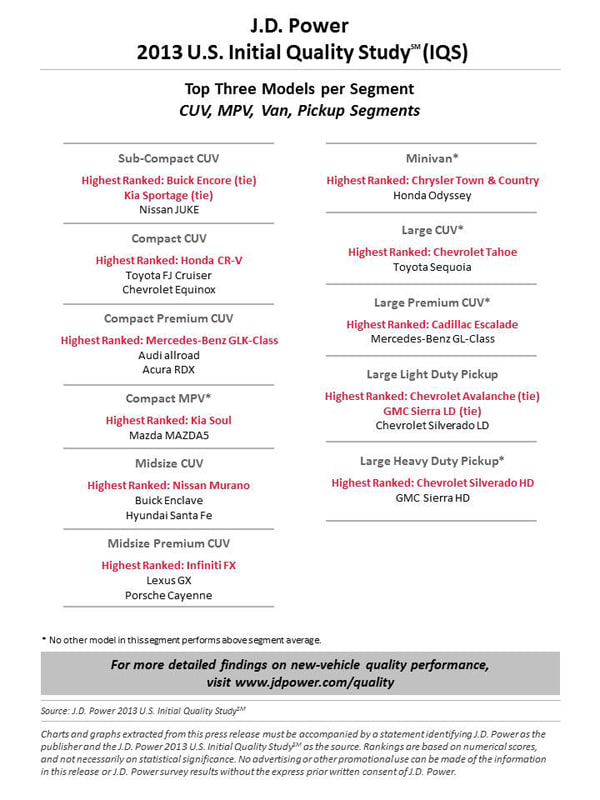
J.D. Power released findings from its 2013 U.S. Initial Quality Study (IQS), which details the problems new-vehicle owners experience within the first 90 days of ownership. General Motors took the largest number of segment awards in this year’s study, with an average number of problems per 100 vehicles (PP100) at 90 for its GMC brand, 97 for its Chevrolet brand, and 108 and 109 for its Cadillac and Buick brands, respectively. The 2013 IQS found the industry averages 113 PP100.
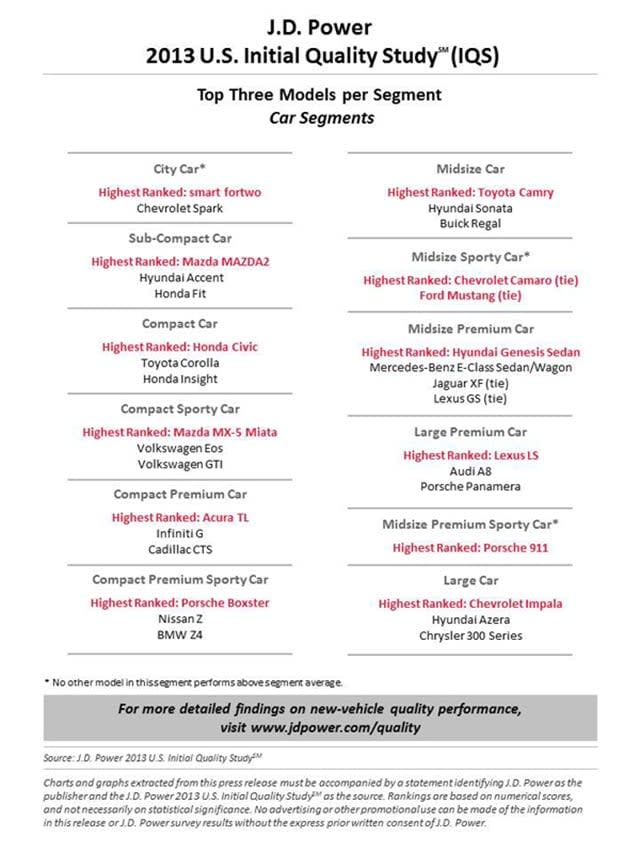
For the 2013 IQS rankings, General Motors received a total of eight segment awards, with its Chevrolet brand receiving five segment awards for the Impala, Silverado HD, Tahoe, Avalanche, and Camaro. Its GMC brand received an award for the Sierra LD. For its Buick brand, the automaker received an award for the Encore, and for the Cadillac brand, the company received an award for the Escalade.
Other companies and brands receiving vehicles include the following: Chrysler received an award for the Town & Country. Ford received an award for the Mustang. Honda received two awards for the Civic and CR-V. Mazda received two awards for the Mazda2 and MX-5 Miata, and Porsche received two for the Boxster and 911. Others receiving awards include Acura for its TL, Hyundai for its Genesis, Infiniti for its FX, Mercedes-Benz for its GLK-Class, Nissan for its Murano, smart for its fortwo, and Toyota for its Camry. Toyota’s Lexus brand received the best score, with 59 PP100 and the lowest average number of problems among all models in J.D. Power’s 2013 IQS.
For the problems owners experienced, the 2013 IQS found that two-thirds of them are caused by design-related issues rather than manufacturing defects. J.D. Power said it revamped its study, now in its 27th year, to better measure problems in new vehicles by taking into account the new technologies and features automakers are offering. Many of these problems related to the driver interfaces in new vehicles, including hands-free technology controls, Bluetooth pairing for mobile phones, and using the navigation system.
One major issue with design-related problems is that only 9% of vehicle owners took their vehicles to dealerships within the first 90 days of ownership to address the issues they experienced. When they did take the vehicles in, dealerships were only able to resolve the issue 13% of the time. When vehicle owners experienced a defect or malfunction, 28% of them went to a dealership, and 42% of the time the dealership was able to resolve the issue.
The 2013 IQS is based on responses from more than 83,000 purchasers and lessees of new 2013 model-year vehicles surveyed after 90 days of ownership. J.D. Power fielded the study between Feb. and May 2013.
More Operations

Fleet Has a Talent Pipeline Problem. What Comes Next? | AF News Recap
Where will fleet’s next generation of leaders come from? This week, we’re looking at the industry’s talent pipeline, what certification can add to a fleet career, how to build an award-worthy track record, and the return of Automotive Fleet’s Personal Use Survey.
Read More →
Smith System Launches Driver Risk Management Program
Fleets have more driver data than ever, but identifying risky behavior doesn't necessarily correct it. Smith System's new Driver Risk Management program combines monitoring, training, and follow-up coaching to help fleets connect risk signals with driver intervention.
Read More →
Automotive Fleet Opens 2026 Personal Use Survey for Commercial Fleet Managers
Less than two weeks left! Commercial and corporate fleet managers are invited to share how their organizations handle company vehicle personal-use policies, charges, and driver eligibility.
Read More →
From AI Prompts to AI-Generated Safety Songs | AF News Recap
Can better prompts make AI more useful for fleet managers? This week, we’re breaking down smarter fleet analysis, an AI-assisted experiment that turned safety training into music, and what happened to fuel prices in August.
Read More →
How to Write Better AI Prompts for Fleet Analysis
Include these six elements in your fleet prompts to generate more relevant analysis and accurate answers.
Read More →
Fleet Meets: Eric Kilgore
This edition of the Fleet Meets series features one of the industry's best leaders driving multi-market and national operations.
Read More →
Why Reactive Fleet Management Is Becoming Too Expensive to Sustain
Research highlights a growing need for proactive management strategies to address rising costs in fleet operations effectively.
Read More →
What Your Fleet KPIs Aren’t Telling You
Tracking fleet metrics is only useful when the data leads to better decisions. This guide helps fleet leaders assess cost, utilization, and downtime more accurately, identify performance gaps, and prioritize the actions that can improve operational results.
Read More →
Hidden in Plain Sight: Fleet Compliance Risks
Fleet compliance isn't just about having policies — it's about consistently enforcing them. This practical guide reveals six hidden compliance risks common in public sector and shared fleet operations and outlines proven strategies to improve visibility, accountability, and audit readiness
Read More →
Turning Fleet Payment Data into Executive Insights
Does data alone drive results in operations?
Read More →